Interview: Ba’al
We’re doing this because it's what we want to do, and it's the music we want to hear, and if other people like it, then that's a great bonus.
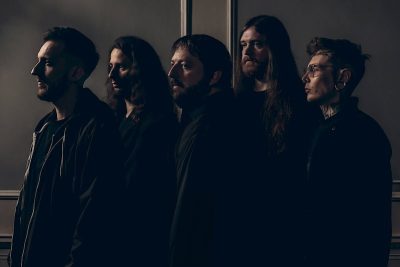
Blackened post-metal band Ba’al have recently released their second album The Fine Line Between Heaven And Here and it is a stunning album that has deservedly received a heap of praise, with its bleak but beautiful soundscapes gaining a whole host of new fans. Gavin Brown caught up with three fifths of the band in bassist Richard Spencer, guitarist Nick Gosling and drummer Luke Rutter to get an insight into The Fine Line Between Heaven And Here, how the year has gone so far for Ba’al and the emotional resonance of this album.
E&D: Your new album The Fine Line Between Heaven And Here has recently come out. Have you been happy with the reaction to it so far?
Richard: Yeah, it’s been more than we imagined, in basically every sense. It’s done better than anything we’ve released beforehand, the number of people that have bought it, streamed it, bought merch. It’s not something that we, in this band, anyway, have ever experienced before. It’s not like it’s on the UK Albums charts or anything, but for underground post metal, it’s doing pretty well.
Nick: It really feels like it’s been a step up, definitely. Obviously, we don’t do it for the numbers or anything. But having said that, the numbers are pretty wild by our standards.
E&D: There’s been many people saying it’s their album of the year already, that must make you feel proud?
Nick: Yeah, it’s pretty overwhelming to be honest. Like I said, we’re doing this because it’s what we want to do, and it’s the music we want to hear, and if other people like it, then that’s a great bonus. But the level to which people have been praising this in the weeks since it came out, has been incredibly humbling.
E&D: What are your albums of the year so far?
Richard: That’s a good question!
Nick: I constantly make a note of absolutely everything new that I listen to and I give it a score. I’m just gonna consult my list.
Richard: I’ve got a couple of come to mind. There’s a post metal band called Pothamus. Their new album is amazing. I’m looking forward to seeing them again at ArcTangGent in a couple of weeks. BRUIT ≤, the French, post-rock band, their second album came out this year. That’s amazing. The new Rivers Of Nihil album, I think, is great, obviously, we’re playing Bloodstock and they’re playing as well. So looking forward to seeing them. Yeah, those ones, and it’s not metal, but the new FKA Twigs album, is amazing on the more experimental pop side of things.
Nick: Yeah, my, my picks so far are also the new Rivers Of Nihil, it’s basically what they do, so I was always gonna be happy with that. The new Imperial Triumphant. I know they’re a bit of a Marmite band because they are extremely chaotic and impenetrable in a lot of ways, but I think it’s very similar in many ways, to what they’ve done in the past, but I will always take more of that. The new Deafheaven was obviously going to be great. New Horrors album. Been a fan of the Horrors for quite a while, so that’s great. I suppose one of the lesser known ones is a band called Trauma Bond. They’ve got a new album called Summer Ends. Some Are Long Gone, and I’ve given that a straight 10. It’s an absolutely horrible, devastating album. If you want something that’s truly rancid and horrible to listen to, that’s a good one!
Luke: I’m terrible at keeping up with new music. I can’t even think off the top of my head of any new albums I’ve listened to this year!
Richard: You must have listened to the new Dream Theater album, Luke.
Luke: Oh, yeah, I have listened to that a couple of times.
Richard: Me and Luke are the two resident Dream Theater fans in the band. I think the new one’s fine. That’s my review of it. It’s fine.
E&D: Going back to the album, what have been the biggest influences on the sound and outlook of it, and did you want to include more strings this time?
Richard: Yeah, the general influences are broadly quite similar to what we’ve had in the past. There’s a lot of post-metal, Cult Of Luna, Amenra, that kind of thing. There’s a lot of black metal and post black metal. Deafheaven, Alcest, those sorts of things. I think the riffs that me and Nick write are quite influenced by Conjurer as well. The way they smash together genres, they do sludge and metalcore and bits of black metal, that’s always been an influence for us, just the abandon with which they just throw the riffs together. We try to do a lot of that kind of thing. The strings, we’ve been gradually experimenting with different textures over the last few things we’ve done. We were intentionally pushing the boat out a bit with the synths and the strings this time.
Luke: We started looking in more into using backing tracks live as well, so we don’t feel as bad about putting them on the album when we know we can effectively recreate that in a live scenario as well.
Richard: Yeah, it’s always been a balance of wanting to expand the sound but not making it too reliant on any extra things that we’re not playing live. But like Luke says, now we can do that with backing tracks. I’ve been playing viola on the last several Ba’al releases, and then this time, I’ve expanded that to a string quartet where I played three of the parts, and then I got my friend Alex Marshall to play the cello. Since we did some of the synths ourselves, we got a guest synth player, we got Tom from Hundred Year Old Man to play french horn on one track. So yeah, we were intentionally trying to push things a little bit further than we had before, and I think it just adds something without becoming the central focus of anything.
E&D: Is that something you want to expand on more with your music in the future?
Richard: I mean, we’ve not really got that far. This album’s taken up so much of our time, we haven’t really got around to writing any stuff seriously, although we have made a few inroads with a few We’re quite maximalist in the way that we do things. So, although we don’t know exactly what we will or won’t use in future releases, I can’t see us really abandoning that line of thinking. I think we will continue to do some form of expanded stuff, I’m sure.
Nick: Yeah, the basis of the new album has been written for years now. I mean, it was recorded two years ago, but the majority of the songs in some shape or form had been written as far back as lockdown. A lot of the parts have been sitting around since then. So it’s been weird listening back to the album and playing it and thinking this, as much as this is what Ba’al sounds like now to everyone else, to me anyway, it feels like Ba’al from two years ago. So I suspect in the future, it’ll probably be a case of doing similar things, obviously, because that’s how we ride, but maybe just a bit more in every sense. But it’s hard to predict what’s going to come after this,
E&D: Does the city of Sheffield influence the music you make, especially on this album?
Nick: We’re not all from Sheffield at this point. It’s just me and Joe, and lyrically, I think it does influence Joe quite a lot. Musically, there’s the city itself. It’s hard to really know how much the city has influenced us, but you there’s quite a strong music scene. There’s a lot of really legendary, often groundbreaking bands that come from Sheffield, that influence us specifically. There’s Rolo Tomassi, 65daysofstatic, Cabaret Voltaire, all these really cool, interesting bands. Obviously living here, you hear it a lot more, because it’s hometown musicians and stuff like that. So it probably has influenced us indirectly, without us even realising it, to be honest, I can’t really speak for Luke or Richard, because they’re from the south
Richard: Yeah, we’re the resident Southerners, so less so on that front, I guess, although, we’ve lived here for 10 or more years at this point. So all that stuff is still filtering in a little bit. What you’re probably getting at is the lyrical angle, which our vocalist, Joe, who is from Sheffield, there’s specific references to Sheffield. The concept is summed up in the first track, and a lot of it is to do with the industrial city versus the nature, the splendour of nature that’s literally right up against the city, and the way that those things interplay. There’s also little moments of Sheffield dialect, if you look in the lyrics that he’s thrown in here and there, and there’s some audio samples that are quite Sheffield specific. There’s an ambient background section that’s taken from recordings of a tram from Sheffield City Centre and things like that. So conceptually, lyrically, definitely on this album and that all comes from Joe.
E&D: The album has a very beautiful and emotional feel about it, amongst the heaviness Was that what you wanted to convey with the concrete against the nature concept as well?
Richard: I think so, yeah, since Joe’s been in the band, which is 8 years or so, his lyrics have become more and more central to the way that the music comes together, and it’s always very emotional stuff. It’s quite dark, but also cathartic, with some hope in there as well. I think with this album, having the industrial versus the nature thing, that sort of enhances that, and fits with that concept quite well. I think basically the answer is yes, but it’s just a strengthening and enhancing of the kind of thing we’ve always done since Joe’s been in the band, I would say.
E&D: What are the most emotionally affecting albums of all time for you?
Richard: Wow, that’s a big question isn’t it? I’m going to have to think about that.
Nick: For me, it was probably my first real taste of screamo and very sad atmospheric music. There’s a band who are no longer together, called The Elijah and they had an album called I Loved I Hated I Destroyed I Created which sounds very post metal! It’s a terrific album, but it’s just so overwhelmingly sad sounding, even without listening to the lyrics. I’m typically a bit stoic, and I don’t really let my emotions out much. I don’t cry at anything, really, but that’s an album that brought me to tears. It’s really quite effective, and also, Time Will Die and Love Will Bury It by Rolo Tomassi, that’s quite a big one. When that album came out, that was as close to perfect an album I think you can make, certainly within the genre, and that sort of affects me quite a lot. I don’t really pay attention to lyrics at all. So, when I listen to Nick Cave and Deftones, a lot of their music is based on a lot of heavy emotions, and I just don’t pay much attention to that at all. I just think, Oh, these riffs are cool. Oh yeah, he’s Nick Cave. His voice sounds good. Stuff like that.
Richard: A lot of the time, i’m pretty similar to that. But there was one that I thought of, which was the 40 Watt Sun album Wider Than The Sky, which was the first one that they did when they sort of stopped being a metal band and started to do very stripped back slowcore, very emotional stuff, where it was all about the lyrics, that’s very sad, but also has the element of hope in it, a similar combination, I guess, of what we try to do, but in a more stripped back, slow style. That’s very emotionally powerful. Then on the metal side, Mass III by Amenra, the first time I heard that, it’s just a sledgehammer in the face riffs wise, obviously, but it’s just the anguish and the emotion that comes through with the vocals and the way they put everything together. The first COLDWORLD album Melancholie². You have no idea what he’s singing about, because it’s so lo-fi screaming, but you can really feel the desolation in there. That’s one of my favourite albums of all time, and I think the emotion is a big part of that.
Luke: From a different perspective, the last time I needed a bit of a cry, the album I reach for is actually Sleep Token. A bit of a different approach, but in the emotions in the music and the way he sings, sometimes it just gets you.
E&D: It’s been five years since your debut album Ellipsism, how have Ba’al developed as a band since then?
Richard: Well, that’s a good question. It’s hard to quantify when you’re in it and you’re doing it. There’s multiple reasons it’s been 5 years, with the pandemic and stuff, but we released an EP last year called Soft Eyes on Ripcord records, all those songs were written and recorded at the same time as songs from this album. It was a very bad idea to record that many songs at the same time. It was incredibly gruelling.
Nick: that was my idea, and I am sorry!
Luke: if anything, one of the main things that has changed over that timeframe is the members of the band. They brought me in just as they were recording Ellipsism, and we’ve had a couple of guitarist changes since then as well. All of that’s just come together to make a more cohesive unit as a band and as and when it comes to writing music, it feels like we’re a bit more all on the same page now in terms of how we contribute and the give and take of ideas.
Richard: Luke joining the band as we were writing Ellipsism, and obviously you did have a big impact on that album but we’d written probably more than half of it when you joined. There’s parts of your stuff in there, but less so than on this stuff. We had a new guitarist join just as we were writing the stuff for Soft Eyes and this new album. He brought a lot of his influences in as well. He’s since left, but it’s basically been members joining and having exerting their influences, pulling in a slightly different direction from the core thing that we’ve always had, although we’ve been developing over years, I’d like to think we’ve just got better, as time has gone on, playing together, we’ve got less prescriptive about what ideas do or don’t fit with the band as well. We’ll try out anything. If somebody comes in with something that’s slightly more or less of a certain genre or whatever, then we’ll just go for it anyway, and then often it’ll work.
E&D: Have you had any thoughts about an album of remix tracks from this new album, like you did with the Re-llipsism EP?
Richard: We’ve not discussed it. I mean, the Re-llipsism thing seemed like a good idea when we just released Ellipsism, that was when the idea came about. We got the stems from Joe Clayton, our producer. And then it took us until this year to finish them. It was a lot more effort and work than we thought it was going to be. There’s a lot that goes into just being a band for writing our normal songs and playing our normal gigs and all that stuff. So putting that on ourselves on top of that turned out to maybe be a bit more work than we thought it would be. It was really fun, but we haven’t, discussed doing it this time. It’s possible we might.
E&D: With your music, do you feel that you can be more eclectic and take more risks than perhaps you couldn’t in the past?
Richard: Yeah, I definitely think so. I mean, it’s not like in the past we were specifically saying, No, we can’t do this or whatever. But I think as we’ve played together for longer and just felt more confident in what we do. I guess also just seeing that people seem to connect with what we do as well. I think we all feel more confident in just bringing in any idea, even if it seems slightly out there, within reason, obviously no one’s suggesting that Joe starts rapping or anything, but within reason, someone brings in an idea that’s slightly outside of what we’d normally do, by the time we’ve played around with it a bit, it ends up fitting, it comes out sounding like Ba’al more than it it originally sounded like.
Nick: We have in the past, poo pooed an idea, because it’s maybe a bit too similar to stuff we’ve done already. I can only speak for myself, but I would never want to, stagnate, I guess is the word. I would never want to feel like I’m not moving forward. There’s some bands out there, and I’m not going to mention any names, but there are bands out there who’ve made a career out of releasing almost the same album over and over again. Often it’s great, and often they do that very well, but I don’t think that’s what we or certainly not I want to be doing. I look more at bands like Ulver, that’s a pretty extreme example, where you literally have no idea what their next album is going to be. It could be absolutely anything. I think we’re open to almost anything. Whatever happens next,
E&D: Are you looking forward to your appearance at Bloodstock?
Nick: Yeah, definitely. We did our album launch, and we played the full album, just over an hour’s worth of music. It was the first time we’d played four of those songs. Either we hadn’t played together, as we’d not done a gig in quite a while, and obviously this was the first gig we did with Will, who’s been playing live guitars for us. So there was a lot of stress and nerves around that, because we were headlining, it was quite a big event for us, and that went really well, and we’re all really comfortable with the material. So now that that’s out of the way, I do actually feel quite relaxed and actually just straight up looking forward to it, the nerves that I had before have basically gone. I’ll probably feel a bit nervous on the day, because I’ve been in that tent before. You can fit a few thousand people in there, and that’ll be easily the most we’ve played in front of so, but yeah, it’s just going to be great.
Richard: We’re very honoured to be invited back, because we did play once before, many years ago, with different lineup, because we won the Metal To The Masses competition. That was great, but this time, to have been invited back purely on the strength of our music and our live show, that’s great. Going back to what we were saying at the very beginning of this conversation, the response to the album has been amazing, and there’s been a lot of people through our comments and messages and stuff, saying, I’ve just discovered this band. I’ve just seen they’re playing Bloodstock. I’m going to be there. I’m going to go and see them for the first time. Like Nick said, it’s going to be the biggest crowd we’ve played to anyway, but I think, quite a lot of people who are just discovering us for the first time and hopefully will live up to what they’re expecting from listening to the album.
E&D: What other live shows have you got coming up that you can tell us about?
Richard: Bloodstock is the next one. Then at the end of August, we’re playing One For Sorrow festival, which is an all dayer in Plymouth on the 30th of August. We’ve got a couple of gigs either side of that. We’re playing Firebug in Leicester the day before with Cairns and Acceptance. The 31st, we’re playing in Cheltenham, at the Frog & Fiddle with Cairns as well. Then in October, we’ve got an all dayer on the 25th in Leeds, with Hundred Year Old Man, Still, Partholon, Codespeaker, The Grey and a bunch of other bands, 26th October, we’re playing in Nottingham with Partholon and Codespeaker. Then we’re back in Leeds, 1st of November, for Dark And Wild at Northern Monk brewery, which is a live music/beer event. Basically, we’re playing the afternoon session of that with Din Of Celestial Birds and Pleiades, that’s gonna be really good. I think that’s it for this year. We’ve got a couple next year. They’ve just been announced, but, yeah, I think that’s mainly it for the time being.
Nick: Yeah, little bits and bobs, here and there.
E&D: On the upcoming dates, will you be doing the new album in full or is it a bit of a mixture of material?
Richard: I don’t think any of the sets are long enough for us to play the album full, none of those will be at the moment. Maybe we will again at some point in the future. But no, for the time being, it’ll be predominantly new stuff, with probably one or two old songs as well.
Nick: Typically our songs are always about 10 minutes, actually I think it’s quite easy to plan a setlist, because they’re always half an hour, 40 minutes, 50 minutes, etc. So it’s if it’s half an hour, we’ll do 3 songs. If it’s 40 minutes, we’ll do 4 songs, etc. So the problem is, when there’s 1 or 2 songs on the new album which are 12 or 13 minutes, that’s when it gets difficult, because then you have to start matching the 12 minute songs to the eight minute songs to make it work!