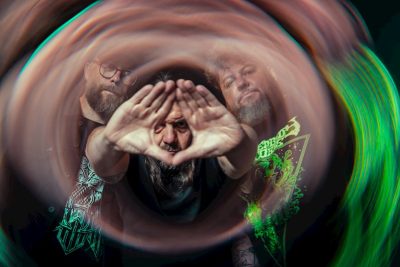
Interview: Slomatics
Every record is a highlight, and every trip to play is a highlight. I think the three of us still feel as excited about doing this now as we did twenty years ago.
Slomatics have just released their latest album Atomicult and it sees the Belfast doom/space rock trio on spectacular form with a record that is both majestically heavy and achingly beautiful, complimented with a whole host of electronic flourishes and the results are nothing but phenomenal. To celebrate the release of Atomicult, Gavin Brown caught up with Slomatics guitarist David Majury to hear all about its creation and twenty one years of Slomatics.
E&D:Your new album Atomicult is out now. Can you tell us a bit about it?
David: It’s the second album in what’s going to be a trilogy. We’ve done this before where we thematically link records, and there’s a bit of a concept going on. Strontium Fields is the first in what we’ve planned to be three records that are all linked together. So it’s more like a continuation of that record, I guess, but hopefully doing something that’s a little bit different, as different as you can be at this stage, after twenty one years, you know.
E&D: What are the biggest influences and the sound and outlook of the album, and can you tell us a bit about the story that it continues?
David: To talk about the influences first, again, I always find it a bit of a hard question to answer, because we’ve been doing this for quite a long time, you know. And I think, not that we’re not influenced by other bands, I always find it really funny when heavy bands say they don’t like Black Sabbath, which is clearly a lie, right? Or the Stooges, or Hawkwind. Those things are, of course, there. But I think in terms of influences and where our sound cames from, those are probably things that were twenty years ago. I think when bands are starting out, that’s when the influence kicks in. So when this band started, the two really distinct influences, and I don’t think we really sound like either. It was Pink Floyd live at Pompeii and Harvey Milk, the American sludgy guitar band. I still love that band. I still love both those things. But I guess when you’ve been doing something for quite a long time, you start to fall into that. You start to know what you sound like a bit more. I’m probably less influenced by external things, maybe, than we would have been twenty years ago. But that said, one thing that I think in the last couple of records, I write most of our music, that has influenced me a lot, is I’ve been listening to loads of neo-psych, garagey stuff, Oh Sees, Ty Seagall, a lot of that stuff I find myself gravitating towards. Those are all shorter songs, and I think we’ve tried to make a distinct move away from the doom metal, everything’s fifteen minutes long. I guess that’s come into play in terms of the way that we’re writing now, but in terms of influences, it’s the same stuff, we’ve always banged on about old sci fi, Hawkwind records, Loop, all those sort of noisy, repetitive type bands. I’ve always been quite into that, so that probably still comes through. Then, loads of krautrock. Can, Amon Düül and all that stuff which we’re obsessed with, so that doesn’t change much.
E&D: Can you tell us a bit about the continuation of the album story?
David: We always try to avoid spelling things out too clearly. We’ve never published lyrics to songs. We never really talk about the distinct meaning behind songs. There is a theme in this, and I suppose it’s based around, sort of post-covid existentialism, and that we live in a slightly different world now, but there is a distinct story to it. Our drummer, Marty, writes the lyrics and writes all the melodies and all the vocals and he and I are both old sci fi fans, particularly given our age, a specific kind of late 70s, early 80s, British dystopian sci fi that was really a bit sinister and a bit otherworldly, and I think we’re trying to capture a bit of that with this stuff as well. That’s always something we’re trying to build in there. And I think, post-covid, I don’t know about you, Gavin, but it feels like that’s the world we’re in a wee bit right now, politically and in terms of technology, in terms of the environment, it does feel like a bit of an eerie time, almost like we’re living in what was predicted by 2000AD comics back in the 80s. I think that’s where we’re coming from, but this is like a progression on the last record, and there is a kind of finale to the whole thing to follow with the next record.
E&D: Have you had thoughts about that record?
David: We’ve sort of mapped it out thematically, where we wanted it to go and what we wanted things to sound like. Hopefully the three records will all sound slightly different and there’ll be a progression in there. We write all the time. This record was actually recorded nearly a year ago. This is the longest gap we’ve ever had between writing and recording and then the record being released. So actually, about half of the next record is now written as well, and we aim to get back in the studio early next year and try and finish that up, We’ve definitely got it all mapped out, and we think we know we’re going.
E&D: How was the experience of working with Rocky O’Reilly, producing the album, and then having James Plotkin mastering it?
David: Yeah, it was really good. We’ve used Rocky for almost everything that we’ve done now for well over a decade, and we’re in a really good position. It’s a local studio here in Belfast, so we don’t have to go and stay anywhere for a week, which means we can space out the recording sessions, which makes it very relaxed and fits in around all the boring, real life stuff pretty well. We were talking about this recently, and how when we first recorded with Rocky, we brought in CDs of Harvey Milk and May War side two, Melvins, Loop and Spacemen and all that stuff. We’re playing him these records, like we want to sound like that. There was a lot of discussion about how the records sounded. We’ve done so many albums with him, and so much recording with him, it’s almost a cliche when people say a fourth member of the band, but he really is! We don’t even really need to say, we’d like it to we’d like it to sound like this. He knows exactly what we want. He’s not from a heavy music background at all. He played in a band called Oppenheimer, who were synth pop. They’re really good. He has no background in our sort of stuff at all, but he’s really into sonic palettes and experimentation. I don’t consider myself a musician in any shape or form. I just like turning everything up and seeing what it sounds like, and he absolutely loves that as well. No idea is ever too much. He’ll quite often say, oh, put that kick drum in a stairwell, and then we’ll put it through space echo, and it’ll be amazing. It’s actually really good fun. We record a lot, but I’d record way more often if we could afford it. It’s just a really inspiring place to be, to kind of hear all this coming together. With James, again, we’ve used him for quite a long time. We actually played with Khanate, I’m gonna say twenty years ago, when they finished up the first time, he’s such a nice guy, and he’s really, really efficient. He’s a really easy guy to work with, and again, when you use the same people over and over again, it comes pretty easy to do. We send him the mixes, and he’ll send us, usually two mixes back, or two masters back, and he’ll say, listen to the first one, then listen the second one. First one’s always great. We never need any more. It’s like he just knows what to do. So, yeah, it was super easy and really good!
E&D: Do you also think it is your most eclectic album to date especially with the beautiful track ‘Relics’ and the atmospheric parts of ‘Night Grief’ and ‘Summer Skeletons’?
David: I hope so. I’m glad you mentioned those songs, Gavin, because hopefully people will pick up on that stuff. We’re a three piece, and I write most of our riffs and music at home, and then when the songs kind of come to some sort of a form, I’d break it down the practice room, and that’s when Marty, our drummer and singer, kicks in, and he’ll either change it completely or play almost exactly what I hoped he would play. So both of those are really good outcomes, but in the band, neither Marty nor I are really metal guys at all. We grew up with all that stuff Celtic Frost, Voivod and Metallica and all that. We’re that age where 80s thrash was a really big thing, but we don’t really listen to a huge amount of that stuff now. Hopefully, with those songs, what we’re trying to do, is get some some of the other things that we’re interested in onto the record, so clean guitars and lots of synthesisers and put a bit more space in. If you’ve ever seen us live, it’s just, really loud caveman dirge! With all bands who sound like ours, if you only do that, I can find it loses impact. Even bands I’ve really enjoyed, half an hour is maybe enough live, so on a record, we always sort of feel, if you don’t have some light and shade and some, different sounds and sonics going on there, records can wear people out a bit, so it’s an attempt to do that a little bit as well. This record has got two or three songs with no fuzz pedals on them, and it’s got one song with no guitars on it at all. So we tried to just stretch that stuff out a bit more, and we might do more of that next time.
E&D: Is writing the massive riffs the best thing about working on Slomatics music?
David: I think that my favourite moment when it comes to writing music is I’ll have written all the riffs and all the parts, and it’s like I mentioned earlier. My iPhone is full of ridiculous song titles and a million thirty second clips. I’m quite meticulous, and I’ll sit at home and try and tie those together, and we’ll have something that I think is good. I’ll bring it down the practice room and definitely, my favourite moment is I’ll play the riff, and half the time, the guys go like, no, that’s rubbish. I’m not interested. But sometimes, Marty will just start to play along, and he’ll hear that song, and almost note for note, what I hope the drums would sound like, which to me, is really rewarding, because it’s a nice musical connection. Other times, he’ll play something totally different and start singing a melody which is not what I expected at all over the top. That’s probably even better, that’s more fun because you get to hear your song as somebody else’s song. I always think, that’s really a magical moment. Half the time we bend these things anyway. We go through a lot of stuff before each record, but those moments, even if we weren’t doing gigs or making records, just going down the practice room on a Wednesday night, and that thirty seconds where it all kicks in, that to me, is just the best craic, you know.
E&D: Is that how you’ve always worked?
David: Yeah, more or less. I think early on, we find what works for us, and we all play our roles and all have our parts. Marty has started occasionally coming down with guitar riffs and things like that. He’s a really good musician, generally, he can play lots of things, but the general pattern is, I write all the guitar stuff, bring it down. Marty will work out the drums, and we’ll chop it together and put it in place. He then goes away with an iPhone recording and comes up with vocals, and Chris thinks about the synths and the textures and all of that. I can barely play guitar, Chris is a really capable player, so he works out funny chords to play over the top of these stupid riffs and all that stuff. We’ve always just kind of done that, we don’t argue about anything. We were down last night, and Marty and I had worked on a song we thought was great. Chris was like, terrible. That’s fine. That song’s gone immediately, and we’ll just keep on going and produce plenty more, you know.
E&D: Is your prolific recorded output a result of working on music all the time?
David: I’ve been asked this before, and I could give a nice answer or I could give you the true answer. So which would you prefer?
E&D: The true answer, the truth is always the best!
David: Okay, so we’re not young. We’re all middle aged men with families and kids and jobs and mortgages and all those really boring, real life things. This band only started really when I was in my early 30s. I was never in bands as a teenager, and I think a lot of people are in bands from the age of about 13 to 18, and then real life comes along and they drop it and forget about it. That didn’t happen to me. When I started getting into bands through our local punk DIY scene in my mid to late 20s, I felt like I was making up for lost time. It’s like, I shouldn’t have this opportunity, but I’m really pleased to do so. For me, it’s always like, just document everything, just do everything you can. I suppose the three of us all of that kind of work ethic of, we have no real right to be doing this at this stage in our lives. So therefore we make as much of it as we possibly can. We all live really boring, mundane lives, and can all turn up at practice at the same time every single week. Loads of guys I know, really talented players in Belfast, their bands have fallen apart because somebody moved away, or somebody got a job, or somebody had a child, or one of these things. But for us, having jobs and kids and all, it’s more of a reason to do this. This is the release. This is the fun bit. So we just try and do as much of it as we possibly can. In the 1970s AC/DC put out a record every single year. The Stooges were in and out and done in four and a half years with three of the greatest records ever recorded. Like, when did we start taking fifteen years to make an album? It’s outrageous. People just need a work ethic. The Fall never had this problem. People just need to just get on it and get it done and move forward, you know? That’s why we keep putting out so much music. I’m sure a business manager somewhere would tell us that’s a horrendous idea! Every time an album comes out, I’m thrilled to bits, and can’t believe our music’s on vinyl. So, you know, if that can continue to happen, then amazing. And I’m well aware there will be a day when nobody wants to listen to us anymore or put out any of our records. So until that moment comes, we’re just going to keep on shoving that stuff out!
E&D: What are your favourite pieces of guitarwork of all time?
David: I think I tend to gravitate towards, broken guitar sounds. I’ve never been a fan of these really showy technical players, that’s just never done it for me at all. Ron Asheton from the Stooges, huge for me. You know? Every record he plays on sounds like you’re in the room with an amp that’s about to break, and everything’s turned up way too loud, and there’s loads of feedback and noise. I just love that. Kevin Shields from My Bloody Valentine. You can’t even make out what he’s playing half the time. It’s so amazing. It’s just like this wall of noise. People like Neil Young, again, that kind of guitar really on the edge. I’ve always liked those sounds. J. Mascis, players like that. I guess at my age, there was an era from the late 80s to the early 90s where a lot of British bands like Loop and Spacemen 3, American bands like Dinosaur J, had rediscovered old guitar gear that people weren’t using, big muffs and fuzz pedals and all that stuff, and had just cranked all that way up. That really still resonates with me, truly electric guitar sounds, like everything sounds like it’s about to break. Modern stuff like Part Chimp, if you’ve ever been at one of their gigs, you can’t not come away from that and think that sounded amazing. How did they do that? Those guitars? Those are the sort of things that I’ve always really loved, and that plays a big part in our music, just creating sounds that sort of don’t work in a way,
E&D: What are your live plans once the album comes out and you’re looking forward to taking these new songs to the stage?
David: Yeah, we are. We plan to play quite a lot of this record live. We always do try to play a fair amount of each new record live. We’re going to Norway for a launch show in a bar in Oslo called Brewgata, which is a micro brewery with a really small stage right in the corner, probably about a hundred and fifty capacity. It’s small place, but rammed and really good fun. We’ve played there before, and that’s how we know the guy who runs the bar. When he knew when the record was coming out, he said, Look, why don’t you just come over here and do a show in Norway, which is an amazing thing to get to do. So we’re doing that. Then we’ve got Abyssal festival in Southampton a couple of weeks later, which I think is in a church, that’s going to be cool, with an amazing lineup with like Margarita Witch Cult and Trippy Wicked, those sort of bands. Then we’re in London a few weeks later with Blind Monarch and Sea Bastard. We’re playing in Dublin, the first time in nine years, I don’t know how that happened. We’re playing with Conan, who are old friends of ours. So really looking forward to that. We’ve got quite a lot of other stuff already booked in for next year. We’re going back to Poland and going over to England again. There’s a couple of festivals and bits and pieces, but we’ll announce that nearer the time. We don’t tour at all Gavin, real life and work gets in the way. These weekend shows, we look forward to them so much because we’re not sitting in a transit van for three days to make it happen. You can get to go and really enjoy the experience. So, yeah, looking forward to those, and we’ll play as much of a record as we can squeeze in.
E&D: What Slomatics gigs have been your favorite over the years, the ones that still stick with you?
David: There’s so many that we’ve really loved. There’s been some really big ones, like we played Roadburn, eight years ago, and they had to close the doors before we played because the room was already full. That felt like a really big deal. When you play the festival, there’s always the slight fear, that no one will watch your set. So when they closed the door and said, they had to turn people away, it felt amazing. That gig went really well, so that one always stands out as special. But as much as I love playing those shows, I really like small shows. We grew up playing in the hardcore DIY collective here in Belfast, where it was like, a really crusty PA being held together by people holding speakers up and all that. My love of that has just never gone. Those sort of small pub gigs, we played a place in Norwich about this year, and it was a basement bar, and it was really, really hot and sweaty. This amazing crusty hardcore band played first. To me, those gigs where people are like, two foot away from you, I just love that experience so much. The Brewgata one that we played last year in Oslo was like that, so yeah, big and small.
E&D: You mentioned you’ve been a band for 21 years. Did you ever think the band would still be going after all this time?
David: No, I don’t think we ever really thought about it at all. I don’t think we ever thought about having a lifespan. I think the secret is, we never had goals beyond meet up every week and play, that’s the fun bit. Maybe do some gigs, and, if at all possible, put out seven inch that was the dream, right? So when we had that quite early, there was just no reason to stop. We didn’t think that far ahead. We never think, are we still going to be invited to play festivals or whatever? That stuff will stop eventually. That doesn’t bother us, just live in the right now, and I think a combination of just really loving what we do, when we go down to practice every week. It’s as much kind of for your head as it is for everything else. When you’re in that room for two hours and you’ve got two amps at full volume. You don’t think about anything. It’s just an amazing thing to have in your life. So that’ll continue forever. We’ll always go down and practice. Whether we’re still doing gigs, is kind of secondary. If you told me, you’ll still be doing this in twenty one years. That seemed like quite a long slog, but I certainly don’t tend to stop anytime soon.
E&D: What have been some of the other highlights in those 21 years?
David: Yeah, this isn’t a great answer, but there’s just so many. Anytime we travel anywhere, the thought that anybody would pay to put us on a plane and fly us somewhere in Europe, buy us some beers and have a stage ready, and people would turn up to watch it. Every single time that happens, I’m genuinely so blown away and excited, but certainly putting out records feels amazing. Particularly now. I think it’s harder to sell records now than it was 10 years ago. The world’s a more expensive place. Shipping is totally insane. Donald Trump’s doing his best to ruin the American market. There’s all that stuff going on. So every time we put out a record, it really does feel like it’s such an achievement to be able to do that. Especially growing up in Belfast, there’s always been an amazing music scene in here. Every reasonably large city in the world somewhere has a band playing in it right now, who would be your favourite band ever, but you’ll never get to hear them. What really always resonated with me is there’s always these tiny things everywhere, and so many bands in Belfast have never that I’ve loved over the years, thought were the greatest thing ever have never put a record out, and they’ve been finished after three years. So every time you put a record out, for me, it’s like just the biggest achievement and the biggest kick, The thought that this is documented now and this is done, and in 10 years time, if somebody wants this, they can still hear it. So to me, every record is a highlight, and every trip to play is a highlight. I think the three of us still feel as excited about doing this now as we did twenty years ago.