Interview: Kavus Torabi
I really love performing solo because it is just me with a synthesiser, a guitar and a harmonium and some effects pedals and it’s a whole different energy.
October By Name is the brilliant latest solo album by Kavus Torabi and it is a swirling and intoxicating mix of psychedelia, folk and progressive rock that is utterly perfect listening for these autumn months. Gavin Brown had the pleasure of catching up with Kavus as he told us all about October By Name as well as his work with Gong, Cardiacs and The Utopia Strong in a fascinating interview with one of the country’s most important musicians.
E&D: Your new solo album, October By Name has just come out. Did you feel that the first song you brought out for it, ‘Water Into Wine’, was the perfect introduction to this album?
Kavus: Actually, I didn’t know. That was the one I asked friends because you could never be objective about your own stuff, and I couldn’t tell what would be the best one to start with. I wondered whether I should start with the last song, the real epic ‘Ancestor’s Song’. This is one I’ve been doing live for a bit, but when I asked my friends, that one kept coming out pretty much on top as well. That should be the first single, and a part of me was glad that they said that because, it’s got a chorus, which is always a bonus with me. I don’t often do a chorus, so looking back at it now, it seemed like the obvious choice.
E&D: How did the creation of the album go?
Kavus: It was unlike the previous album, The Banishing, which was written in a fairly turbulent period over a few years, and in a few different locations. This one, even the oldest song was about a year old. So all six songs are very recent. They describe this period of my life ,really in the last year, and it’s always been the idea with this solo stuff for it to be very autobiographical, not just in terms of the lyrics, but so I can see where I’m at in terms of what my lyrics are like, what my production’s like, where my artwork is at in terms of the illustration, where my voice is at, where my arrangements are. It’s a way of me marking where my head is at and the kind of music I want to make in any given period, because the other stuff I do is collaborative. So this is a chance to go, this is where I was. This is what I was thinking about, and this is what I wanted to do at this particular period of my life.
E&D: Did you produce the album yourself?
Kavus: Yeah, with the solo albums, it’s a way for me to do everything. The only thing I don’t do is master it. I do all the artwork by hand and I mix it all, and I play all the instruments, and they have to be instruments that I’ve got here around me. They can’t be sort of MIDI instruments or anything like that. I hand letter all the lyrics and everything. So it’s just a way of being able to put all of myself into one thing.
E&D: Did you want the album to take you on a journey as you’re listening to it?
Kavus: Yeah. Whatever I do with whatever record or project, that’s always what I want to happen. The last piece of the puzzle is when you’ve got all these songs and they’re finished. It’s like, well, what will be the best order? Because if you change the running order around, it tells a completely different story. You want the story to ebb and flow and have its ups and downs and things in the right place. I think.
E&D: What inspired the title of the album and was it important to have it released in the month of October as well?
Kavus: Yeah, absolutely. I had a couple of titles that I was thinking about, but I wasn’t really taken on them. I had this dream, in real life I’d bought myself a little van, and in this dream I had, I turned up to a Cardiacs rehearsal, and Jim was also in a van, and I said, “Jim, is that a VW?” He said, “No, this is an October”, and he pointed at the badge of the van, and it said October on it, and I turned to my friend and said October by name, October by nature, and then in the dream, I said that’s my album title! I woke up and said, “Well, the dream told me to do it. I’ve got to trust my subconscious”. So there it was.
E&D: Are you looking forward to taking these songs into a live stage?
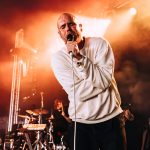
Kavus: Oh yeah, I can’t wait. I’ve been playing three or four of them already on the road, but since doing the album, some of the lyrics have changed, and I’ve got a bit more focused on the arrangement. So yeah, I can’t wait. I really love performing solo because it is just me with a synthesiser, a guitar and a harmonium and some effects pedals and it’s a whole different energy. I really love it.
E&D: How have you your recent solo shows gone and how have the new songs been going down as well?
Kavus: In the last year, they’ve really taken up at least half of the set. I haven’t really waited for the album. I’ve just been playing them live and playing them in really. In the same way that we talked about the album being a journey. The live set is a journey as well. So I tend to segue a lot of stuff and stretch things out perhaps, and have these long sections where I won’t say much. I’ll just segue three or four tunes together. Again, it’s a new trip. For years of doing bands, I really started playing solo around 2015. So it’s been a new thing that’s developed for me.
E&D: Will you be playing the new album in full, or will it be like you say, a mixture?
Kavus: Probably, I can play all of them except for the opener, ‘Signals Shine’, which I would need a piano, and I can’t really play piano very well.
E&D: Going on to some of your other bands. Have you been pleased with the reaction of the latest Gong album, Bright Spirit, since it came out?
Kavus: Yeah. Really pleased. I mean, again, I wasn’t entirely sure what people would make of it until it came out because it was a really hard album to make. It felt quite the process was a bit more fraught, given that the previous one, Upending Ascending, had been so easy to make. It was a bit of a harder album to make, and so, the effort to make it started to colour it for me. So it wasn’t really till people started hearing it that I was able to hear it again through them and through what they’d said, and go. Oh, I think we made a really good one. Frank Byng, who mixed it, did an amazing job on it. So yeah, I’ve really come to love that album, and each of the other things, whether it’s Gong or the solo stuff or Utopia Strong, they all, for me at least, seem to speak to each other in terms of how I write for each of them. So I might have ideas in the Utopia Strong, which will then filter out into the way I write stuff in Gong or the way I write my solo stuff.
E&D: How did the recent Gong live shows go? I know you played with Blood Incantation. Was that a cool experience?
Kavus: Yeah, it was amazing. We met those guys in Denver a couple of years ago, and they said that we got to do something together. I couldn’t wait because I think that last record they made is brilliant, Absolutely Elsewhere, and they’re such nice guys. These two gigs were incredible. I mean, two of my favourite gigs we’ve done in recent years, and went down really well. They’ve got their fans, they are just total music heads. So whatever worries I had about playing to a metal crowd. I mean, I love metal, so I wasn’t like I didn’t get the music or the people, but their audience are so open-minded that it went down brilliantly, and they gave us the same time as they had, so we did like a full headline show. Fingers crossed we could do more stuff together again. But I’m on tour now and we’re still touring Bright Spirit pretty much till the end of the year. I’ve got a few weeks off to do the solo tour, and then touring, we’re gone till November.
E&D: With all the constant recording and touring, do you find it challenging fitting all your musical projects in it or does it almost work out and fit around one another?
Kavus: Well, that’s the thing. It kind of has been up until recently, and then I just found that, Gong is so full on the activity and the amount that we do that each time we’d put out a record, the next two years of our calendars would just get carpet-bombed with dates because you never say no to these gigs, so I was finding that everything else I wanted to do, I was having to fit in around whatever holes were in the Gong calendar, and I just felt like I love doing that stuff, but I don’t see The Utopia Strong or my solo stuff as being a side project, and I didn’t want them to have to be relegated to a side project because Gong was just so busy. So while we were recording Bright Spirit, I just said to everyone, “I think I need a year off”, and it turned out I wasn’t the only one feeling that way. So we said, “Okay, we’ll see this Bright Spirit thing through”. So it was like the next two years, and then after November this year, we’re going to have a year off because I want to put more into the solo thing and grow it a bit and and just be able to put more energy into it rather than just fit it in around when I’m in Gong mode kind of thing.
E&D: What about The Utopia Strong? Have you got sort of anything coming up that you can tell us about?
Kavus: The last album Doperider was so brilliant. I feel like we’ve just completed a trilogy with it. We had the trilogy of Utopia Strong albums, the Gong albums, and for me the solo ones. The response to Doperider was amazing. We did two pretty full-on UK tours, which are I think the best we’ve ever played. Each night’s different because we’re improvising it all, and I think that the idea is that we’re going to reconvene in January and start on another album, and maybe maybe try and approach it differently to everything we’ve done before.
E&D: Are you still doing DJ gigs with with Steve as well?
Kavus: Yeah. We’ve still got a few this year in the in the calendar.
E&D: Do you love doing that and is it an excuse to play such a wide range of music?
Kavus: Yeah. We don’t do nearly as much as we used to. I think when when we first got together, I think to some degree it was maybe a novelty, but also we just did a lot of that, but the energy that we had from doing that has gone more into The Utopia Strong, but I still really love it. We still get booked for stuff. It’s really good fun, and again, it’s always improvised. We turn up. Well, we used to turn up with boxes of records. Now we both turn up a stick full of stuff each, and then the way we do it together is just scroll through and go. What about this? No, what about that? And then just trying to respond to the room as best we can with whatever weird mixture of stuff we’ve brought with us.
E&D: What’s been some of the most memorable DJ gigs that you’ve done?
Kavus: Well, I have to say, Wembley Stadium for Blur was pretty awesome. That one really takes some beating. It was ludicrous that we got asked to do that, and I don’t know how it happened, but there it is. Beyond that, it just would be lots of really cool festivals.
E&D: As a performer and a punter, what have been some of your most memorable festival experiences?
Kavus: It’s so long since I’ve been at a festival as an actual punter, because generally the amount I do in terms of DJing and performing, you kind of get festivalled out. My first ever rock festival was Donington in 1988, the notorious Donington, where two people died in the squash. I was in that squash, and that was quite an eye opener to any festival like that. I think the most memorable thing recently was seeing Ozzy’s last performance, Back To The Beginning in Birmingham, which was just a pretty much amazing day all round. Even at the time. because we knew it was going to be Ozzy’s last performance, it felt like we were saying goodbye to him. I’ve been seeing Ozzy since I was a teenager, So, over the years, seeing him in different itinerations in different places, with Sabbath and then to see him for the last time, give really one of the performances of his life. We were close enough to him that I could actually see him rather than having to watch him on the screen, and to get the news two weeks later, it weirdly felt like being in a dream because all my life, all the members of Black Sabbath have always been alive, so that was a pretty emotional day.
E&D: How was the experience of the last Cardiacs album LSD and the subsequent tour?
Kavus: I mean, that incredibly emotional. It’s an album that Tim and I started in 2008, and then when Tim collapsed in that year, it’s an album that just stopped there. But we had recordings of it, so I’ve been listening to it for the following 12 years. Often sat with Tim in hospital in his rehabilitation place, just the two of us listening to it together. We had all these ideas for the album. It was always going to be that we finished it. And even when Tim was really in that terrible sort of half-life state, it was still the idea to finish it. I think the idea was that he was somehow going to produce it, he was going to be well enough, or at least have enough care, to be able to go back to his studio and be able to communicate via us lot how he would like it done. And in fact, the week that he died, they’d already sort of brought the light switches home and widened the doors and things at his place, so that so that he could get in and out. So there really was the plan to finish it. And then after he died and the dust settled, it was with Jim that was saying, “Well, let’s do this. Let’s finish off this album”. And we all knew, Tim included, that it had some of his best compositions on it, and it seemed it seemed wrong to just let it languish there. I mean, it’s a lot of responsibility going. Well, how do we finish it without the boss. But I’m really pleased about the way it came out. It felt a really important thing for me. This thing that had been with me for ultimately about 18 years, that was just hanging around, and I knew how good it was. So for me, it was a really big deal just to get it over the line, and to sort of close that chapter. The gigs have been amazing and it did feel that the tour was like a celebration of Tim and the Cardiacs and everything that’s been done in the past. I think the previous year, Vic, John Paul, Joe Spratley, Bob and Jim had done a celebration of Tim and his music on tour, and and it had guests on, and that was amazing, but it wasn’t it wasn’t necessarily a Cardiacs gig. It was a celebration of Tim. I mean, a Cardiacs gig was a sort of different thing. So, my idea, or at least the idea with how we approach this is, how would we have done this? What were me and Tim talking about when we were actually making this album? Let’s try and you present it more like that. So the motivation behind it was to play a lot of the stuff, or at least to have one section of it playing exclusively stuff from the new record, which had never been played live before, and then the other thing I wanted is I didn’t want to then tread on the toes of what the guys had done with the Sing to Tim concert the year before, so I deliberately avoided playing some of the classics. I mean, there’s a couple that you have to play. You have to play ‘Big Shipping’ but we avoided things like ‘Tarred And Feathered’ and ‘Day Is Gone’, and some brilliant tunes, they’d already been covered. So I wanted this to be something different. We went for some real deep cuts as well.
E&D: Did the new material go down well as well?
Kavus: Yeah. I mean, what was brilliant about the new material is, at least in terms of me and Mike Pennart and Bob Leith, and also Craig, who had arranged the woodwinds and stuff on it, it was the people who had made the record playing it. So it went down really brilliantly, and it was that stuff really that I felt, what a shame Tim didn’t get to hear this stuff performed live. I mean, he’d been part of performing ‘Dirty Boy’ and ‘Ever So Closely Guarded Line’ and that kind of thing. But to to have heard tunes like ‘Volab’ and ‘Breed’ and ‘Down Up’ and ‘Spelled All Wrong’. To have to have got to have heard those tunes live would have been amazing. But yeah, they were extremely emotional, those gigs.
E&D: Does it feel almost surreal for yourself, playing with Cardiacs and Gong?
Kavus: Yeah, I don’t know. It’s funny because the Cardiacs thing, certainly, it just seemed to be these almost linear events, this narrative that took place where I heard them in Plymouth when I was 16, and then I got really into them, and when I got a bit older, hitchhiked from Plymouth to see them, and then chatted to Tim a bit, and then moved to London, and then Tim liked my band, so I met him a bit more. Then they needed a guitar tech, and I could do it, and then me and Tim became sort of pals, and then, a few years later, when John couldn’t do it, and they needed someone, so inevitably it was me, and everything just happened in this quite logical way, and weirdly in the same way we’d gone, I sort of got to know Daevid Allen, and I could feel like it was almost like he was feeling me out the last couple of times I’d seen him before he asked me. So, if I say like on paper, God, isn’t it weird that these two groups I was really into, I ended up being in? It does. It seems surreal then, but the way it happened did seem not obvious. If I could see the path that led to it. It’s like, oh yeah, I understand why that happened, just in terms of where you put yourself and the kind of music you play, and I suppose the kind of person that I am, I get on with people, and I’m a doer. I’m a hard worker, and that’s half the battle of being in any band, I think if you get on with people and you work hard, that’s the people you want in your band. Those are certainly the sort of people I want in my band, when I’m putting together stuff. In terms of both Tim and Daevid Allen, they were similar figures in a way. I found them very relatable and very easy to get on with. I didn’t find them in any way intimidating. As soon as you start talking, you’ve found common ground immediately, and then the next thing, you’re friends, you’re talking about the same things and the same experiences, and the same way of processing whatever it is data that is firing into our brains as we navigate through this life.
Photo by Layla Sunshine