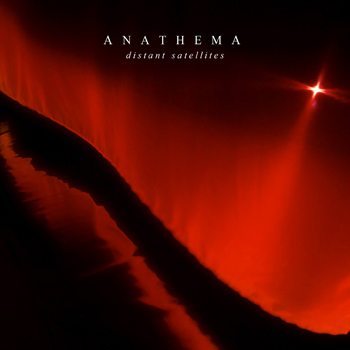
If you’ve seen or heard Anathema’s ‘unplugged’ shows then you’ll be aware how canny Danny Cavanagh is at using looping technology to create multi-layered arrangements on-the-fly. Acoustic guitar and piano figures are laid end-to-end and superimposed like Lego bricks. The technique seemed to infiltrate the band’s process to such an extent that it informed much of the composition on 2012’s Weather Systems and is taken to its next logical stage on Distant Satellites.
The three-part ‘Lost Song’ suite features a rhythmic pattern that has a drum machine feel but is played live and given life by John Douglas’ accents and swing. As it is augmented by repetitive piano motifs, orchestra and harmony vocals, further humanity (with all its attendant passion and frailty) is breathed into the glitchy mechanical beat.
Since the advent of Pro Tools the brick-building, copy-and-paste approach to arrangement has been used and misused as a compositional aid. What Distant Satellites presents is a musical architecture that has been born in a more organic fashion from looped material in a live context. As patterns repeat and layer over one another these songs gather the emotional intensity for which this outfit is famed.
Take ‘Ariel’ as an example. The song begins with a trickling piano arpeggio straight out of the Michael Nyman songbook and over the course of six minutes a typically beautiful Lee Douglas solo vocal is harmonised and repeated in canon by Vincent Cavanagh while an orchestra swells to a tempestuous finale to depict a "love so strong it hurts". The vocal canon and the sheer force of the track lend it a quasi-religious ecstasy. The individual shapes slot into place in a kind of musical Tetris - what at first seems simple gathers in complexity, weaving a tapestry of colour and making the heart race that bit faster as the pieces fall and form a whole.
The eponymous ‘Anathema’ self-consciously attempts to coalesce the multifarious elements of the band into a mission statement. Vincent’s melody would have sat happily on the Judgement or Alternative 4 albums. This is Anathema now though and this song would not have been performed with such confidence and conviction ten or fifteen years ago. The impassioned voice and Danny’s wonderful edge-of-feedback guitar solo represent performers at the crest of a wave of self-belief.
With ‘You’re Not Alone’ the flow of the album takes a sling-shot out of its orbit and veers into a more overtly electronic space. Processed hi-hat and snare hits bring Radiohead’s music to mind until John Douglas takes over on the acoustic kit and a heavy octave riff gives a tantalising glimpse into what it would have been like if the Oxford band had collaborated with King Crimson.
An organ interlude, ‘Firelight’, segues into the title track which, if anything, sounds even more like Radiohead than what has gone before. It’s only during these electronic pieces that the copy-and-paste repetitiveness makes itself known. They lack the dynamics of the electronica-meets-krautrock tour-de-force of ‘Closer’ from A Natural Disaster or the sublime ‘The Storm Before the Calm’ from Weather Systems.
‘Take Shelter’ melds the electronics with orchestra. The strings attempt to inject feeling into the cold ‘lost in space’ atmosphere but it just isn’t enough and it feels like Anathema is in danger of drifting off, losing contact with mission control. The piano intro to Mike Oldfield’s Tubular Bells first brought prolonged repetition to the notice of the record-buying public and was all the more affecting for its subtle human flaws. Anathema is a band known for the humanity and passion in its music and these are not qualities that can be accurately translated into MIDI data.
Ultimately this is a fine album that tails off into anaemic and derivative territory. Distant Satellites works best when the techniques of modular pattern-based composition are applied to the live performers.