The first time I heard Acid Mothers Temple and the Melting Paraiso UFO was a mind-melting, genre-wrecking explosion of wild, shrieking, weird noise at the band’s Highbury Garage performance in May 2001. The first I heard of the band was a week or two earlier, seeing their ridiculous name next to a tiny, brightly coloured album-cover square and a short review of their album Absolutely Freak Out! Zap Your Mind!), in the Sunday Times of all places. The review described a bizarre-sounding mix of sounds to match the exotic titles and image, from gamelan to guitar solos and all sorts in between. Soon after, I saw the distinctive name pop up again, this time, excitingly, in the gig listings for the week ahead. I begged my friend to go with me on a Thursday night, and despite a raised eyebrow, the combination of loyalty and my enthusiasm convinced him. It was an exhilarating many-tentacled monster of a gig which irrevocably expanded my musical horizons… though perhaps not so much for my friend. Wild, wailing guitar noise, suddenly fragile, chiming melodies, strange but organic folk atmospheres, ethereal vocals and unpredictable assaults of feedback and odd synth eruptions were worlds away from my ordinary diet of grungey leftovers and nu metal facsimiles. The sonic chaos lit an anarchic firecracker under my expectations of rock, or any and all other music.
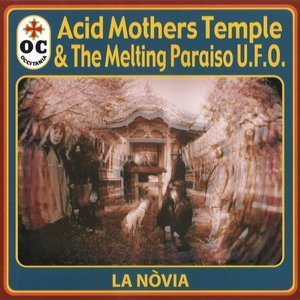
Together with the infinite ‘Pink Lady Lemonade’ riff, seemingly a feature of every Acid Mothers Temple show that has ever been, the centrepiece was the epic ‘La Novia’, which I heard two or three more times on subsequent tours before I managed to grab it on CD, spotting the memorable title amidst the confusing riot of the merchandise table. The CDr I excitedly came back with from the first show turned out to be an odd solo album by bass player Tsuyama Atsushi, entitled Is This a Pencil or a Sheep? While… er… interesting, it was my first initiation not into the peaks of the band’s catalogue, but into the unpredictable and often mildly underwhelming backwaters of the Acid Mothers family discography.
Amidst solo projects and side projects and unusual collaborations, as well as the flood of releases of vastly differing quality and interest, La Novia stands out as the high point in the band’s hyperactive recording career. Several of their many, many records can be riotous but incoherent collections of ideas and influences, or else slightly lacklustre transcriptions of their frenetic live energy. Even the best of the others, like the crushing self-titled first album, suffer from the occasional misfire or lapse into self-parody. But La Novia is ludicrous enough in concept to be conducted with total seriousness throughout, and it’s unified enough to make sense-- a deranged kind of sense, certainly, but somehow one that ends up approaching genius.
The album on vinyl (Eclipse, recently reissued by Prophase) features only the long title track, spread over two sides, with the CD issue by Swordfish including a couple of interesting but somewhat superfluous bonus tracks. ‘La Novia,’ the thing itself, is an epic forty-minute rendition of an Occitan song by a Japanese psychedelic noise-rock band encompassing gentle folk, kosmische riff cycles, unpredictable noise and Tuvan throat-singing. The band apparently heard a version by Occitanian singer Rosina de Peira while on tour in France and promptly incorporated it into their sets, before extending it to the elaborate, sprawling beast of its recorded form. The two lines of lyrics seem almost arbitrary, but the relentless, chanting intonation becomes hypnotic. The words (in the endangered Occitan language, obviously) are attached to a mournful, unhurried melody line which becomes a stately mantra through its repetition and re-emergence on various instruments and in various styles, throughout their cycling, circling rendition.
Beginning the track is just over five minutes of nothing but eerie combinations of vocals, kicked off by Tsuyama’s version of throat-singing style and gradually joined by the other members, first droning monotonously, then picking up the iconic melody, then in a round, then with freeform improvisations scattering in various directions. The secret of the album is in its extended sections where a seemingly slight phrase is repeated beyond monotony, patient and confident, waiting for the richness in the layers of sound to flower. And just when you’ve settled into nothing more than this continuing forever, another world is suddenly opened up by the entrance of a roaming monster bass groove, or a screaming guitar solo kicking down the door, or the unexpected sound of violin or bouzouki, recorder or “bowed peacock harp” floating in. Or that eternal riff returning once more. So while five minutes of vocals weaving around the melody have stretched out and made you forget there is any other kind of sound, they were also setting you up for the resounding impact of the first crunching, echoing guitar chord. It hangs in thick air before falling again, repeating, and then, gathering with it the delicate acoustic melody and a snaking bassline, setting off into the universe for the first electrified freak-out section. The next half-hour and more will explore the wildest variations from the farthest reaches of the sonic imagination, yet always inescapably orbiting the same now-ancient melody. Sections of driving rock freak-out spontaneously combust or decompose into swamps of hazy strangeness, hums and drones. But the pinwheeling explosions always collapse majestically into glorious wreckage which then ignites a hundred other blazes; and the marshy glades into which the sounds nosedive, desperately flail and become submerged, are always home to some unearthly lifeform that will be stirred into lurking forth to proclaim the endless, primordial riff. The final fade from acoustic reprisal of the theme into synth swirls and silence is only a departure. It will return.
By comparison, the three minutes of track two, ‘Bois-tu de la biere?’ is an ephemeral, weird garden contained in a soap bubble, its lilting otherworldly folk abruptly burst, vanished out of existence at the sound of the word “shock” at the end. Less of a shock, more of a nervous wander into darkness is the final track ‘Bon Voyage au LSD’, 20 minutes of incredibly gradual horror-movie escalation from silence, to scuttling thumps, to all-out rattling and shaking noise. An evil trick to play on listeners absorbed into the cosmic journey of the first epic track…
But this album is all about the main piece, its scenes all returning to the same haunting phrase, one that has now been echoing around the depths of my skull for more than a decade since I first heard it. Working at a pub in Luton town centre years ago, I even taught the resident parrot how to whistle the main riff. Which is perhaps fitting for La Novia: this ridiculously sublime, sublimely ridiculous glimpse into a sonic world of endless strangeness.