 By: Matt T.A. Smith
Montage of Heck | website | facebook |
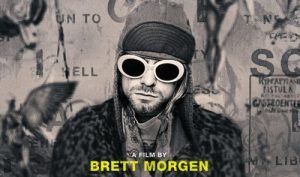
I was more than a little sceptical on first hearing about Brett Morgen’s documentary about the most well-documented musician in human history, Kurt Cobain. First of all, it was to be the first biopic of Cobain made with not only the blessing, but the cooperation, of his family. This immediately brought back memories of reading Charles R. Cross’ Courtney Love-sanctioned Heavier Than Heaven back in my youth; a book which rapidly changes from a detailed work of non-fiction to an astoundingly poetic fantasisation of Cobain and Love’s relationship and the last days of his life, largely devoid of credible referencing.
In conjunction with concerns regard the validity of the piece, the second, and most obvious, cause for alarm (or possibly a snore) was its necessity. I have always been of the opinion that a worthwhile documentary should not only be informative, but also have a sense of necessity; that this is a story that needs to be told. With a plethora of films, both good and bad, having already been published exploring the careers and personal lives of the members of Nirvana, and Cobain in particular, alongside those recording the making of individual albums, Nirvana’s contribution to both grunge and wider musical ecosystems, the circumstances regarding Cobain’s death, and so on, it left me wondering what Morgen’s film could possibly contribute to this already over-saturated cinematic niche.
I have long considered myself a fan of Nirvana’s music, finding fascination in Cobain’s infamously contradictory dichotomy between his career and his celebrity when used as a unique source of inspiration for his art. However, as much of an admirer as I consider myself to be, it was not until reading an interview with Frances Cobain, Kurt Cobain and Love’s daughter, in Rolling Stone that I was suitably intrigued in Montage of Heck. Acting as the film’s executive producer, Cobain’s referral to her father simply as ‘Kurt’ throughout the interview, along with her assertion that the documentary wishes to present the musician as simply a man, as opposed to the revered, pseudo-religious figure that has subsequently evolved into being, indicated an unexpected level of detachment from the subject matter.
It must be pointed out that there is, of course, a further debate relating to the agenda of the documentary lurking ominously in the background; indeed, exactly who is profiting from its release? And why choose to create a film of this nature now? There is also the nagging issue regarding the worldwide release of a documentary that deals with some of the most intimate moments of a notoriously introverted artist’s life. However, I will refrain from exploring these topics here, and will, instead, simply discuss this documentary as a lone piece of cinema, irrespective of any underlying politics at play.
Montage of Heck very much fulfils Frances Cobain’s promise of a portrayal of a man over that of a rock star. The film is primarily comprised of footage collected from home videos depicting Cobain’s transformation from excitable toddler to cynical adult, with a number of animated scenes encompassing an astounding level of attention to detail illustrating Cobain’s teenage period. Interspersed throughout are a series of brief interviews with those closest to Cobain prior to his death; limited to his sister, mother, father and stepmother, girlfriend, wife, and best friend/bandmate Krist Novoselic, I found this restricted approach to be a refreshingly intimate change from the usual parade of superfluous friends-of-friends, hangers on, and celebrity acquaintances that are commonly drafted in to bolster pieces of this nature. As a result, the initially-questionable omission of Dave Grohl from the film was nowhere near as glaring as I had anticipated.
Although the documentary’s lens is fixed unwaveringly on Cobain himself, as opposed to a straddling attempt at a chronicling of Nirvana’s work, the film inevitably utilises footage of band rehearsals, live performances, and television interviews. However, unlike the home videos presented within, the majority of the Nirvana-centric footage has previously seen the light of day through being included as part of alternate documentaries, the band’s own With The Lights Out compilation, or the more recently-released Live At Reading and 20th Anniversary editions of Nevermind and In Utero. Additionally, any fans hoping to hear unearthed Nirvana gems will be disappointed, although this is hardly a surprise given that that well dried up long ago thanks to the unabashed posthumous mining of the band’s remarkably small amount of recorded output. Instead, the ‘new’ audio materials included in the film are simply early acoustic noodlings made on rudimentary tape decks during Cobain’s various periods of unemployment in his late teens. Thankfully, these demos are deployed in an understated manner, mainly being used to accompany the sublime sections of animation within the film; a smart move by Morgen given that the rough recordings simply aren’t strong enough to have been placed at the forefront of this exhibition.
While the subject matter will draw audiences to this documentary, the real attractions of the piece are its masterful pacing and editing. The film largely foregoes the use of a narrator, instead carefully cutting between the aforementioned home videos and interview footage to tell its tale. This results in the creation a series of long-form montages, each addressing a categorical period of Cobain’s life, which are, in turn, each followed by a shorter, more aggressive montage animating sketches and scribbles from his journals during the era in question, set to a soundtrack of a Nirvana’s more raucous compositions (think ‘Territorial Pissings’ rather than ‘All Apologies’). The result is a rigid verse/chorus/verse structure for the biopic, that commendably manages never to feel too predictable. Additionally, Morgen must be praised for the way in which Nirvana’s career and rise in popularity is continually utilised as background context for Cobain’s individual story, rather than as a pacesetter for the documentary.
In terms of the content itself; the film unintentionally portrays Cobain’s life as split into pre- and post-Courtney periods, with Love being featured heavily in the latter half of the documentary. Whilst it is obviously the case that any man’s wife would form an integral part of his life’s story, one gets the sense that Love had significant input into the depiction of her husband following the start of their on-screen relationship, and, as a result, it can be argued that this portion of the documentary could have been further edited for brevity without damaging the narrative. Conversely, I found the initial sections of the film to be significantly more captivating; the struggle of a young man simultaneously attempting to find himself, love, and a career is inherently more relatable than a drug-addicted millionaire struggling with the pressures of success. Surprisingly, a good deal of Cobain’s youth is narrated by the musician himself, with his sombre tone and matter-of-fact manner providing these sections with a powerfully eerie quality.
Cobain’s mischievousness provides moments of genuine humour throughout, with his interview antics and one particular piece of home footage showing his shaving of his beard into a moustache and mocking Chris Cornell with a purposefully-tortured rendition of Soundgarden’s ‘Outshined’ proving to be the film’s most comedic scenes. However, Morgen cannot be accused of holding back with his documentary; while Cobain is undoubtedly portrayed as a gifted and determined artist, the biopic is rife with uncomfortable moments. Cobain regaling his first attempt to lose his virginity in his own words does little to shed him in a good light, while latterly, footage of him and Love high on heroin following the birth of their child evokes emotions of both anger and pity. However, it is in these moments that Montage of Heck truly succeeds as a warts-and-all depiction of Cobain’s life; it is a novel piece of cinema that gives the viewer an opportunity to actively dislike its protagonist. Indeed, there were points throughout the documentary where I found myself conflicted; how could such an irresponsible and troubled personality deserve such respect? This detachment of the artist from his art is handled with great expertise.
A further point of note is the way the film handles Cobain’s death, or rather, doesn’t. The documentary simply ends at the point at which Cobain’s life ended, with the only reference to his passing appearing on a text card at the film’s conclusion, mercifully saving the audience from any debate surrounding the tragedy or circumstances of his death.
Whilst a documentary such as this runs a risk of descending into self-indulgence, given that an artist’s persona is rarely more interesting than their art, this is a pitfall that Montage of Heck largely manages to avoid. In a sense, the documentary attempts to turn film-making on its head, with Cobain being used as a subject to fuel the film’s incredible graphic and editing performances, as opposed to using these devices to pander to his depiction. Whilst the chronicling of Cobain’s life proves useful in this manner, it’s hard to recommend this documentary to casual Nirvana fans, who would be more suited to a number of previously-released works concerning the history of the band itself. However, as an example of documentary-making, Montage of Heck is nothing short of outstanding. Admittedly, the film’s necessity is up for debate, but the validity of a piece of cinema so raw and emotive simply cannot be argued with.