| Following on from our interview with Her Name Is Calla about their beautiful low-run, high-end merchandise, music critic Amanda Penlington talks about two bands who have gone out of their way to offer their fans something different.
Paper Merchants: Radiohead and Wild Beasts
In the digital age where downloads and social networking are the normal modes of communication between musicians and their fans, two of the best-loved Indie bands have shown great innovation by turning to the medium of paper to release new music.
Somewhat ironically, Radiohead’s decision to release The King of Limbs as “the world’s first newspaper album” caused much internet buzz amongst fans and music sites. The band are no strangers to finding new ways to release their music. Back in 2007 they pioneered the idea of the pay-what-you-want digital release with the album In Rainbows. And whilst other musicians have spent the last few years catching up with their lead, by making music available for little or no money via Bandcamp, Spotify, Soundcloud and the like, Radiohead have moved on – or perhaps it’s more accurate to say that they have taken an intentional retrogressive step – to offer music fans something different.
Building on Radiohead’s newspaper album idea, Wild Beasts are set to release their latest single Bed Of Nails on a limited edition run of postcards, each of which is signed by the band and contains a download code.
Of course both bands are providing their fans with collectors’ items – quirky and unique objects that the music buyers will treasure as something special. But what interests me in the case of both of these releases is how in a digital age, musicians are turning to somewhat nostalgic physical objects to release their music.
Music is an ephemeral art form, existing only as sonic waves in a transient moment. The choice of a paper format acts to venerate the art of music by association. Firstly, it provides an artwork-laden physical substitute for music’s intangible sonic qualities. Secondly, whilst our encounters with music do not necessarily gain our complete attention (one can ignore or talk-over it), it’s almost impossible to ignore the written word when reading. By using printed materials to represent their music Wild Beasts and Radiohead subtly point to this discrepancy of experience.
In addition, Radiohead’s newspaper album wittily subverts the idea of the newspaper as a disposable form of mass communication. Packed with “625 tiny pieces of artwork” The King of Limbs is more likely to be fetishized by fans than used to wrap tomorrow’s chips.
Wild Beasts’ postcard release is also a playful gesture steeped in meaning. Containing the band’s signatures it retains the aura of sincerity and authenticity associated with postcards. It draws on the history of the postcard as a personal, sometimes romantic, missive. But, freed of an envelope, the postcard is a format that is easily read by anyone who encounters it en route to its intended recipient. So, in a reflection of the lyrical content of the song it contains (Bed of Nails is a sensual, public declaration of private desire), Wild Beasts’ postcard is a personal document tantalizingly displayed for the rest of the world to see.
It’s noticeable that each band’s decision to release on paper comes at a time when music is in danger of being devalued because of its very accessibility (via illegal downloads and ubiquitous background music). In both cases the use of old-fashioned written forms of communication acts as a kind of metaphor for what has been lost with the invention of the internet. Postcards and newspapers are nostalgic formats, associated with a bygone age of written communication. Once common, both are endangered objects in themselves that have been substituted in most people’s lives by email and websites. Reminding consumers of an era before the dominance of the internet marks an attempt to retrieve music from its devalued status.
In releasing on paper Radiohead and Wild Beasts are not just giving music fans innovative ways to encounter new music, they are also offering us a chance to remember and reflect on the meaning of tangible forms of communication within an increasingly virtual society.
|
Written by Amanda Penlington
|

If you liked that, you might like these...
Festival season is upon us, and so we thought it would be a good idea to make sure you’re up to speed with all the options out there for you over the next couple of months. We all know the big names but the best festivals out there are the smaller, underground events. Here are six festivals that Benjamin Bland has earmarked as being perfect for discerning music lovers...
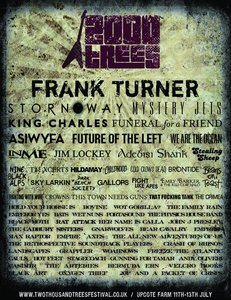
2000trees Festival (11th-14th July 2013)
Location: Upcote Farm, Gloucestershire, UK
Price: £72 two day ticket (last 100 early entry permits on sale TOMORROW)
Line-up: Frank Turner, Mystery Jets, And So I Watch You from Afar, Funeral for a Friend, Adebisi Shank, Future of the Left, Dry the River, Maybeshewill, This Town Needs Guns, BATS.
Recommendation: 2000trees is the ultimate small British festival experience. The line-up is lovingly curated by people who really care about the UK music scene and is extremely diverse. The Thursday night features a special bonus Frank Turner solo set alongside Future of the Left but only 100 tickets for that are still available (and they go on sale tomorrow at 7pm so be quick in deciding if you want to go for that option).
2000trees’ new sister festival is ArcTanGent, which we have been banging on about all year (hence why we’ve not included it in this round-up), and you can win tickets for it with us here.
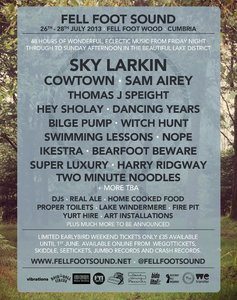
Fell Foot Sound (26th-28th July 2013)
Location: Fell Foot Wood, The Lake District, UK
Price: £42.50 weekend ticket
Line-up: Sky Larkin, Thomas Truax, Gum Takes Tooth, Witch Hunt, Bilge Pump, Hey Sholay, Ikestra, Bearfoot Beware, Super Luxury, Cowtown.
Recommendation: A big selling point of Fell Foot Sound is its location, in woods overlooking the beautiful Lake Windermere. This is put on by the same people behind the British Wildlife events in Leeds so there’s a nice selection of noisy rock acts on the bill, plus a selection of great local ale and food.
Off Festival (2nd-4th August 2013)
Location: Dolina Trzech Stawow, Katowice, Poland
Price: £40 weekend ticket (camping costs extra)
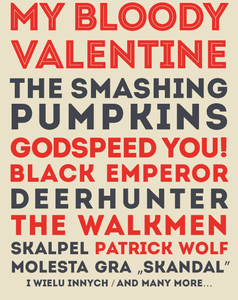
Line-up: Godspeed You! Black Emperor, My Bloody Valentine, The Smashing Pumpkins, The Walkmen, Deerhunter, Japandroids, KTL, The Haxan Cloak, Chelsea Wolfe, Julia Holter.
Recommendation: This is one of the best festival line-ups I have seen in many a year. Real diversity, from big alt-rock names to obscure drone and jazz via almost anything else you could imagine. Tickets are dirt cheap considering the amount of music that’s going on, and beer and food is cheap too. The downside is that accommodation and travel costs are more expensive at this late stage, but that’s par for the course, and it could still be done on a smaller budget than most medium to large UK festivals.
Supernormal Festival (9th-11th August 2013)
Location: Braziers Park, Oxfordshire, UK
Price: £75 weekend ticket
Line-up: Clinic, Shit and Shine, Mugstar, Shield Your Eyes, Richard Dawson, The Physics House Band, Hookworms, Michael Chapman, Coma Wall, Bass Clef.
Recommendation: This extremely independent Oxfordshire based festival is full of all sorts of weird psych acts, ranging from those on the poppier side of the spectrum to those at the polar opposite. This is an acquired taste, perhaps, musically but it’s one of the most forward-thinking and intriguing festivals out there and everything is very reasonably priced as well.
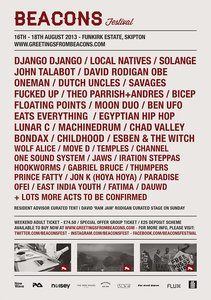
Beacons Festival (16th-18th August 2013)
Location: Heslaker Farm, Skipton, UK
Price: £99.50 weekend ticket
Line-up: Bonobo, Django Django, Local Natives, Gold Panda, John Talabot, Wire, Fucked Up, Savages, Uncle Acid & The Deadbeats, Department M.
Recommendation: A slightly more mainstream festival than some of the others here, as names like Bonobo and Django Django prove, but there are some great hidden gems in this line-up (especially on the electronic side of things). There’s an impressive variety of acts and the festival has been building up a fine reputation over recent years so, if you want a line-up with some bigger names included, and aren’t tempted by 2000trees then this might be the one for you.
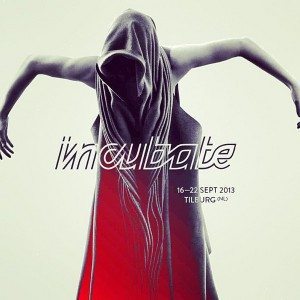
Incubate Festival (16th-22nd September 2013)
Location: Various Venues, Tilburg, Netherlands
Price: £68 for the week (camping costs extra and is only available Friday to Sunday)
Line-up: Built to Spill, Immortal, Mayhem, DOOM, Wolf Eyes, Tim Hecker, Shonen Knife, Bersarin Quartett, Public Service Broadcasting, Teeth of the Sea.
Recommendation: This is heavy duty stuff. An immensely exciting diverse line-up is on offer from Incubate this year, meaning that anyone with even a passing interest in underground music would struggle not to find plenty to see. The event takes place over a week but, unless your pockets are particularly deep it is advised that one aims just to pop over for the weekend. There’s an extraordinary array of non-musical attractions still to be revealed as well A £68 pass is still enormously good value and there’s a vibrant couchsurfing community in the city if you want to avoid lugging a tent over.
Two Honourable Mentions
Truck Festival (19th-20th July 2013): the Oxford based festival stalwart has a slightly dull set of mainstream headline acts included this year, but then there are also sets from the likes of Bo Ningen, Rolo Tomassi and Tall Ships (plus an appearance by Rumour Cubes, featuring our very own Hannah Morgan, as guests of Get Cape on the main stage). If the aforementioned bigger names appeal to you then this is likely more than worth a punt.
Woolf Music (17th-18th August 2013): this tiny festival in Wiltshire has only 200 tickets available so is very intimate but nonetheless features some intriguing acts, most notably highly rated Bristolians Thought Forms.
Minnesota, the “Land of 10,000 Lakes”, and it’s an appropriately cold day in the depths of winter. Yet in the modern wood-cladded studio overlooking the plentiful trout stream in Cannon Falls, the temperature is toasty.
Brent Sigmeth is at the controls today, where he’s been employed for the past two decades. However, it was as a studio-hand that he started his employ exactly 20 years earlier, delivering tobacco and sandwiches for the alt-rock heroes of the day, Nirvana.
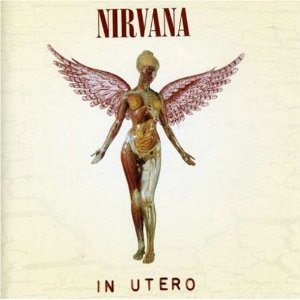
They had come to the quiet backwater to lay down tracks for their follow-up to 'Nevermind' with soundman Steve Albini, and so as to not attract unwanted disturbance, the band booked in as the Simon Ritchie Bluegrass Ensemble. “Steve had recently worked at Pachyderm with P.J. Harvey and The Wedding Present, so even though the name was a bit goofy, we assumed it would be something really interesting and cool. No inkling whatsoever that it would be Nirvana. Steve had faxed a pretty detailed set-up sheet for the studio a week or so beforehand, so the studio owner also assumed it would be something big.”
Brent and another colleague didn’t find out the band’s true identity until a truck filled with all of their equipment showed up a couple hours before he was to retrieve them at the airport. “One of the flight cases in the truck had “Nirvana – Seattle” written on it. We wondered if it was actually them, or even a band that might be borrowing some of their equipment. Steve had been working with some pretty big names, but Nirvana was pretty much the biggest at that time, so we were still sceptical.”
So, fresh out of engineering school and in at the deep end, Brent was trying to soak up everything he could from Albini and Messrs. Cobain, Novoselic and Grohl. “I hadn’t really experienced a full-on professional recording session from start to finish, so it was pretty incredible to see how Steve approached it all.” Says Sigmeth, being a fan of his from his days fronting Big Black. “I was very into raw punk-rockish “realistic” recordings, and Steve was the best. It was very apparent when the band started rehearsing and microphones were being moved around, but it still sounded bigger than life. Of course, hearing and witnessing Nirvana run through a song or two blasting through the main control room monitors was kind of earth shattering for me.”
Albini was of course the man who had recorded the Pixies’ first long-player, 'Surfer Rosa', and that was one of the defining reasons why Cobain placed his trust in the producer to record 'In Utero', in an effort to distance themselves from the perceived commercialism of their 1991 breakthrough. “It was obvious to me that he was a scientist with a firm grasp of his trade, not just a punky sound nerd. It had a big effect on me, but I was also just pretty overwhelmed. Most of the experience is foggy in my memory, probably because of nerves and age. It went by very fast.” Although it was all a bit of a blur, Sigmeth can hold his head very high in admitting his place on the album. “I think it’s a timeless record… it’s not just a 1993 time capsule.”
In an effort to put further distance from 'Nevermind', it’s been said that Cobain used some cheap guitars to record 'In Utero'. For instance, in the ‘Heart-Shaped Box’ video you can see him toting a white Univox, rather than his usual favourite Fender Mustangs, Jaguars, Jazzmasters or Strats. “I’m not sure if it was as much distancing from 'Nevermind' as much as just wanting more fucked up guitar tones. I believe he had a Silvertone guitar – a really cheap department store guitar made in the 60′s.”
Sigmeth pauses for a moment as he’s struck by a sudden realisation: “Funny. I’m so busy right now that I didn’t even realise it was actually 20 years ago exactly that I was sitting in the studio with them. Wow.”
So, as it is indeed 2013, Sigmeth ponders a question over the anticipated 20th anniversary re-release: “I think it would be excellent if Steve’s mixes were released as an entire package, maybe mastered by someone he trusts. After all, it’s all the Nirvana I listened to between the recording and the actual release later in ’93. A cassette tape of Steve’s mixes had fallen behind the tape deck at Pachyderm and I found it while cleaning up after the boys and Steve had left. It had all the Steve mixes on it. I’m proud to say that we protected that cassette with honour. We made no copies. Sometimes, it was brought out of its secure hiding place and played for trusted fans through the same speakers it was mixed through. I loved the original Steve mixes of the remixed singles.” Oh, to be one of those trusted fans!
Of course, we can only speculate as to what Cobain would make of such a project. Having met the man, Sigmeth reckons “he’d be okay with however it is released, as long as Dave and Krist are down with it. I got the feeling that he really really trusted those two. It was pretty obvious; you can’t travel around the world, bare your soul, stand nearly naked in front of the universe without the support of a couple genuine and down-to-earth guys like Dave and Krist.”
Strangely, for such a seminal work of audio art, there are no details in the album liner notes of the two weeks spent in the Minnesota woods: “myself and Pachyderm Studio were not given credit or thanks on the 'In Utero' release. We were disappointed, of course, yet somehow humbly okay with just having been there.” Perhaps they will get their reward soon.
Originally published on the rather lovely The New Phonographers.