 By: Martyn Coppack
The first thing that springs to mind for most people when the name Bruce Springsteen crops up in conversation is the image of a stadium rousing blue collar hero from the swamps of New Jersey. It’s an image cemented in peoples minds after Springsteen appropriated the US flag in 1984 and in one move, tapped into the consciousness of an entire generation. It was a moment akin to the big bang, where the moderately successful songwriter suddenly took on iconic status and for better or worse, multiplied his fan-base by millions. He was born in the USA but belonged to the world.
This success, which on the surface may have seemed to have come easy, was a long time coming though and if ever there was an artist who paid his dues it was Bruce Frederick Joseph Springsteen, the boy from Freehold, NJ. Like some character from one of his songs, he came from a working class family who often struggled to put food on the table. It almost feels churlish to highlight but here it’s the truth, and key to understanding many of his songs. One only needs to listen to ‘Factory’ from Darkness On The Edge Of Town to understand the frustrations of his father who would get up early each morning to go to work, or the many allusions to parental relationships, torn by a lack of money and a counter-cultural generation. The boy leaving home in ‘Independence Day’, the anger of ‘Adam Raised A Cain’ and the sadness of ‘My Fathers House’ all linked in to Springsteen’s own relationship with his father. It was a sadness that would stay with him but also become the link between many souls around the world.
Focusing on that is only half the story though and to truly understand the man they call The Boss you have to look to the new Jersey shoreline, in particular Asbury Park. It is here that he bust his chops in countless bands, learning the skills that would in time turn him into arguably the greatest live performer of our times. You can still visit Asbury Park although it is all about ghosts now. The Stone Pony still stands as does Madame Marie’s stall, the boardwalk gets rough at night, but if you listen hard to those ghosts in the wind you may just hear that New Jersey sound. It could even be Southside Johnny tuning up in The Stone Pony. If you are really lucky it could be Bruce himself making a surprise guest appearance as the carousel stands desolate a few miles down the road.
These ghosts are what creeps out of Springsteen’s work and none more so than on two albums which would outside the casual circuit, may be all but forgotten. Coming before the ur-text of Born To Run, ground zero for the E Street Sound that would dominate the next 40 years, Greetings From Asbury Park, NJ and it’s follow up The Wild, The Innocent And The E Street Shuffle were curious hybrids of singer-songwriter naivety and New York jazz all mixed up in a sound developed through countless rock and roll covers. Almost anomalous when considered in the canon, it is here that we see the famous E Street sound find its feet. Coming before Born To Run which cemented the thematic concerns of Springsteen for the rest of his career, they offer an insight into a songwriter developing a style but also still in thrall to his own heroes.
Ask any hardcore Springsteen fan what their favourite song is and there are a few songs which will overwhelmingly be mentioned. Apart from ‘Rosalita (Come Out Tonight)’, whose video introduced an audience to the man’s live shows, the other answers you will get will be ‘Lost In The Flood’, ‘Incident On 57th Street’, ‘New York City Serenade’ and ‘4th Of July, Asbury Park, Sandy’. You may, at a push, get a few fans of ‘Kitty’s Back’ too. These are songs which own mythical status but for many they are unknown. For the believers, they represent the pinnacle of Springsteen’s work and catching one of these songs in concert is akin to finding the holy grail. That’s a whole other story though.
Where Springsteen’s first album, Greetings From Asbury Park, NJ introduced us to an artist, it suffers from poor production and a lack of cohesion. It’s testament to the power of three songs that the album is lifted from a rather run of the mill attempt to something much stronger. From the Vietnam story of ‘Lost In The Flood’, the first epic in Springsteen’s work, through the bittersweet ‘For You’ to the pure rock and roll of ‘It’s Hard To Be A Saint In The City’, Greetings shows flashes of inspiration but never really shows any indication of what this aspiring songwriter may become. In time ‘Growin’ Up’ and ‘Spirit Of The Night’ would become core songs and grow in a live setting but here they are muffled and lost.
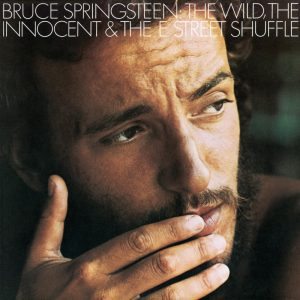
Perhaps understanding this, and possibly in his first case of taking control over his music, the follow up album would be a much different affair. A tour de force in musical technicality, The Wild, The Innocent and the E Street Shuffle is Bruce’s buddy album, his love letter to New Jersey and New York and in ‘Rosalita’, his calling card. A concept album in two parts, it is here we are introduced to a myriad cast of characters who would come to occupy his work for many years. Spanish Johnny, Rosie, Sandy, Madame Marie, Little Angel…people who drift in and out of not only the songs on WIESS but also in unreleased gems such as ‘Thundercrack’, ‘Bishop Danced’ and ‘Seaside Bar Song’. This is the cast of the Asbury Park shoreline, the teenage brats of E Street, the ghosts you hear.
From the dissonant sound of the horns revving up at the start of ‘The E Street Shuffle’, it is obvious that we already have a much more confident sounding Springsteen. After years of playing and touring in early bands such as Steel Mill, that musicianship coalesces here to become something more. It’s the genesis of that last gang in town, the best bar band in the world, the heart thumping, booty shaking E Street Band and as the songs progresses they invite you in with open arms. Even years later, when the song made a return on the Wrecking Ball tour, it’s effect was to unite the crowd in one swaying mass of dancing and joy. Infectious and upbeat, it was a perfect start.
To go from this to the wistful ‘4th Of July, Asbury Park, Sandy’ is a bit shocking at first but as the story unfurls, it reveals itself to be a song which will in time become one of his most loved. As Danny Federici’s accordian leads you down the boardwalk way past dark, where the girls promise to unsnap their jeans into the fear of the fairground where our protagonist catches his sleeve on the Tilt n’ Whirl, it’s a carnival atmosphere full of the ghosts of that windy Asbury Park walk you took earlier on. Unrequited love never felt so real.
After this is a song which would take on extraordinary lengths in concert and become a showcase for each member of the band to show off their wares. On album ‘Kitty’s Back’ is much shorter and whilst the music takes centre stage here, the shortness allows you to focus on the lyrics, a steamy affair a world away from Sandy. This is the seamier side of Asbury Park once the lights go down, it’s the sound of the bars just off the side-walk as they settle down for a night of music away from the trappings of a tourist trade. It is no small wonder that ‘Wild Billy’s Circus Story’ fails to ignite after this tour-de-force and as such gets a little lost.
The second half is even more of a revelation though and after the lull of Wild Billy, a tinkle of piano ushers in the now classic ‘Incident On 57th Street’. It’s difficult to explain what this song means to some fans, a song which rarely makes an appearance these days but when it does immediately elevates that particular gig to classic status. Such is the power of the song, even a solo piano version is greeted with joy, a full band version is a once in a lifetime achievement for many fans now.
It’s the simple way in which Springsteen tells the story of Spanish Johnny that sucks you right in. Pretty much a template for ‘Jungleland’, Born To Run’s epic closer, it brings all those characters that inhabited Greasy Lake, the boardwalk and E Street and throws in a Shakespearean tension where Puerto Rican Jane begs for Spanish Johnny to love her and take her away whilst the “romantic young boys” beckon to go and make easy money out on the street. The peril of the switchblade knife and the police car siren just a block away where eventually it would get sunk into flesh on the later ‘Jungleland’. It’s Springsteen at his storytelling best before he turned his eyes to much deeper concerns.
The familiar rattle of guitar that opens up ‘Rosalita’ opens up the party atmosphere once again with a song which would become staple encore song for many years. A breezy stomp which may or may not be autobiographical (“the record company Rosie, just give me a big advance!”), it’s the sound of young love again only this time thwarted by Rosie’s father who sees nothing but trouble in this young boys eyes. Never mind the fact that he makes his living as a musician, there may be a little of that tension between him and his own father here but here its treated as an act of rebellion. The deeper concerns are lost here as we are thrust once more into the arms of the E Street Band and Clarence Clemons wonderful saxophone.
The pay off is ‘New York City Serenade’, a song which plays off a beautiful crescendo against a desperate tale of escape. Here the words are kept moderately simple, almost whispered, playing a cruel dichotomy against the swelling orchestral sound. It’s a lesson in discreetness and is actually a moment of reflection on the more bombastic nature of some of Springsteen’s songs when you revisit it. It’s this quiet reflection which would come to the fore on the later acoustic albums except here is is an electrified sound kept at lullaby pace.
Rosie aside, there are no hits here. WIESS is an album that plays as a whole and invites you into it’s crazy cast of characters in the manner of an old time jazz album. The swinging tones and loping rhythms play out against a rock and roll heritage to create something quite remarkable and although the horns would make an appearance in later albums, never would they be so playful as on here. Its an album which is unlike anything else in Springsteen’s career but is one which underpins the true ethos of the E Street Band. The familiar clarion call of the earthshaking, legendary E Street Band all starts here. It is as much their album as Springsteen’s. Its ghosts would follow him into the studio in the following months as he started work on what would become the first defining album of his career, an album which may have started with Spanish Johnny and Rosalita but ends with Mary and Wendy. For Springsteen, his music was about to take on a whole new meaning, for the fans it would signal the end of the Asbury Park sound and a move into more heartland territory. Sandy, Wild Billy and Madame Marie were about to become ghosts.
Dedicated to the denizens of Greasy Lake, Daisy Jeep and all those crazy #BruceBuds hitting The River tour