(((O))) INTERVIEWS
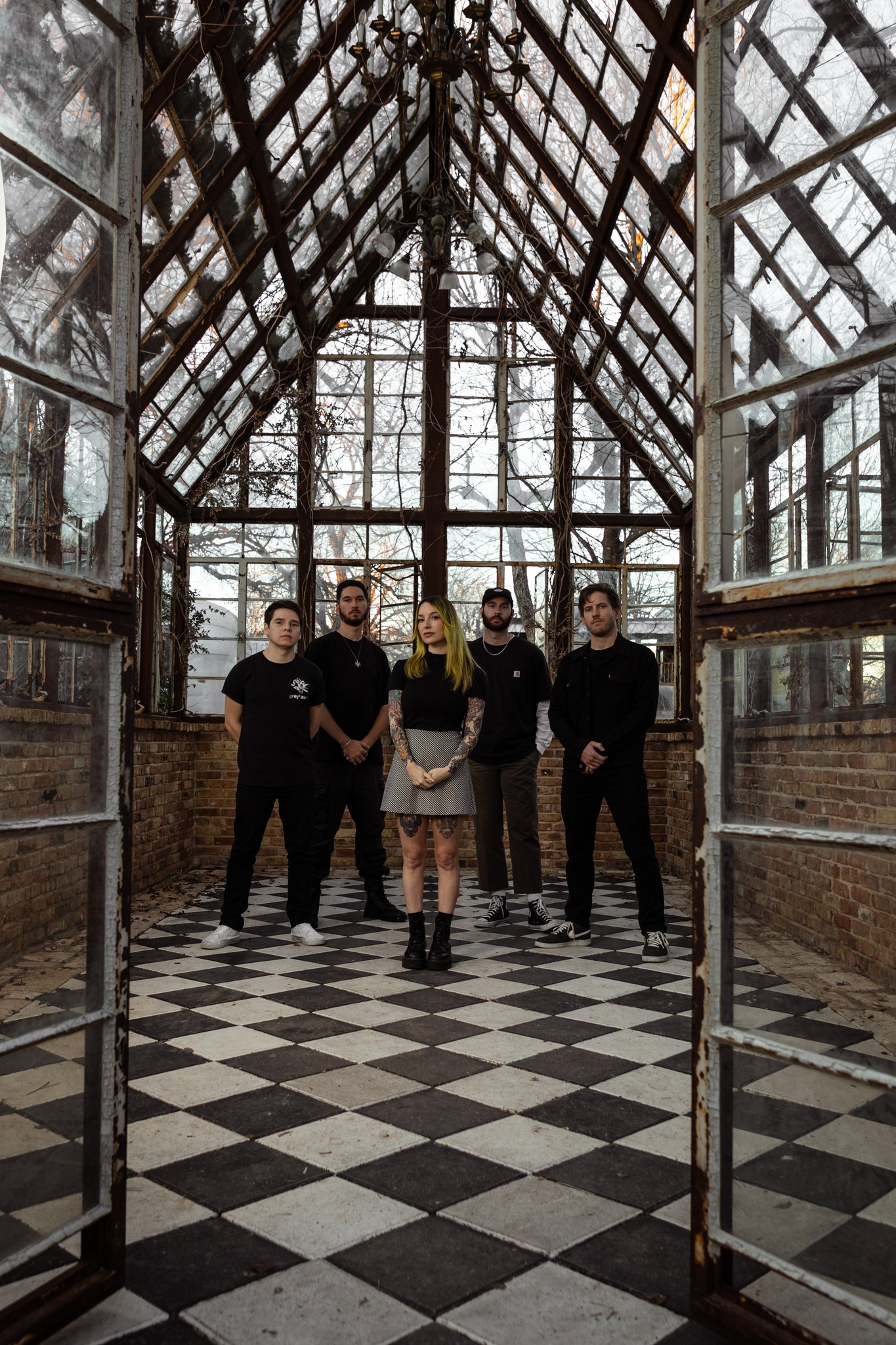
Brooke Hampton from Slow Pulse
Gavin Brown had the pleasure of talking to Slow Pulse vocalist Brooke Hampton to hear all about the new material, the return of the band, how the hardcore scene in Texas is currently and who her biggest vocal inspirations are.
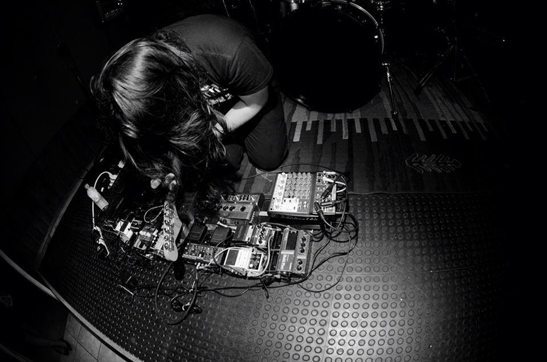
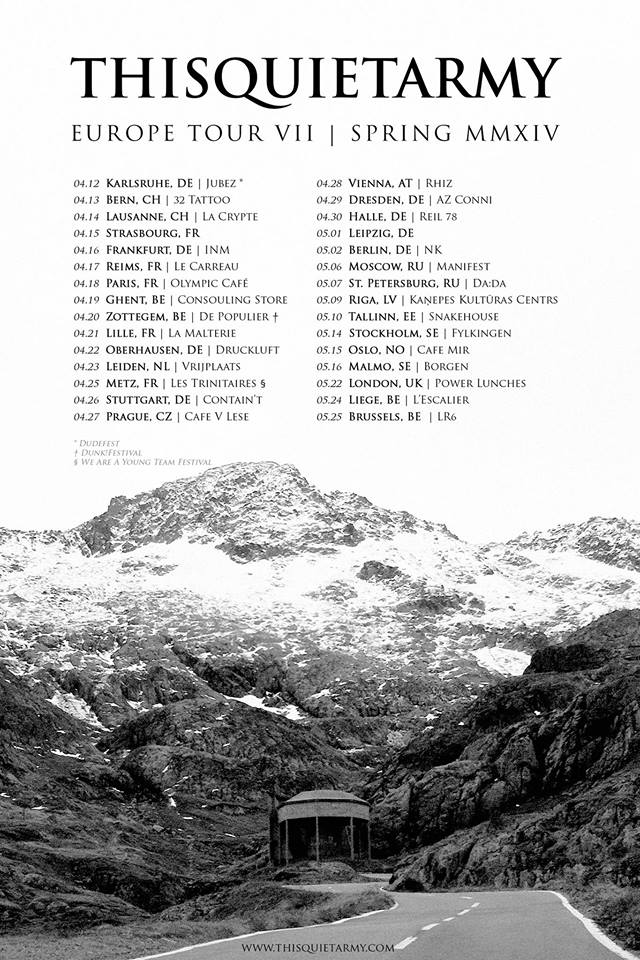
As part of the ConSouling Sounds EP series, Syndrome and thisquietarmy recently released their Split collaboration The Lonely Mountain. Daniela reviewed this EP for Ech(((o)))es and Dust and wanted to find out more so she asked Eric Quach of thisquietarmy some questions before he left Montreal for another long tour.
(((o))): Hi Eric, how is it going?
Eric: Good, I’m currently writing this on the way to Quebec City for a gig, last one in Canada before flying to Europe next week.
(((o))): How’s life in Montreal?
Eric: Montreal is sick of winter, we can’t take it anymore - it’s been a long 6 months and we just had yet another snowstorm last weekend. Besides that, all is fine, managed to get some work done for the next tour and albums, spent time with friends and family, went to see some good shows, do typical Montreal stuff... there's still quite a lot to do in winter despite being cold, if not we just stay in and work on art.
(((o))): Eric, have you ever been to Gent?
Eric: Yes, I’ve been there many times, it’s almost like a second home lately. The people from ConSouling Sounds are based there and they have been very hospitable when I have days off on tour. I’m looking forward to the opening of their new brick and mortar record store opening on April 5th, and playing there on Record Store Day, April 19th.
(((o))): Let’s start at the very beginning. How did you start producing music?
Eric: I started producing music in my bedroom, shortly after I picked up an acoustic guitar around the 00’s. I used to paint a lot as an artistic mean of expression and I just wanted to translate that creative spirit in the same way but with sounds. A couple of years later, I started picking up the electric guitar and pedals and founded Destroyalldreamers where I’ve been heavily involved with the production of our demo and subsequent albums. By the time I started thisquietarmy, I felt more confident in my abilities as a composer and producer.
(((o))): When and where did you meet Mathieu of Syndrome for the first time? Any particular memory?
Eric: We met in June 2011 in Gent; I was on tour with Aidan Baker and we were booked in this old house in Gent with Syndrome. We each played in different rooms of the house. That’s when I met Mathieu and the ConSouling Sounds crew for the first time.
(((o))): How come did you decide to do a Split album with Syndrome? And how you managed to do it?
Eric: At that show, Mathieu gave me a copy of his first EP Floating Veins and mentioned an interest to collaborate. A couple of years later, I had recorded some tracks and asked Mathieu if he thought they were suitable for a collaboration.
(((o))): What is the idea behind The Lonely Mountain?
Eric: Since Mathieu took care of completing the tracks I gave him, I also let him pick the concept and titles. But I suppose the concept is about a specific mood or an atmosphere, suggested themes stem from the chosen titles.
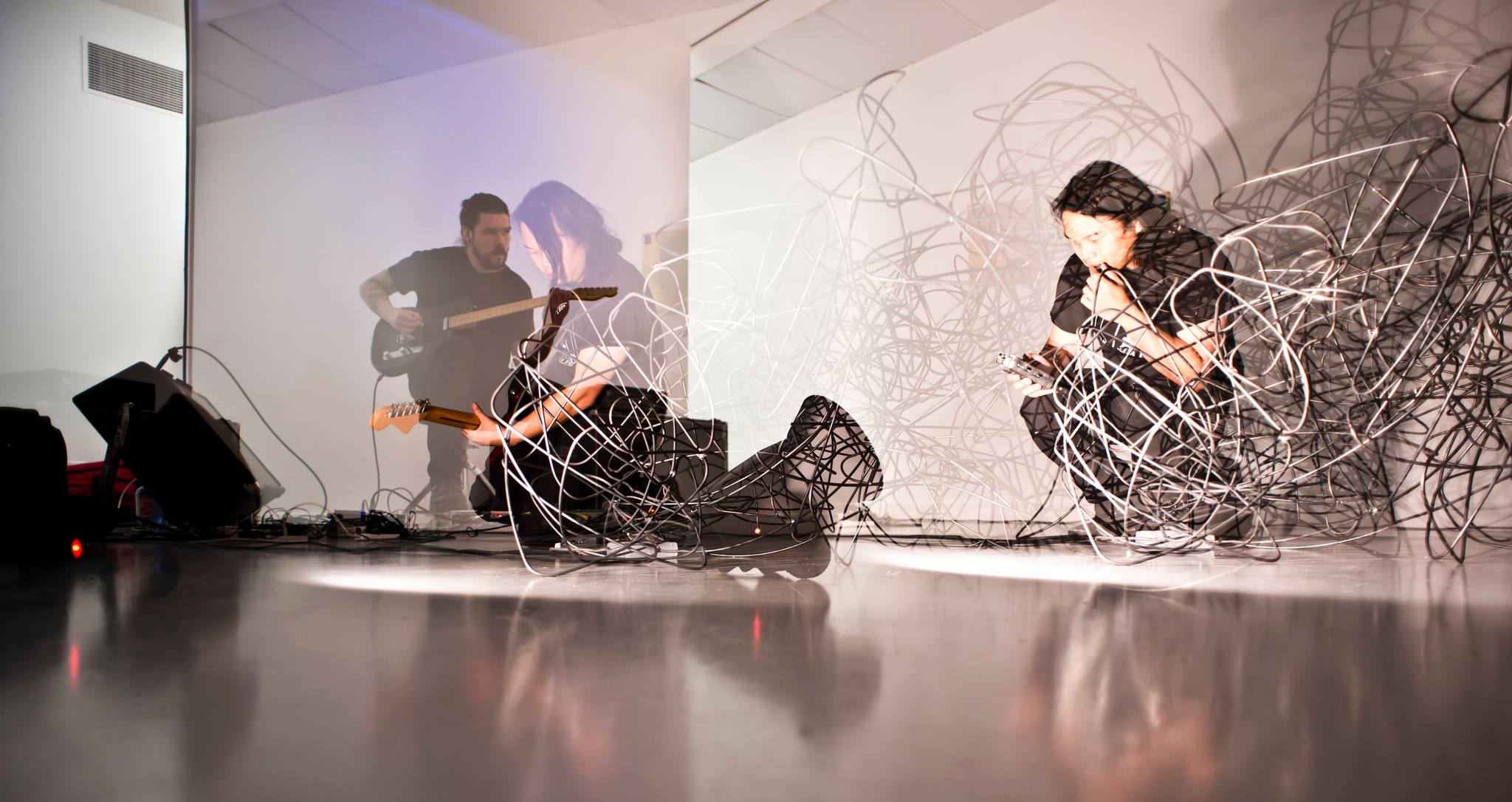
Syndrome and thisquietarmy
(((o))): Should you describe it with one word which one would you choose?
Eric: Dark.
(((o))): I like your Split album and the live track is brilliant. How was playing live together like?
Eric: It was great, we always talked about doing a live improvisation the next time we did a show together, and it happened in Brussels at M4. We didn’t prepare anything, we just talked about what it could be and how we’d start it… I did several live collaborations before so I was confident enough about doing it. Eventually once we were into it, the improvisation just took a life of its own and guided us through the whole thing.
(((o))): What did you enjoy most? Were there any difficulties in the cooperation?
Eric: I think that both thisquietarmy and Syndrome solo sets are very detailed, melodic, thought-through and rehearsed. So I think it was great to just let go and see where it led us, I enjoy the darker noisier abstract aspect of what becomes, together. And we knew that it was OK to do something different, especially since that's what happened with our record. In the end, it was collaboration in its true sense and our style was quickly defined.
(((o))): Eric, I appreciate your works together with Aidan Baker, Year Of No Light and Labirinto. Why do you like these kind of collaborations so much? Is there something you are particularly looking for?
Eric: Playing and collaborating with people is always very different than playing solo where you may be in control of everything but are also very limited in your own capacities. When playing with different musicians, it allows more dynamics and interaction, things can get less predictable. The situation creates new ideas that you’d never come up with on your own. At the same time, it’s different than to be committed with a band where there’s a long-term relationship with the members of the band. Collaborations are like one-night stands basically and whatever happens happen, for better or for worse, and I'm always up to others as long as I respect the other musician or band. I actually have a collaboration with Noveller coming up soon on Shelter Press which was recorded early last year in Brooklyn, New York - look out for it.
(((o))): I saw both you and Syndrome playing live recently, thisquietarmy in Berlin supporting Caspian and Syndrome at Dunk! Festival 2013 when Mathieu played that awesome 28 minutes long track. Would you rather play in small venues or larger venues?
Eric: Larger venues usually have a better and bigger sound system that can handle what I’d like to achieve soundwise (wide frequency range, bassy low end, crisp details), so it’s always exciting to play big venues and to be exposed to more people. However, I like the intimacy of the small venues where everyone is cramped up – the sound may not be as good but at the same time, there is no escape and it’s more effective to connect with the audience... or rather the audience can connect more easily with me and not be distracted by larger, unfocused spaces.
(((o))): With whom would you want to do a tour/concert with?
Eric: I could say Godspeed, Swans, Low, Slowdive, Mogwai or whoever - but the best may be people that you already like and that you get along with because a tour can be long.
(((o))): Do you ever get lost in the music?
Eric: I get lost every time I perform.
(((o))): What are you working on right now?
Eric: Finalizing the logistic details of my upcoming tour, and also other touring projects for the fall. Music-wise, I’ve been developing some ideas here and there, recording some demos, maybe planning my next album a little bit more differently this time and just going with the flow. Locally, I've been doing a lot of live collaborations with local bands that I play shows with, to perform tracks from Hex Mountains... who knows, maybe I'll bring it more collaborators for the next one as well.
(((o))): What do you listen to when you’re not writing music?
Eric: I try to listen what’s going on but it’s hard to keep up with everything, always going back to older stuff. These days, I really only discover new bands on tour, with the festivals that I play or the bands that I happen to cross paths with.
(((o))): Eric thank you very much for your time. Any last words?
Eric: Thanks so much for your support, and hopefully see you on the next tour – I’ll be playing 30+ shows in Germany, Switzerland, France, Belgium, Czech Republic, Austria, Russia, Latvia, Estonia, Sweden, Norway and UK from April 12 to May 26. Check out my website for the dates.
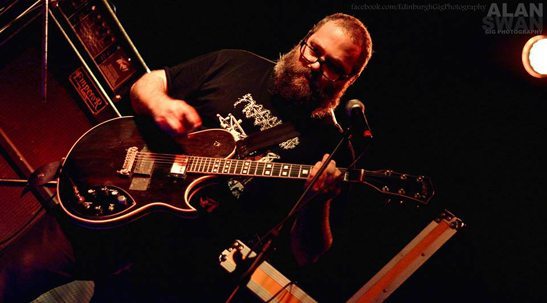
I’m meeting Chip King outside Audio in Glasgow, and it somehow seems very fitting to have a chat with The Body’s singer/noise maker. Audio is based underneath the railroad tracks of Glasgow Central Station in the end of a dark damp tunnel, so the perfect setting for a chat with the frontman of one of the scariest noise bands on the planet right now.
(((o))): So this is The Body’s first European tour. How’s it been going so far?
Chip: It’s been really great! We’ve been very well received so far and it’s been great seeing all these different places. We had a long drive from Amsterdam where we were two days ago as we took the ferry to Dover and then drove up to Glasgow. But when I was a kid my dad, who was in the Army, used to be stationed down in England, so for me personally it’s been great seeing this place again, it brings back memories.
(((o))): Would you say things are different over in Europe compared to the US? For example, Europe has a lot of amazing festivals right now, like Roadburn, Temples Fest, Desert Fest, Heavy Days in Doom Town, Doom over Leipzig Festival and many more.
Chip: Yeah, Roadburn was amazing! Walter and all other people that are involved really put so much energy into that festival to make it so great. And it returns as they seem really positive on what they’re doing. This seems to be the general vibe I’ve noticed so far in Europe. People putting themselves out there to do lots of stuff for bands that are touring and I think it’s really refreshing. We also played Doom over Leipzig and everything so far has been so well done. The way you get treated over here as a band is different than in the US; it’s a lot more accommodating and supportive. In the US we have the Maryland Deathfest and a couple of other things and people are really psyched to get similar things happening in the US as well.
(((o))): I understand you’re on tour with a different drummer as Lee [Buford] doesn’t fly?
Chip: Yeah unfortunately Lee couldn’t make it. We tried to come over on a freighter but that didn’t really work out. So our friend Matt [Melon] decided to help out. We’ve been making music as The Body for 15 years now and I know Lee a lot longer than that, so yeah it’s of course different with Matt, but it’s been working out great. It’s quite funny as Matt plays in Pissgrave from Philadelphia, which is a black death metal band and he’s more used to playing with blastbeats, like real technical fast playing drums, so it’s fun to see him with The Body. Pissgrave is probably one of the better bands on the East Coast by the way.
(((o))): So, Lee just sits grumpily at home for missing this adventure?
Chip: No not at all, we’ve tried to get him over so he’s a bit sad he couldn’t make it, but he realises it’s better for the band. There was so much energy and effort already put into the trip that it kinda made more sense for us to come. So much money and time has gone into it so we just said let’s make this happen. We’re looking into ways to get Lee over somehow for a future visit as he’d be psyched to be here. But the charisma and vibe is there between Matt and myself. Before the tour we practiced a few hours each night for 8 days straight to get Matt up to scratch. Which was all great fun as Lee was there as well and I told him to play more blastbeats!
(((o))): What inspires you? I’ve read somewhere that you’re a big Neurosis fan, so they must be an inspiration?
Chip: Neurosis have always been inspiring, but I’ve recently been listening to a lot of older music, like early Judas Priest and for years when I was in Providence I was listening to all the local noise stuff and experimental things. I’ve just been trying to branch out on the classical stuff. I see so many bands on tour that when I get home I just want to hear different stuff. It’s kinda all over the map.
(((o))): The Body released a cover CD and you also released this Dead Cops/Cop Killer 7”, did you guys like to show the world what kinda stuff inspired you or what you like to listen to?
Chip: Yeah we did this whole cover CD, with covers of Danzig, Sinead O’Connor, Black Flag, Grass and Judas Priest. We kinda wanted to show what we like to listen to, but it was also just like let’s have some fun and see what happens when we try it. The CDR we’ve done, which is all covers, we did that just before going on tour as we didn’t really have anything to merchandise with at the time, and especially in the USA if you don’t have anything to sell, your tour can be really really short. Everytime we did something like this it turned out being lots of fun and being really happy with the result.
(((o))): In the UK and Europe the doom scene has been exploding lately, it’s been doing really well. Like in the UK bands like Conan have lifted a lot of bands and the scene in general to the next level.
Chip: Yeah, there some great things happening here at the moment.
(((o))): The Body’s music kinda fits in this scene but also does something more unique I think. You’ve said something about a lot of bands just playing the same Electric Wizard riffs all the time. What’s your opinion about that?
Chip: There are so many bands out there that are playing the same riffs and I feel like not a lot of people are trying to push their music into a different direction. To me it gets a little stale, but for other people these types of bands are the greatest in the world.
(((o))): It’s well-known that The Body is fascinated by death and suicide. And you guys love guns as you have posed with guns in your press pictures and mentioned in other interviews how much you guys love guns. Is that all part of the message The Body likes to get across?
Chip: I feel like it’s all kind of an issue of how much you appreciate life. What is living if you’re on the way to dying? It’s kinda like the trap of mortality.

(((o))): We always react in our most pacifistic way when there’s another mass shooting in the US as there is such a different view towards guns in Europe. The laws are also a lot different over here and it’s much harder to get a gun. Do you think that’s part of the reason why these things happen in the US so often?
Chip: Part of the problem may be the fact it’s easier to get guns in the US, but at this point there are so many guns out there already, so many illegal guns that if you change the laws now there will still be millions and millions of guns, but it might be a start. But it will also affect people who legitimately and legally buy guns and safely own them and use them, it takes away their ability to do that, but those guns are still going to be in the hands of people who will use them for any reason they seem fit, without having any responsibility whatsoever. A lot of the mass shootings, like that happen in the US, but also here like in Dunblane and Norway for example, a lot of times it comes down to something like mental illness, but also our culture seems a lot more violent and we have a big fascination with violence in the US, which I think we’re all kinda are you know. In terms of everything we see and how we live.
(((o))): The Body releases a lot of albums, EPs and splits and a lot of these are on various labels. How does that come about? Do you get approached by these labels to release with them?
Chip: Yeah, well we know Matt of RVNG Intl. from back in the days in Arkansas. He’s a good friend of ours and we released I Shall Die Here on RVNG. We release a lot on At A Loss Recordings, which is run by another friend of ours, Joss. And when Bettina asked us to release an album on Thrill Jockey we were pretty excited about that too.
(((o))): Some people might have been a bit surprised to hear The Body released an album with Thrill Jockey. Do you plan to stay with them for more releases?
Chip: Thrill Jockey has been nothing been great, so we’ll stay with them but we can do smaller releases and do whatever we want with anyone else, but Thrill Jockey has been nothing but perfect. It was funny, because when Bettina first approached us we were like ‘sounds like a weird mix’, but it’s been natural and amazing. And it seems to open some doors to other people that hadn’t heard of us before so that’s great. Yeah, Thrill Jockey has been super supportive.
(((o))): The Body has been very prolific lately. What else do you have planned in the near future?
Chip: It’s nice to keep doing other stuff, to keep it fluent. We got a couple of exciting releases planned. At A Loss will release a split we recorded with Neil of Krieg, which sounds like old-English punk, very primitive and repetitive. On top of that it includes some programming stuff as well, lots of noise stuff and soundscaping, and both Neil and I sing on it. It’s a great collaboration as Neil has been doing the whole US black metal thing like forever and has great integrity and isn’t someone who’s jumped on the bandwagon like 10 years later. Neil also has an intense live performance, so were hoping to play some more shows together where we can collaborate live on stage.
Collaborations are lots of fun as we’re quite loose as a band because there’s just two of us, and we’ve been playing together so long now, it’s kinda fun to see what happens when there’s another element in there. We’ve been playing a lot with an extra drummer lately or with someone doing extra sounds over the music, so it’s been real fun to bring that into the studio as well.
(((o))): Talking about collaborations, how did you get to work with The Haxan Cloak on I Shall Die Here?
Chip: When we recorded Christs, Redeemers and the collaboration with Krieg, at the same time we also recorded other songs for RVNG and Matt had mentioned to maybe send it to someone else to mix it and do some other stuff with. We initially tried someone else and that didn’t really work out well, but Matt knew someone else at Tri Angle Records, which was Bobby, or The Haxan Cloak, and he was interested. So we sent the first couple of tracks and when we got them back we were like, ‘wow this is awesome!’. He added a lot to the tracks which blew my mind, it was great. We intended to be more collaborative but Bobby saw it more as remixing.
We’re also releasing another collaboration with Thou, which we’re going to record soon. And there’s a split release planned on Thrill Jockey with friends of ours of Rhode Island.
(((o))): Thanks a lot for this chat Chip, really great to get to speak to you!
Chip: My pleasure and enjoy the show!

Shameless self-portrait with Chip
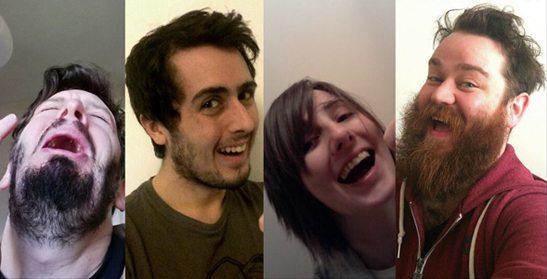
A Fight You Can’t Win: Thank you and goodnight.
I’m not sure, as I sit down to write this, exactly what it is I’m trying to do, or to say. It’s part eulogy, part interview, and part rambling. I have no structure planned, so it could all go horribly wrong. It’s not an assignment piece, it’s just a thing I want to do, however it turns out.
Y’see, A Fight You Can’t Win are calling it a day. One last gig, one last EP, and it’ll all be over. No more. That’s yer lot.
Now, for many of you out there, that will probably mean nothing. Most likely, you will never have heard of them. Or if you have, you might not care.
But I care. I care quite a lot. Y’see, it galls me, it really does, when we lose another exciting, genuinely talented band, for whatever reason. And that is what A Fight You Can’t Win are. Or, I suppose I should say, were. One of the best, most exhilarating, most intense, rudest and funniest bands I have ever had the pleasure of seeing, meeting and being friends with. To be sure, they could be unpredictable, chaotic, and maybe a bit ramshackle at times, but that’s all part of what made them so much fun. In all of the many times I saw them play, they never gave it less than everything they had. I never, ever felt let down after one of their shows. Drained, sweaty, battered and occasionally broken, but never disappointed. Ever.
Well. Anyway. I didn’t want their end to go un-noticed. I don’t think they deserve to vanish without trace, without a fanfare of some kind. And I wanted to give them the chance to explain. So I asked them. And they, being lovely, lovely people, humoured me.
To set the scene, I asked Matthew (Bakewell - guitar, vocals and creative obscenities) for a potted history of the A Fight You Can’t Win. I had planned to ask a few questions along the way, but he, being Matthew, made them a bit redundant. (I think I’ll let this run for a bit, and I’ll add in the questions I meant to ask, and pretend I did it all at the time. I may adjust the order of things, but I promise not to alter the context.)
‘The band’, he said, ‘was started by Paul Diamond (Bass) and myself after the break-up of our previous band, Clayface. From the start, we decided that we were going to be playing nothing but 2 minute loud and fast pop music. Sander (Yes, (((o)))’s very own metal editor) joined a few months later and we were playing gigs not long after that. (It was around this time that I first saw them, in some grotty cellar in Edinburgh. Hooked on the spot.) We released our debut album in April 2010, Lesley (Makesnoise – possibly not her real name – guitar and backing vocals) joined the following August after we put feelers out for a second, female guitarist.’
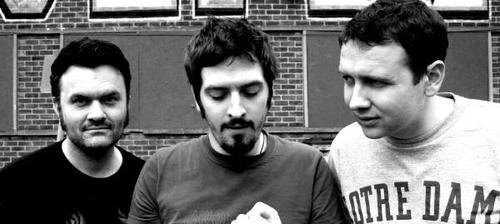
AFYCW: The early days
‘In November 2011, we released the ‘Every Last Breath’ EP and, following that, got a SAMA (Scottish Alternative Music Awards) nomination and Radio 1 airplay, and we were feeling pretty chuffed with ourselves.’
And rightly so. The EP was a belter, gigs were a joy, things were looking rosy. And then…
‘In September 2012 Sander and Paul decided that they had to leave the band due to increasing work and family commitments. We had always admired Stewart (McLachlan - drums and gasping) and Robbie (Smith, bass and beard) and they were the first people we contacted about joining almost straight away and, thankfully, they said yes.’
‘We retreated to The Cottage (practice room and studio, up north) for two days of intensive practice and songwriting, and started gigging again in October. We released an eponymous EP in June and went on a mini tour of Scotland and Ireland, which cemented us as a group and improved our live show immensely. Plans were put in place for a new album in mid-2014 with another tour which would hopefully have included Northern England.’
And then we got the ‘Not Sleeping, Just Dead’, announcement, saying that the band was no more…
‘Unfortunately the spectre of work commitments reared its head again and Lesley and Robbie decided that, because of the full time nature that the band had taken on, they had to call it a day.’
Did you think about keeping the band going on in some form?
Stewart and I decided that it wouldn’t be possible to continue without them. Also, I was growing increasingly less and less enthused about the band myself due to work and stuff. I was just hoping I was going through a ‘phase’, but I think if they hadn’t pulled it, I would have a few months down the line. Life, eh?’
‘It was decided we would record a last EP and have a farewell gig in May. We always said that we would end on a high, and given the last EP, we’re definitely doing that!’
I always think that any band I like deserves to be huge, and I’m slightly surprised when I realise that the world doesn’t share my opinion, and that they have to earn a living doing real jobs. So, I ask:
Did you ever think that AFYCW should have been bigger, that it could’ve been the ‘next big thing’?
We were getting good feedback from people who came to our gigs, particularly when we were on tour and in Belfast. That said, I still never felt any buzz from Edinburgh itself, but when we played in Glasgow we were always well received by the crowds there. I don’t think we were on track to becoming much bigger that we had gotten - that might have been a contributing factor in it breaking down. It felt like there was a ceiling for Edinburgh bands, and that we’d hit it.’
Is it going to be like that for all those Edinburgh bands – Birdhead, Black International, Vasquez, etc – who inhabit the same space as AFYCW? That if they want to ‘make it’, they need to get out of Edinburgh?
‘Not necessarily – but we’ve got our work cut out for us. Even though I’m not in a band I’m still eager to work towards putting Edinburgh on the map – we really do have a set of bands that deserve serious recognition. We’ve got serious venue obstacles – sometimes it feels like there’s an agenda to suppress any non-festival creativity.’
‘Better to keep trying than to give up like cowards.’
I didn’t want Matthew to hog the interview, so I hassled the others next…
Why, I asked, did you decide to leave, and was it a difficult decision to make?
Lesley: ‘It was an incredibly difficult decision to leave AFYCW and something I gave months of serious thought to. There were a few reasons that all added up to it being something I just wasn’t able to commit to any longer. We’d had a great year with the release of the AFYCW EP, our first tour, a Kerrang! review amongst other things, and two absolutely cracking videos, but unfortunately these things don’t just happen by magic. It takes massive amounts of time and effort and the band was, essentially, becoming a full time job on top of all of our other full time jobs. The next item on the agenda was an album, which we’d partially written, but the thought of the hard and often thankless road ahead was something that I felt I just didn’t want to take on. My full time job is as a community musician, which I absolutely love, but it does mean that my patience and creative energy for doing more music in every spare second is limited, and I really had to assess if AFYCW was the thing I wanted to be devoting those limited resources to.’
‘I have a lot of my own personal music projects too, and it simply wasn’t possible for me to do everything any ore, and that if I had to choose, then those were my priority.’
Robbie: ‘It was a very, very tough decision. Lesley and I had both independently come to the conclusion that we were going to leave the band at some point, so we thought it was best to let Matthew and Stewart know sooner than later.’
Was it hard, telling the rest of the band?
Lesley: ‘It was becoming increasingly obvious that the level of mental investment involved was taking its toll on everyone else too, and I don’t think any of us wanted it to get to the point where our personal relationships with each other suffered as a result, and the band finished in some sort of horrible implosion/episode of Jeremy Kyle. It was a difficult conversation for all of us to have, it’s really like breaking up a long-term relationship. We’d all lived and breathed AFYCW for the best part of a year. Fortunately, we’re all big girls and boys and we were able to have a pretty honest and reasoned talk about where we were and how we felt about it all. Of course it wasn’t easy – when you’ve invested so much energy in something it’s always difficult to leave it behind, but we all felt that we were really proud of what we’d done and that carrying on wasn’t really an option.’
Robbie agrees: ‘Once we did (tell them), the others decided that they didn’t want to carry on with new band members, so we decided to record a final EP and have a big final party of a gig to send us off. I’ve had a great time being in this band and I’m really happy with what we’ve achieved in the last year or so but, sadly, being in an independent band can be hard work – we really gave it our all with the last EP, and with a potential album looming on the horizon, I realised I couldn’t commit the time, energy and money that that would require.’
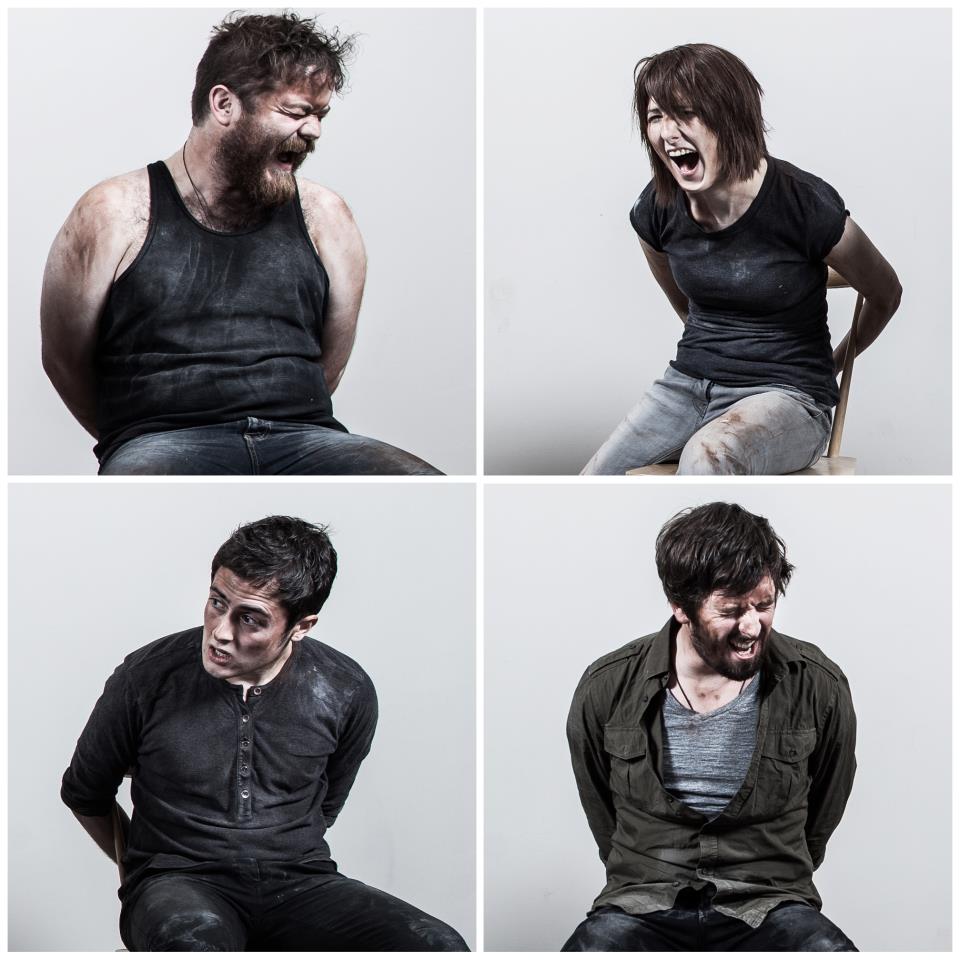
I asked Stewart if he’d had any idea that the split was coming.
Stewart: ‘I didn’t, no. To such an extent that I genuinely assumed it was a joke at first, ha ha! That sucked.’
How did you feel about it, once it was confirmed?
Fine, really. These kind of things are always rubbish, it goes without saying, but we’re in a blessed situation of ending on friendly terms, having put together two records I’m immensely proud of. Ending on a high is completely OK with me.’
So, what’s next for everybody?
Lesley: ‘We agreed that we wanted to release the new material we’d been working on, which we feel is the best music we’ve ever done, so we got our heads down to record those songs and plan a small scale release. We all wanted to feel like we finished things properly, rather than letting it fizzle out. We can’t wait to let everyone hear those recordings. It feels so good to be finishing on what for us is a musical high, with something we’re really proud of. As for what’s next for me, I’ll by no means be giving up music. I don’t think that’s something I could do even if I tried. I’m planning on getting my head down and working on some of my own projects. I’ve got the best part of an album written so I’ll be aiming to finish that and see where it takes me…’
Robbie, presumably you’ll be keeping on with BRITNEY (with Stewart) and your association with Ultimate Slaymaster?
Robbie: ‘Absolutely. Britney will continue Britneying. Stewart will no longer speak to me or look me in the eye, so that does make it difficult. As for Ultimate Slaymaster, my role in that band is merely ceremonial. In fact, I have never even seen them play.’
Stewart, you’ve got plenty to be getting on with. New Shudder stuff, Billy Ray Osiris and Britney with Robbie. Do you ever stop?
Stewart: ‘Hahaha! I’m honestly not as busy as I want to be, yet. You can blame my degree for that. I have some new things that’ll be coming together in the summer, if all goes to plan.’
Anything you can reveal?
‘Not yet. It involves a couple of guys from one of my favourite Edinburgh bands, and a lot of riffs. Should be well fun.’
Matthew doesn’t rule out a return to noisy music sometime in the future, but, ‘I’m now writing acoustic weepcore.’
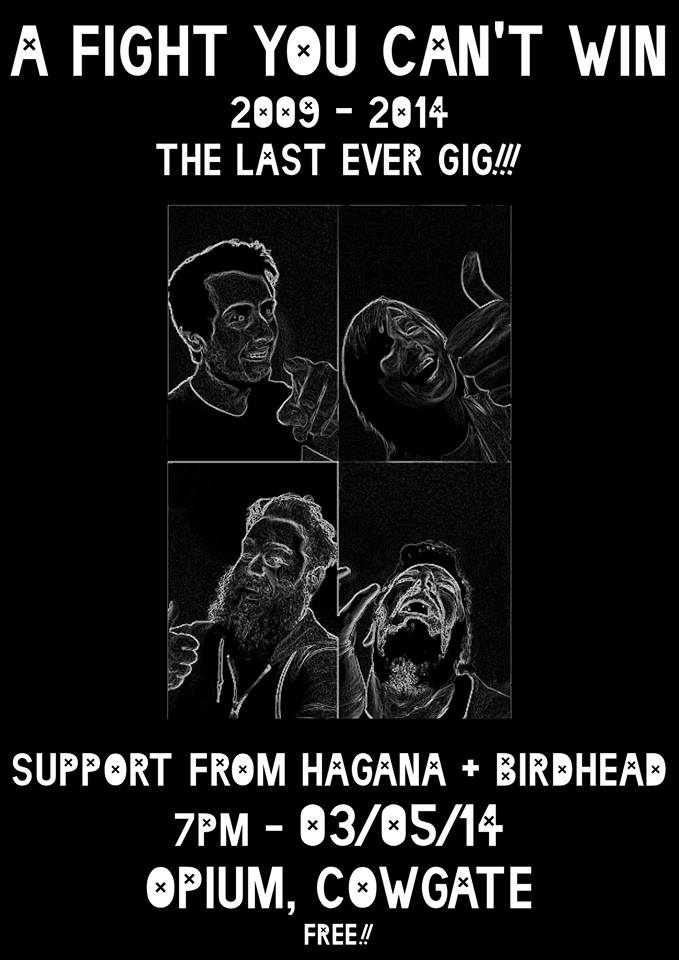
A Fight You Can’t Win will be playing one last gig at Opium in Edinburgh on Saturday 3rd of May. It’s going to be free, and support will come from the excellent Birdhead and the equally excellent Hagana.
Are there, I ask, going to be any surprises? Special guests? Cake?
Robbie: ‘Well, we wanted Stephen Donkin (of Birdhead) to burst out of a giant cake and heckle us, but his demands are ridiculous. He wanted £800 and a backstage deli meat platter. Also, I guess all of the new songs will count as a ‘surprise’, as it’s the only time they will ever be played live.’
Well. There you go. Another fine band leaves the stage. It’s no big deal. Nobody died. Everybody’s still friends. It’s just another case of real life getting in the way, I guess. A few people will miss them. I certainly will.
If you can be there, I urge you to come to see them off on the 3rd. I can’t guarantee any special guests, but there will probably be shenanigans. And maybe some goings-on. There WILL be rude words. And A Fight You Can’t Win will be, for one last time, awesome.
Matthew, Lesley, Robbie, Stewart, Sander and Paul, thank you for having been a thing, and I wish you all the very best in whatever you do in the future.
If you're in Edinburgh on May 3rd, then come to Opium to give these guys a proper send-off! Here is the Facebook event page with more info.
This May sees the first Beyond The Redshift festival across 3 venues in North London. The stellar line up ticks a lot of our boxes here at E&D Towers so we sent our Editor to talk to co-curator Johannes Persson from Cult Of Luna.
(((O))): Hi Johannes, I know you're incredibly busy so thanks for taking the time to speak to us. When Redshift was first announced we were quite surprised as we thought you guys said you were taking a break in back in December and you said that you were putting your feet up for a while. What changed that, was it getting involved in Redshift, or is there other reasons?
Johannes: Nothing has changed. What I said was that after summer, we have nothing planned, and we’re not planning to plan anything. It doesn’t mean we’re quitting - actually it does mean we’re quitting, well some sort of hiatus. But, we are not going to be that active any more in that sense, and we’re never gonna be the band that release an album every eighteen months any more. We’re never gonna be that band again. We might do a couple of shows here or there, but we’re not gonna tour, we’re not gonna do a record. So that’s the whole thing.
(((O))): So Redshift could be quite a rare chance to see you then?
Johannes: I would guess so, in quite a while.
(((O))): So how did you get involved with Redshift?
Johannes: Actually it was our agent, Haydn that came up with the idea, then it kinda grew and grew. When you start talking and brainstorming with any project, things grow out of proportion. I think it came out really well - just a couple of weeks until we are home free, but when it comes to the line up it’s the best line up I’ve seen in quite a while. But I’m sad there were a couple of bands lost along the way.
(((O))): That’s what I was going to ask, was this all your first choices?
Johannes: To be honest a lot of these bands we’ve played with before, and a lot of the bands are on record I love. Some of the bands I’d never heard before, but Haydn is playing me a bunch of bands, saying “listen to this!” which actually made me discover a couple of new bands that I’m very happy are taking the time to do this festival. Every band themselves are worth watching.
(((O))): So why did you choose to do it in London?
Johannes: It was Haydn ’s idea, as it got bigger and bigger we ended up here. I can’t even remember how many times we've played London; ten or twelve times. There are towns or cities when you know ‘this is gonna be good!’: London, Paris, Berlin, Stockholm, Oslo, you know it’s gonna be good every time. So why not make it even better?
(((O))): Did you start off with a concept for it, or did you start off with a list of bands you wanted?
Johannes: I started by asking my friends! This is almost going to be like a class reunion because we’ve been touring Europe since around 2001, and you meet a lot of people along the way. One thing that I think is quite sad is that some of the bands that I wanted to play can’t, but that is why Haydn is better at economics than me, as well as having very good taste. When I want a band from Sweden, that aren’t very well known and don’t sell a lot of tickets but cost a lot of money to fly over, that’s when he says no. The best case scenario would be to have a festival where no one has heard of any of the bands, but then no one would come!
(((O))): Is there a common thread between the bands? Not necessarily musically, but in terms of the mindset?
Johannes: That is hard to define. It’s the same when we write Cult Of Luna songs, they might differ quite a bit but there needs to be something that connects them. I can’t really say exactly what connects all these artists, but they definitely are in the same realm. They might sound different, but they are in the same atmosphere, the same emotional depth. The form they might take might be different, but they definitely originate from the same thing.
(((O))): It definitely hangs together as an entity in terms of the line up. One band that, to us, sticks out slightly is Godseed – more on the black metal side than post rock / metal…….
Johannes: Have you heard their latest album?
(((O))): I haven’t, is it more progressive?
Johannes: I can agree with you out of a musical perpesctive, but I’m holding onto what you said. I don’t think they stand out that much, but musically yes, they are from a different background. I’m a big fan of their ‘I Begin’ album, and that is black metal, but it has progressed without losing it’s edge.
I’ve always liked black metal musically, but not the ideology, especially from the 90’s - but now people have grown up. Black metal has a wide variety, for example Mayhem and Darkthrone, totally different kinds of music.
(((O))): It has a kind of intensity that other genres don’t have. Maybe intensity’s not the right word, but you know what I’m getting at?
Johannes: They’re doing it for real, there’s a hundred percent honesty to it and that’s what resonates with me. I’m not a big fan of technical black aspects of black metal though, when things became symphonic. That’s horrible. Godseed have made progression and pushed black metal to outskirts I haven’t heard before. They’re like us in terms of where we are – not close but the circles are intertwined a bit.
(((O))): Without wanting you to name favourites, are there any bands you’re really pleased to see on the line up?
Johannes: I’m very excited to see Jesu. I don’t think people probably know of The Old Wind, but I want to educate them, as they are one of the best unknown bands out there. I’ve seen Amenra three times now, and normally I get easily bored by bands and leave after the first song but not with them. We’ve toured with Bossk a few times now so I’m looking forward to seeing them again, and I hadn’t heard of Esben And The Witch before, but now I know all of their songs. Abraham deserve so much recognition, they are amazing, lovely Swiss guys.
(((O))): I can tell you’re really excited about the bands that are playing, and that’s fantastic. If you had a blank cheque, is there anybody you would have liked to have been able to get?
Johannes: There are a lot of bands I would have liked to get over to Redshift because of different reasons. What we tried to do though was not have so much of a cockfest, to try and get more female participants. I think it should be 60/40 female/male, but it's more important that the music is great. There are way too few females in heavy music, and in general. I listen to a lot of female artists, and I tried to get some more over but it was definitely down to economics. I could have fifty punk bands at this festival, but that would fail. There are more females at this festival than most.
(((O))): It’s interesting you talk about that as we’re planning a series of articles about women in music. Not to patronize them and say ‘didn’t she do well?’, but to celebrate them.
Johannes: The worst thing that could ever be done is to see them as mascots, as a lever for bands to get themselves arena shows. And I hate them being called ‘girl bands’.
(((O))): Exactly. If we get a press release only references the women in terms of their appearance, we’ll ignore it, and unfortunately a lot of the time that's what 'female fronted' has come to mean. It’s a band and it’s got people in it, it doesn’t matter.
Johannes: “The male fronted band Cult of Luna”. Maybe we will put that in a press release just to see what will happen.
(((O))): If it’s a successful weekend, is it something you’d plan to do again, or have you not thought that far ahead?
Johannes: My hope is that we’re going to do it again. I know that Haydn has put a lot of work into it, and it’s something you have to see if it’s economically viable. If he doesn’t lose any money then yeah – that is my mission but I don’t hold the figures.
(((O))): Would you ever think about taking this to the rest of Europe, or do it somewhere else? Or does that seem too complicated?
Johannes: Maybe I’m getting old, but you know when you see those tours with four or five bands – no way! Two, maybe three bands tops for me, that’s it. How would you even start off something like that? But a man can dream.
(((O))): It seems to us that after ‘Vertikal’ was released, your profile has risen quite substantially. Is that something you’ve seen within the band? I’ve noticed a lot more press for it, especially in the UK – and it also featured on a lot of Album of the Year lists (including ours).
Johannes: We had a couple of years absence before then, and there’s two ways it goes there. Either people forget about you, or don’t like your kind of music, or they stay interested. When we started playing this music there were three bands: Neurosis, Isis, and us. That was basically it. Well, there were probably more, but they were the three bands that got mentioned all the time. But mid 2000s it suddenly went boom, and everybody got a delay pedal, and I think we went past that.
When we decided to come back, it was to do the best album ever and I had a very definite idea with what I wanted to do. I originated the bearing, and the band took over, with a collective idea of what we wanted to do from the beginning. We wanted to be focused and very unorganic, so much so that Erik (Olofsson, guitar) said it was going to sound like a machine, and that we should just play our guitars downstroke to sound more like that.
(((O))): You guys have been together for a very long time, how have you seen the industry change during that?
Johannes: I have been in the industry forever and in the beginning and we didn’t want to be a full time band then, like others do now. We were talking the other day about the ‘360 deals’ (where bands essentially sign over rights for not just their music but income from merch & shows) that young bands are getting, and it totally blows shit. It’s just a reality now, it’s what happens.
You can moralise about it, and I think it’s terrible how art/music is treated like a commodity. It’s horrible how it’s created a situation where bands on tour have to sign away any rights to your only income from the one thing you can’t download, shows. My other band had a manager who was also our record label, so it was really hard because you never knew who you were talking to, and your manager is supposed to stick up for you to a label.
(((O))): What can people expect from the Cult Of Luna set?
Johannes: A lot of mistakes (laughs). There’s going to be at least one song from every album, as Klas (Rydberg, vocals) is gonna be there.
(((O))): Was that a mutual thing to get Klas back? Or is that just for this one off show?
Johannes: Yeah, just a one off, but we are doing a warm up show in Stockholm. It’s going to be great! For Redshift, there is going to be something old, something new, and something inbetween. Some songs will sound exactly like they are but some are quite old so maybe we try something new with them – we’re not apologizing for them, even though I hate it when bands I like do the same thing.
(((O))): It’s definitely trying to find the right balance. Like, when you think about the amount of times Keith Richards has played that riff to ‘Satisfaction’….
Johannes: You either play it or you don’t. We haven’t done that much to them, just a little bit of colour. At the end of the day, if you don’t like our old songs, don’t listen to them.
(((O))): Thank you for your time and we’ll see you next month!
Johannes: Yeah, see you May 10th, thank you!

Not much happens in the West country. It's a rather quiet part of the world where the people are believed to be of a friendly nature, enjoying a glass of local scrumpy as they potter about in their cabbage patches. However, out of this calm has crept Thought Forms - a band that is starting to flourish and bloom. We managed to catch up with Charlie who kindly took the time to tell us a bit about the mysterious trio.
(((o))): Hi, first of all thanks for taking time out to talk to us. You're currently on tour with Esben & the Witch. How's it going.


With such an unusual ideology inspiring their music, it should come as no surprise that Sabbath Assembly’s music appeals to only a small niche of fans. Which is a shame, since their music is beautifully written, smartly arranged, and, incredibly evocative. I spoke to Dave Nuss, the mastermind behind the project, about his inspirations and beliefs, and learned some key details about the future direction of the band.
(((o))): Obviously, the Process Church itself is no longer active. To what degree is Processean ideology still alive? Do its old followers still believe, and have you succeeded in attracting new ones?
Dave: Our intention isn’t to attract any followers to the Church. The Church is definitely long past, and we haven’t met any original members who still believe or practice. As with all the new religious movements from the 60’s, there is a super fascination there, but that moment in history was so different from ours now. The Process Church was very primitive sociologically, hence the mind control that was happening, and for us what’s most important now is psychic liberation rather than entrapment. Even though the Process theology is relevant for the band to share, we are definitely not defining our success by the number of new recruits to these beliefs. What does success mean to us? That’s a good question. I suppose it’s more about connecting rather than convincing.
(((o))): Where have the fans been most receptive to the ideology?
Dave: Well we can’t seem to book a show or hardly sell a record in the US, and that feels pretty significant. Our record label is in Finland and so far we have toured exclusively in Scandinavia and Northern Europe. That part of the world is more in touch with their pagan roots and thus can connect better with our themes; or at least Christianity doesn’t have such a repressive aspect as it does here in America, so therefore people won’t be as afraid off by these subjects. I am consistently surprised here that even my most liberal and open-minded friends are still a bit uneasy about this project.
(((o))): Why do you think it's so hard to market your music in most places? Are listeners simply unable to wrap their heads around the concept of praising Satan and Lucifer alongside Jesus and Jehovah, or does it stem from something deeper?
Dave: Religion is such a personal thing for people, and it’s easy to cross boundaries in this area, consciously and unconsciously. I’ve found the oddest assortment of people connecting with the message of the Church – mostly I hear about it at the merch table while on tour in Europe – ‘odd’ because there seems to be no particular pattern for who ‘gets it’. Mostly I feel like its book-nerds and scholarly types, but then there’s some that really don’t care about the texts and just enjoy the tunes. On the other hand when I was living in NYC, that scene basically took no notice because there’s no fashion or hip element about the band. And now I live in Texas, and anyone that hears about my involvement with this project sort of smiles politely and walks away. Others who choose to get closer – even the most liberal – seem to reach a block. Everyone has their own association with “Satan” – whatever that means to them – and it tends to create suspicion. I suppose the same is true with “Jesus”. For me Jesus is much harder to deal with than Satan. If you look historically at the amount of devastation done in the name of Jesus it’s about a billion times more than ever happened in the name of Satan. So why does the devil get such a bad rap?
(((o))): What problems, in your mind, does Processean theology solve that other religions have yet to figure out?
Dave: I think of it as a holistic kind of path in that it is affirming of the totality of our psychology. Rather than beginning with a premise that there is something wrong with us, as Christianity does, it begins with the idea that we are creative, complex beings with a wide array of forces at play within. Rather than needing to correct this, the Process encourages us to embrace our eccentricity, our passions, our ‘evil’—in harmony with our other aspects, including love, compassion, and charity. Shame is not a part of the theology at all.
(((o))): What made you choose the lineup of musicians that perform on the album?
Dave: Guitarist Kevin Hufnagel recorded one song with Jamie and I on Ye Are Gods, ‘We Come From the One’, and Jamie and I felt this was a good starting point for the next recordings, which became Quaternity. We love working with Kevin and have already begun more demos with him for the next album. Jamie has known Daron Beck of Pinkish Black since they were kids in Ft Worth, TX, so she chose him as the figure with the most terrifying voice. Mat and Marja from Hexvessel are kindred spirits and label mates, so we thought it’s appropriate to have them on as well, which led to a subsequent tour with us. We invite guests on to fill a specific role – for Mat and Marja it was recitation on ‘The Four Horsemen’.
(((o))): In a 2012 interview with Invisible Oranges, you stated in reference to the first two Sabbath Assembly albums that "both albums were recorded instrumentally with hired guns and it came across", and that you were excited for the new chapter of the band because the new members were more in tune with the ideology. Has that carried over into 2014? Is the current lineup on board, and how did their acceptance (or lack thereof) impact the album?
Dave: Our preference is to work with people with a metal background because that is the ‘spirit’ we want to be in the music. So for Jamie and I, we don’t care whether someone ‘believes’ in the Process Church’s message, but we do care that the person is ok with singing about Jesus and Satan – whether they believe in the message or not, or even are just apathetic about it, or even think the whole thing is just a fucking comedy. Any of those options is fine, but believe it or not that’s pretty hard to find! Most people are pretty concerned.

(((o))): Are any of the new performers permanent additions to the band?
Dave: Kevin Hufnagel. The strings on Quaternity were recorded with pros, but we do have viola and stand-up bass players coming on the upcoming tour to play those parts.
(((o))): Quaternity has a very ethereal, almost ritualistic atmosphere to it. Musically, what influenced the album to make this atmosphere?
Dave: The song on Ye Are Gods, ‘We Come From the One’, we found so enchanting with Kevin’s 12 string and Eyvind Kang’s viola, we started off on that trip for the new songs and just stayed with it. It wasn’t really an outside influence, we just liked the clarity that we were getting with all the acoustic stuff. Also we felt the songs were coming out way creepier that way than with distorted power chords and double bass. My friend was saying to me today that the album is a tease – like it’s building towards a climax you never get. It never exactly “kicks in”. That will be the next album…..
(((o))): What about 'I, Satan?' It still retains that ethereal atmosphere, despite being extremely harsh and heavy. What inspired it?
Dave: The melody and riff for that song actually was inspired by a Tibetan chant, and Kevin played it on his Gibson SG tuned to C, so it just portrays complete brutality along with the meditative quality of a Buddhist prayer. Then we adapted lyrics from the Process’ text called Gods on War in which Satan is proclaiming his power and might and intentions to destroy all of humanity. We all really love this track, and it indicates the direction of the band for the next record.
(((o))): This is the first album to feature primarily original material from the band, as opposed to primarily Process Church hymns. Why the change in approach?
Dave: It’s really time, and it looks like the next album will be all original. I think we’ve done all we can do with the hymns, and are more interested in expressing our own thoughts, passions, dreams, ideas. Take a hymn like ‘The Four Horsemen’. That hymn on the album has been altered, added to, and subtracted from so much that it hardly resembles the original sheet music at all. So we started to wonder, why are we even using the hymns at all? We have our own songs, so let’s just do those. The band will remain in the spirit of the Church always somehow, based on its inception, and we’ll continue dealing with similar themes. But as far as working on the hymns, it’s time to move on.
(((o))): You mentioned in that Invisible Oranges interview that music is your "most sacred scripture". Do you see music itself as a religious or spiritual experience, independent of the views it may espouse?
Dave: To me music has to be safe place where we can explore whatever we want to explore. I am 100% against censorship because I don’t believe in the correlation that, for example, if someone sings about suicide it causes the listener to kill himself. So in this freedom of expression comes the potential to access the ineffable because we can completely let our unconscious roam. And in this roaming – the writing process, or improvising – we land on these unknown places that we can’t explain but the melody or harmony or vomited lyric says it for us. That act of ‘seeking and finding’ is a religious experience, as you say, independent of the views the lyrics espouse. That’s why a Tibetan Buddhist chant, for example, can be moving to me even though I am not a Tibetan Buddhist and don’t even know what they’re singing about. And then that melody can get metal-ified in the band and it can in turn move others. We are transmitting a religious experience.
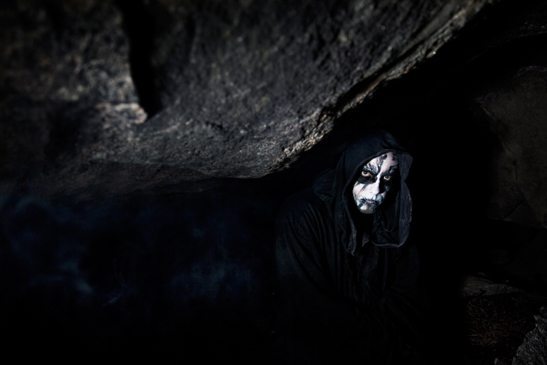
With Sargeist's latest release Feeding The Crawling Shadows now upon us, Berns von Bernington asked the man behind the band and driving force in the Finnish black metal scene Shatraug a couple of questions.
(((o))): You’ve been part of the black metal underground in Finland for more than a decade, being involved in legendary acts like Horna, Behexen, Mortualia and even did the guitars for Drowning The Light. What’s the driving force behind your devotion to the dark arts?
Shatraug: It's just who I am really. I have an unending "need" to create, to express my inner self and paint with the blood of my soul. Nothing less than that.
(((o))): Sargeist started out as a solo project of yours and we’re on the 4th full-length now, Feeding The Crawling Shadows, and a few EPs and splits in between. What inspired you to take on such a project and would you say that it has evolved to more than just a solo project?
Shatraug: Sargeist now is as much as a band as Horna or Behexen, nothing to do with the solo project it began as. When I started it the idea was to have a suitable channel to express myself in ways I didn't see were fitting Horna at that time. Somewhere along the way Sargeist became a real band and we've been doing great ever since.
(((o))): In my personal opinion, I feel that Feeding The Crawling Shadows has transcended Sargeist and is definitely on another level with regards to its predecessor. Would you agree?
Shatraug: Some of it is taking back what we already were, some a reach into darkness through newfound paths and methods. There is some progress but nothing I'd call evolution really, the same roots shine through.
(((o))): Could you take us through the writing process of Sargeist material? Any strange rituals/methologies you guys believe in following in order to write such incredible material?
Shatraug: There's nothing special, the only thing needed is to be able to catch the ideas when inspiration blooms, nothing else. The main thing with Sargeist has always been to let time pass and the songs become to existence on their own. By rushing and forcing the process we could do alright, but that's simply not enough.
(((o))): Keeping it raw and keeping it true to the core when it comes to black metal is something that’s been hammered on, especially when it comes to more modern black metal. Do you find it difficult to stay within the realms of black metal from a creativity point of view? Or do you merely see them as guidelines to producing the type of music?
Shatraug: There are no guidelines for me really. Black metal is the musical vision of Satanist souls and that's how it should be when we're talking of real BLACK metal and not just another musical genre. To me these two are an entirely different thing, even if some bands often transmit the Lord's word without themselves standing behind it.
(((o))): How important is atmosphere and emotion when it comes to Sargeist and the new album? Is this something that is considered when writing material? Because the latest record sure invoked some emotions for me personally, whilst maintaining that morbid atmosphere.
Shatraug: With Sargeist that is everything when it comes to music.
 (((o))): Some people consider you as a godfather figure to the Finnish black metal underground, any thoughts around this?
Shatraug: Hah. People can think whatever they want. I'm simply doing what I would do no matter if anyone cared. It's a passion and devotion; perhaps that's also why my life's work is being recognised.
(((o))): Satanism is a very personal thing, what’s the adaptation of Satanism as a philosophy for you personally and within Sargeist?
Shatraug: Said and talked about in far too many interviews really, but never touching more than it's surface. Satanism is the ever-lasting search for inner enlightenment and wisdom, honour and pride. In some ways it's like a life-code of priest-warriors.
(((o))): With regards to influences for Sargeist, would you say that other bands you’re involved with would serve as a contributing factor to the music of Sargeist?
Shatraug: In some ways they do, as a direct example to try avoiding sounding the same.
(((o))): What’s the overall message and mission of Sargeist as a band?
Shatraug: To awaken the dormant souls who still slumber in the shadows to embrace the ancient art.

This year sees the inaugural Temples Festival in Bristol; with a top draw line up featuring a lot of bands that the crew here at Echoes And Dust absolutely love. We sent Andrew Rawlinson to have a chat with festival organiser, Francis Mace.
(((o))): Thanks for your time Francis, first of all congratulations on the amazing line up you have compiled, just how big is the smile across your face right now?
Fairly big, though there’s still a lot of work to be done before an accomplished smile can be earned!
(((o))): Going back to the beginning how did you get into booking and promoting shows and what was the first show you put on?
I started promoting shows for two reasons; 1) Extreme frustration that no-one was booking the underground bands I knew would pull a big crowd if given the chance, and 2) I wanted to bring the bands I liked to Bristol so that my band at the time (Shadow Law) could support them in our hometown.
The first show I promoted was for Shaped by Fate, Decimate and a bunch more at The Croft, Bristol; a venue I continued to promote in until it closed last year (RIP).
(((o))): Is Temples the first festival you have created? What was the inspiration to create it?
I’ve organised numerous weekend events and all-dayers over the years, but this is the first ‘official’ festival I’ve managed. It was an idea that was bubbling away for a while, but with all major projects timing is a key factor and it wasn’t until recently that the timing felt right.
The inspiration behind Temples Festival was simply to bring a diverse, well programmed heavy music festival to the South West of England with the ultimate goal of booking high-calibre international artists alongside smaller, more underground acts and establishing an annual UK event that will continue to grow year after year.
(((o))): What is the origin of the name “Temples” itself and what does it convey to you?
The festival itself is based in the ‘Temple’ Quarter of Bristol which has historical ties with the Knights Templar. Myself and Jimbob (Temples designer and Hark guitarist) discussed the festival as a whole and we settled on ‘Temples’ as it was relevant to the city and had a staunch feel about it.
(((o))): Since its inception back in June 2013 the organisation and planning on the surface has run incredibly smoothly and efficient, has this been the reality "backstage"
Absolutely! As you would expect, there have been obstacles to overcome but we’ve got a solid team of people working on the production and operative side of things who are helping me run the festival better than I ever could have imagined, which in-turn has enabled me to focus on the promotion of the event itself.
The Temples team know their trade, having booked, promoted and toured with some of the biggest acts in alternative music at the moment, so working on this festival has been a walk in the park for them.
(((o))): Why have you chosen the Motion venue for this festival?
It’s a versatile, interesting, independent venue that features both outdoor and indoor facilities, it has great transport links and above all a supportive attitude towards start-up projects like Temples Festival.
There are very few venues in Bristol that have the right feel for an event like this, but Motion started out hosting DIY hardcore shows and was full of skate ramps when I used to go there as a teenager, so it seems only right to host Temples in a venue that has evolved over the years in the same way that I have.
(((o))): What booking(s) are you most pleased at securing and who are you most excited to see play yourself?
Neurosis and Clutch! I’ve been chasing both of them as a promoter for years now, so to have them both on the same bill is a huge personal accomplishment and I’m excited about seeing them both perform. I’m also really excited about seeing Brutal Truth’s last ever UK show, Tombs, Doomriders, Repulsion, Wolfbrigade; there are too many to even mention.
(((o))): According to Facebook you will be confirming that Temples 2015 will be happening, just how do you plan to top your first year?
I can’t really divulge too much right now but my plan of action is well underway... I’ll be programming a line-up of equal strength to this year’s offerings & perhaps this time introduce a few genres we didn’t have the opportunity to cater for this year. We’ll be giving everyone a little teaser of what’s in store for 2015 VERY soon though so keep your eyes peeled…
(((o))): Is there a long term plan for the Temples ‘brand’? If so what is the “dream” Temples if money etc was no object?
I do have a five year plan for Temples Festival, but as a ‘brand’ we’re simply interested in further establishing ourselves as a festival that caters for the underground music scene and anyone who has an interest in an eclectic range of heavy music.
As for a ‘dream’ line-up, it’d probably feature Black Sabbath, Queens of the Stone Age, Immortal Technique, Doug Stanhope and Led Zeppelin.
(((o))): Many thanks & good luck for the festival!
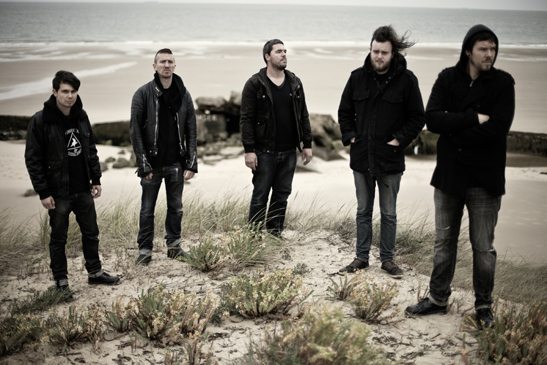
Amenra is one of my favourite bands ever. Their bleak, dark and grim sounding mix of sludge, doom and post-metal always hits the right emotions in me. It was also my first ever review for Ech(((o)))es and Dust when I reviewed their Live album. The Belgium band has been going for many years and is involved in various musical and artistic projects. I asked singer Colin H. van Eeckhout some questions about the band, Church of Ra, his art and their upcoming show as part of Beyond the Redshift festival.
(((o))): Hello Colin, thank you very much for doing this interview with Ech(((o)))es and Dust. First of all, you are one of the founding members of Amenra. Do you remember how it all started?
Colin: I played my first show with Kristof J. Mondy (also founder/ex-bass) when I was 14 (‘92/’93). That wasn’t Amenra yet. It took us a while to form ourselves, to know what we really wanted. So in a way it started then.
Amenra itself got formed in 1999. We hooked up with Mathieu J. Vandekerckhove (guitars) around ‘97 when he joined our band ‘Spineless’, we called it quits in ‘99 and he brought us to Bjorn J. Lebon (drums).
We knew we wanted something different than what we were used to in Belgium. We wanted to be part of something bigger than a band.
(((o))): I love the whole community feeling I get from reading about Church of Ra, about the gigs/tours you all organise together and how lots of people are guest musicians on each other’s recordings. How did the Church of Ra community develop and who is involved in this?
Colin: It started when Amenra started working with different artists of all sorts. We met a lot of kindred spirits along the way, and connected with them. We started working together in different projects with Amenra and sideprojects Kingdom, Syndrome, etc. When Lennart Bossu (guitars) and Levy Seynaeve (bass) joined Amenra, Oathbreaker and Hessian got formed. We worked together with Tomas Lootens and Valentijn Goethals, from Webecameaware for layouts artwork etc, they are also in The Black Heart Rebellion. Treha Sektori from Paris also works with us a lot. I started talking to him in 2009, and soon thereafter we formed Sembler Deah. New projects CHVE, Harlowe, Caan, Darak, Wiegedood are being formed. Through the years photographers like Stefaan Temmerman, Jeroen Mylle, Thomas Sweertvaegher worked with us as well, dancer choreographer Thomas Steyaert, visual artist/graphic designer Tine Guns and so much more.
Church Of Ra isn’t quite about namedropping, everyone we work with and supports us in any way are a big part in who we are today.
(((o))): You are playing the Beyond the Redshift festival in London, which has an amazing line-up. What does it mean for Amenra to be part of this?
Colin: I saw one of the best shows in my life at the Forum in London, Neurosis with Jarboe. It’s a great honor for us to be standing on that stage. I’m really stoked, more and more festivals of that pedigree are being formed.
(((o))): Are there any other bands you are looking forward to seeing at Beyond the Redshift?
Colin: Not really.
(((o))): What can we expect from your show at Beyond the Redshift? Will there be new material in your set?
Colin: No we won’t play any new material, no. You can expect the same thing as always. An honest representation of the band Amenra.
(((o))): You are obviously a very interesting artist and I take it you are a lot involved in designing the Amenra cover art and posters, t-shirts etc?
Colin: I make all the decisions concerning the visual and philosophical aspect of Amenra before I take it to the group in its entirety. Except for the live visuals, that’s Mathieu’s area of expertise.
(((o))): A lot of the Amenra art looks very bleak, dark and grim and it fits the music just perfectly. Where do you get your inspiration?
Colin: Everything I see around me or happened to me through the course of life. Everything that brings a person to his/her knees.
(((o))): Do you have an artistic background, like did you go to art school or anything like that, or is it something you’ve developed all by yourself over the years?
Colin: No one in Amenra has a background in art or music. We’re self-taught. But we cannot deny we get great deals of help from other people. As far as the graphic side goes.
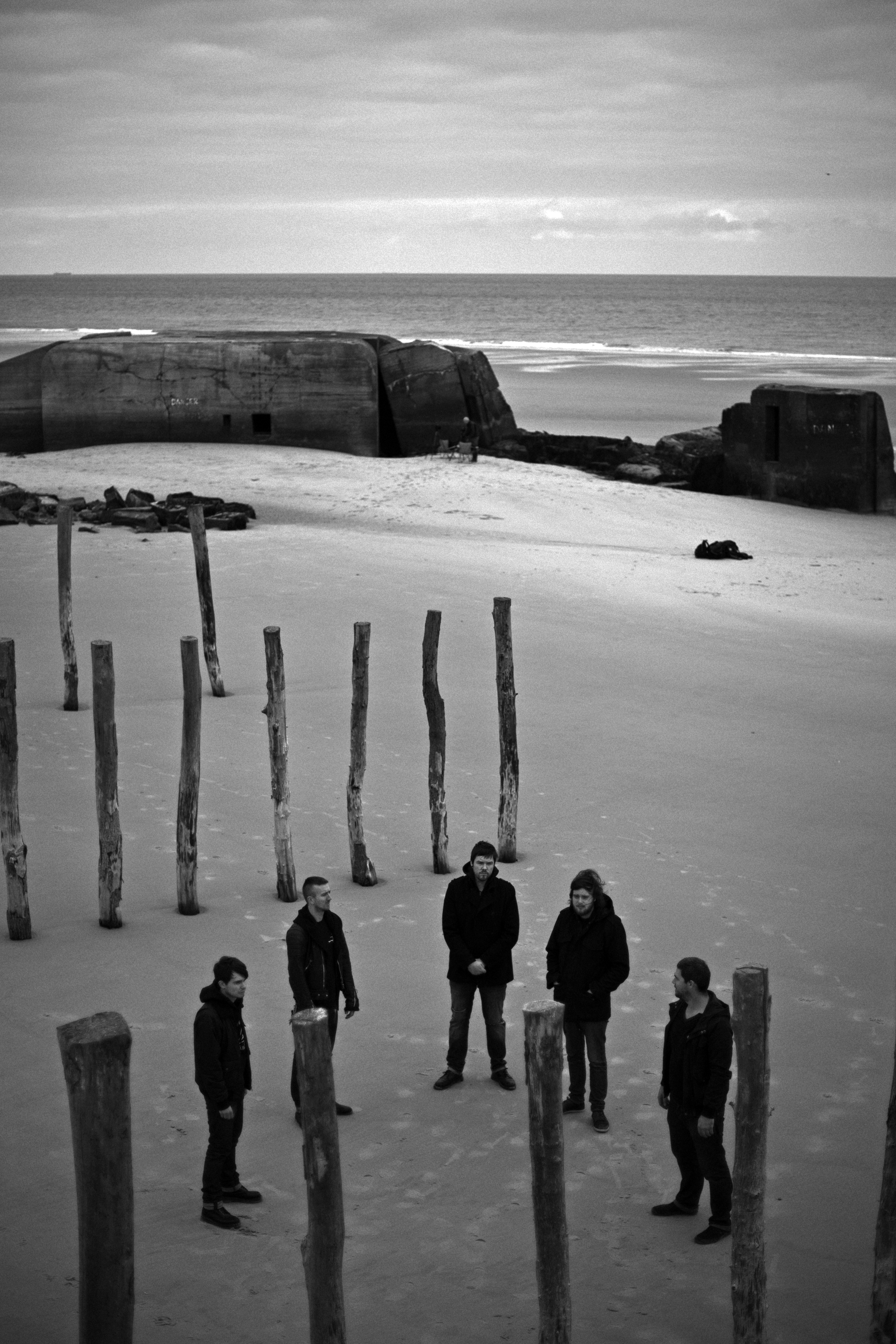
(((o))): I really love the whole Amenra package. The music, the artwork, the posters, the videos, it is all part of the experience. How difficult is it to get everything to work perfectly together?
Colin: Extremely difficult, and what makes it difficult is it takes an awful lot of time. We’re musicians, but our work doesn’t end when a new album is written. We do everything ourselves from beginning to end. And we all do this besides our full time jobs, and family life.
(((o))): Amenra is not a black metal band, but the grim atmosphere it breathes all over the artwork can make people think Amenra is another Norwegian black metal band or something. Do you ever get mixed up? Do you or any of the other Amenra guys listen to black metal at all?
Colin: I think Levy and Lennart have some musical knowledge in that direction. Levy started a “black metal” band not so long ago, called Wiegedood. You’ll hear about that soon.
It is true you can find some grey areas in both worlds, the no compromise lo fi recording for instance, the sincerity of it, the importance of esthetics, and so forth.
(((o))): What can we expect from Amenra this year? When can we expect a new release?
Colin: Depends what you see as ‘a release’. Amenra releases something new every couple of months. Now we have two split 10 inches coming with Eleanora and Treha Sektori, another split 12” with VVOVNDS, live DVDs, a second live album on vinyl and CD. We’re also working on our second book, and on an ambient album and art film. We’re working on a next Mass as well as a second acoustic album.
(((o))): Colin, you are obviously involved in a lot of other musical projects, at least your Facebook page mentions a lot of them. How do you find the time and inspiration to be so heavily involved?
Colin: I know I won’t be around for a long time, and I feel I have to make the little time I have worthwhile. We all have to answer to the force that drives us.
(((o))): I’ve noticed that there are quite some fans with Amenra tattoos, using logos and album artwork. What does this mean to you?
Colin: I am truly honoured that people put so much faith and trust in what we do. We will do everything within our might, to not or never let them down. It urges us to fight hard for them. We make each other stronger.
(((o))): And related to this, and I just have to ask this as I am intrigued, what is the meaning behind the huge piece you have tattooed on your back?
Colin: Let’s call this our talisman. A visual representation in what I believe in. It gives me strength and protects my family.
(((o))): Coming back to Amenra’s music. You are one of not the favourite band within the sludge/post-metal genre for me. I can’t listen to Amenra without getting emotionally involved and I can’t therefore not listen to your music all the time. I have to be in the right state of mind. Have you ever cried listening to your own music?
Colin: More than you can imagine. Sometimes after a show, twice on stage. It depends on the mental state.
(((o))): What music does emotionally hit you?
Colin: Music that comes from the heart, music that heals. Whatever style or genre.
(((o))): On a lighter note, I absolutely love Belgium beers. Are you a beer drinker? If you are, what are your favourite beers we should know about?
Colin: I’m not. I’ve been straight edge for over 20 years now, meaning I don’t drink, smoke or do drugs at all. Same goes for Lennart. You might want to ask the other band members about beer.
(((o))): What is it like to be part of the Neurot family now? And are you still involved with the ConSouling Sounds as well?
Colin: Neurot, ConSouling, Hypertension Records, all the labels back us up like no other. But it’s a fact that we really felt like coming home, when we got signed to Neurot.

Monolord's debut album Empress Rising is one of those releases that just completely blew me away when I first listened to it. This resulted in a very positive review and I was eager to find our more about this Swedish heavy psychedelic fuzz creating doom band. I asked guitarist Thomas V. Jäger a bunch of questions.
(((o))): Can you introduce Monolord to our readers please, like who’s in the band playing what?
Thomas: Hey, of course. Esben Willems plays fuzz drums, Mika Häkki plays fuzz bass and I play fuzz guitar.
(((o))): You play heavy crushing doom but with a huge psychedelic older 70’s feeling to it. Would you agree with this?
Thomas: Yeah I guess so. As said in other interviews, we didn’t really decide what genre to play. It is just a classic ‘go with the flow approach’.
”Hey, let’s tune down to b and play some heavy stuff?”
”YEAH!”
The result is this album.
(((o))): Let me just take the opportunity to congratulate you with your album Empress Rising. It’s an amazing release and I’m sure it will end up high on the end of the year lists, especially with fans of doom. Did you expect it to be received so well?
Thomas: A massive THANKS! We felt that the songs were really good and that was one of the main reasons we decided to make more of it than just a side project. The first song we wrote was ‘Empress Rising’ and that set the tone for the rest of the songs.
(((o))): Is there an underlying message you want to tell us with Empress Rising, or was the whole purpose of the album purely to melt our faces in a hypnotic doom induced trance?
Thomas: Face melting was our primary goal; just to make a record that was really really heavy. No other boundaries were set. Just bring out the heavy and play a riff for four minutes with just a couple of small variations. Then add another riff for four minutes and keep it going until the end for another four minutes.
(((o))): How does a Monolord song develop? Do you guys simply jam endlessly till there are some riffs that just feel right or is there a person in the band who writes everything or parts of songs and then takes these into the practice room?
Thomas: I have had ideas for a doom band since… well maybe almost 10 years back. The main riff for ‘Audhumbla’ is about 6 or 7 years old. It was in my riff vault and was dying to get out.
The first 10-15 minutes (or more) at rehearsal, we jam. That sometimes leads to parts that we use. Or, someone brings a riff or a song to the rehearsal room. We play it through and everyone is putting their ideas and creative touches into it.
(((o))): Can you tell me something about the gear Monolord uses? What sort of effect pedals for example? Are they custom made to create the heavy fuzz guitar sound?
Thomas: Mika and myself really like pedals and effect boxes. But we have no more room on our pedal boards. The main fuzz pedal I use is the Boss hyper fuzz. It just sounds evil and I feel good every time I stomp it in. And I rely on my Suzuki Flying Vee’s. Mika mostly uses a fuzz by Death by Audio that really fits his sound perfect.
(((o))): How did you end up on EasyRider Records?
Thomas: I was checking EasyRider Records out on Instagram at first. I contacted Daniel, mailed him the first demo version of ‘Empress Rising’. He said to come back when we have more songs. I sent a rough mix of the album a few months later and he liked that a lot. And then it was on!
 (((o))): Who made the cover art for Empress Rising and what particular Empress does she depict?
Thomas: The cover was made by this awesome dude called Nik Dudokovic. We had some ideas that we mailed him. He sent us back an idea and we went from that to the whole artwork. Lots and lots of mail were sent. It was almost insane at some point. But it turned out really really well. We had a feeling of this old hag that he made come to life perfectly.
(((o))): What is the Swedish music scene like? I’ve noticed a lot of good and heavy music coming out of Sweden lately, but also from other Scandinavian countries. What’s going on over there?
Thomas: We get this question a lot. I really don’t know why Scandinavia has so much good music. It is exploding on so many levels and in so many genres. I don’t have any good answer. But it is actually pretty easy to get a rehearsal room. That might be one answer. The one we have is not big, or fancy, but we do all our recordings there.
(((o))): What’s so special about Swedish meatballs?
Thomas: Nothing really. We don’t eat meat. Animals are friends, and we do not eat them.
(((o))): If you had a time machine, what 10 gigs would you go back in time for and why?
Thomas: Black Sabbath. With Bill Ward. Without Bill there’s no Sabbath. DO YOU HEAR ME?!? BILL SABBATH!!!!
(((o))): If you were asked to organise your own one-day festival, who would you ask to play?
Thomas: I would mix the perfect blend of rock and heavy. The Hellacopters (RIP), Gluecifer (also RIP), Goatsnake, Conan, Moon Curse, Blue Oyster Cult doing the entire Secret Treaties album and Status Quo only playing the extended version of ‘Forty-Five Hundred Times’.
(((o))): How does a Monolord live gig look like?
Thomas: Lots of smoke, green light, rumbling bass, pounding drums and the guitar, fuzzed out into oblivion.
Well actually, we are playing our first gig, the release for the album in Gothenburg, the 12th of April.
(((o))): Any plans to do an UK or EU tour anytime soon? If you do I’d love you to play in Scotland!
Thomas: There are some plans in the making but nothing for your ears or eyes at this moment. But, we wanna tour everywhere and all the time. Stay tuned for that.
(((o))): Thank you very much for your time! All the best with the new record and I hope to catch you live at some point!
Thomas: Cheers!
‘This is Shenandoah by Disturbed Earth’, said the DJ. ‘Before that you heard Coir’. As the deep drone ramped up a member of the audience turned to the artist to compliment him on the track. He thanked her for the comment and they began a conversation about his upcoming musical projects. ‘By the way’ she then asked, ‘what time is it where you are?’
It’s fair to say that, for The Beatles, Shea Stadium was a significant step up from the Cavern Club. Their sudden stratospheric popularity meant that the show was an easy sell-out and, on the 15th August 1965 fifty-five thousand Beatlemaniacs duly filed into the ground. Unfortunately, while the fans were there for the Fab Four, the technology wasn’t. Vox had created special 100-watt amplifiers for the tour but they were hopelessly inadequate for an open-air concert in a ground that had actually been designed for sporting events. John and co ended up playing their instruments through the PA system.
Technology caught up in short order and by the time The Beatles finished with live performances, stadium gigs had become de rigeur for any band of decent size and the additional wattage available meant that for some genres, notably hard and progressive rock, arenas were the definitive musical space. Just over ten years after the Shea Stadium whisper-gig, The Who made the record for the loudest gig ever, a thundering assault of a concert that measured120db from fifty feet away. Like The Beatles, The Who were playing at a sport arena (Charlton Athletic’s Valley Stadium). Unlike The Beatles, the Who had the kit to handle it. Like acoustic amplification and electrification before it, technology helped music get louder.
Which is all well and good for loud sounds, but what of quieter music? For some styles, even a small venue just isn’t intimate enough. I attended an ambient gig once, in the back room of a pub. There were far fewer than fifty thousand people there but it was still too much. Every clink of a glass, every cough threatened to interrupt the performance. As each track ended, the applause, while deserved, felt almost apologetic. And conversation? Forget it. Ambient is music for headphones. It’s a personal experience, almost the antithesis of stadium rock.
But if technology can rescue music at the higher end of the decibel chart, it can do so in the single figure region too. The availability of online gigs (in reality, live improvisation) on places such as Livestream and on internet radio means that the pleasures of live music; its flexibility, imperfection and improvisation, can be enjoyed in private spaces, even in your own living room. I’ve enjoyed many live performances in this way and I’ve found that the privacy has enabled me to pay closer attention to the music and to hear every sweet detail. It’s ambient music at the interesting end of Brian Eno’s originating maxim.
There is, of course, more to gigs than that. They should be communal experiences, shared moments of musical enjoyment. If they are small enough you should be able to interact with the performer. If you like what he or she is playing, you want to tell them. If you’re happy to have the mystery broken, you can even ask them how they achieved the sound.
That too can be done online. The use of chat rooms means that online performances can be shared. They have become a private communal experience.
Take the conversation quoted at the top of this piece. It was taken from a session of Nightscaping, a regular dark ambient show hosted by ambient artist Har. He presents the show on audio via Stillstream and in video on Livestream. It, like many such shows, is a quiet, comfortable affair (your correspondent often listens from the natural comfort of his bed). Strictly speaking, it’s a radio show featuring live in-studio performances, but there is something else. The chatrooms meant that, wherever the ‘attendees’ were listening from, Melbourne, Los Angeles, Leicester, they could join in and enjoy the experience together. They could talk about the music without talking over it.
That global aspect is yet another advantage. For those of us who can no longer get out to gigs, or who live way off the trail of touring bands, the online experience offers an opportunity to participate in the improvisational musical experience without engaging babysitters or booking hotel rooms. They are, if you like, gigs of convenience, inclusive and inviting to anyone with an internet connection.
Private and communal. Intimate and global. Singular and inclusive. The experience is a patchwork of contradictions that nevertheless make sense. They aren’t likely to replace real eyeball-to-eyeball concerts and the technology required to transmit moshpit sweat online remains beyond the power of even the smartest boffins but if you’re looking for a quiet and personal gig-going experience, you’re only a click away and, unlike The Beatles, we already have the technology to achieve it.
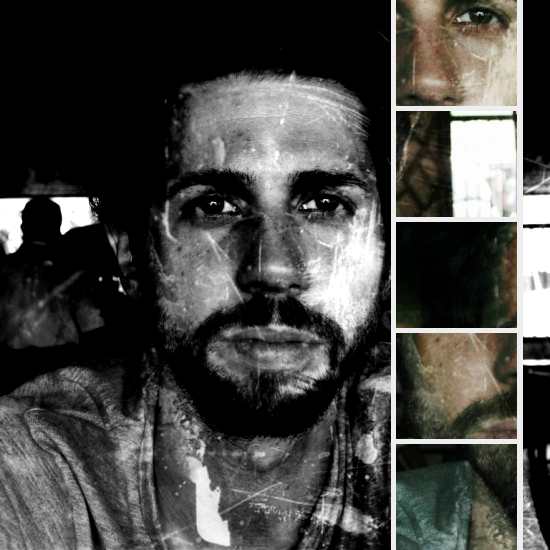
Row Boat's new album, In Between, is out through perennial E&D favourite label Fluttery Records on April 11th. On the eve of its launch, we sent Daniela Patrizi to talk to the man behind the boat, Mark Wardale.
(((o))): Hi Mark, how are you? How's your weekend?
Mark: Hei! I’m great thanks! I’ve been spending the weekend putting final touches in place with my son for an epic Mother’s Day for my wife. I also got £75 cashback on car insurance too..so a pretty successful weekend I would say!
(((o))): How’s life in Yorkshire?
Mark: Well the sun is starting to creep from behind the clouds finally, which makes life a little bit easier here. I’m not sure what other people think of us Yorkshire folk, apart from that apparently we put a capital ‘T’ at the beginning of lots of words, like “T’int” (is not), “T’other day” (the other day) and of course “goin’ dahn t’ nick” (I’m quite poorly & I don’t seem to be getting any better).
sorry…….shall we begin?
(((o))): Really? Never heard before about that ‘T’ and it sounds funny! As you know I really appreciate your music and the passion you transmit through your songs and I’m very curious to know what inspires you most. Starting at the very beginning, how did you get into producing music and when?
Mark: Well I started writing at a very young age. But before then I was picking up my father’s guitars (he was always performing as a singer when I was younger), then I picked up drumsticks from the age of 10. I was in a few bands, one of the bigger named “Some Are Saints” which was an original rock band but we struggled after our original singer left. After that disbanded in 2008 I concentrated on more of my own influences which was more ambient, progressive and post material. This is when ‘Row Boat’ came about mid 2009 originally more of an experiment really.
(((o))): Where your band name come from?
Mark: ‘Row Boat’ is taken from a Sigur Rós track off the ‘með suð í eyrum við spilum endalaust’ album called ‘Ára bátur’. It was inspired by the song but isn’t a direct translation. I wanted to have creative rights on the split of the wording as I found it much more open to interpretation.
(((o))): Which instruments do you play?
Mark: This is where people stop reading and say “yeah right ok”. Ok so believe it or not my main instrument is the drums. I’ve played many styles over the years, which has helped me adapt Row Boat into something new on every release thus far. I also play the bass and electric guitar (although I mainly play the electric guitar with a violin bow and have different guitars with strings removed to create differences). I am competent on the keys, violin, and pretty much most percussion. I am also a producer so I do a lot of mixing, remixing and mastering for other musicians and bands.
(((o))): Which band would you say you are most like?
Mark: I wouldn’t like to say personally. People can obviously hear influences of Sigur Ros in my work and I have had the odd “Sigur Ros called and want their B-Sides back” comment haha, but that doesn’t really bother me. That one made me chuckle into my cup of tea. I don’t suppose The Strokes’ huge hit ‘Last Night’ was influenced either by Tom Petty & The Heartbreakers ‘American Girl’!
(((o))): Looking at your discography there's no doubt that you've been really productive recently. Have you ever thought “this is what life was made for”?
Mark: Amongst other things, yes, music IS what life is made for. I have a wonderful and supportive family that let me be creative and they even contribute towards it too. I couldn’t of asked for a better outcome. They also accept that I am a music junkie and complete weirdo sometimes in what I listen too. I don’t keep up with the charts, which is a big deal in the UK. Having said that, it has helped create more of a family atmosphere and supportive network (even across the globe) for independent artists. I feel this is stronger than ever. I digress.
(((o))): Have you ever been so moved by a song that you cried? If so, what was it?
Mark: Yes. Absolutely. I could name a lot. “Hyperballad” by Bjork stands out though. I was talking to a friend recently about this, and its not exactly lyrically amazing in content, but the way she sings the melody on the track just evokes something I can’t explain. More recently “Old Skin” by Olufur Arnalds…..Damn that one really got to me from the first bar.
(((o))): You recently released 'Shallow Waters'. The title itself is really interesting. Which is the concept behind it?
Mark: The title didn’t come about until after the EP was written. Normally I do things a little backwards and have endless lists of potential song titles and album names etc. Once the track listing came together it was very clear it had a very Nordic feel to it. For a short while it was named ‘Berserker’ ( after the old Viking warrior helmets) then my wife Veto’d (which she is allowed to do as she is very good with these kind of things) and said that when she heard the opening track it reminded her of some Long Boat coming out of the fog. From there names were put forward like Blue Waters etc. Just before the release, Daniel Tuttle at Bottle Imp came to me and said well how about “Shallow Waters”. It stuck immediately.
(((o))): Should you pick a song from 'Shallow Waters' to listen to right now, which one would you choose and why?
Mark: I would say that “Orkan” is by far the most interesting track on there. It encompasses everything to do with the EP itself. There’s a lot going on in this track, including subtle vocals, violins, heavy reverb on guitars and some organs.
(((o))): ETT is considered one of the best post rock/ambient album of 2013 and Row Boat one of the best new artists. What does it mean to you? Did you expect so great recognition?
Mark: It was one of my greatest achievements by far. There were so many artists last year that released such powerful albums like 65daysofstatic, Mogwai, Sigur Ros, GWFAA and Umber. To be rubbing shoulders with artists like this is an honor. I have to thank everybody that voted, bought, listened or even mentioned in passing anything to do with “Ett”, otherwise it just wouldn’t of received such recognition. I certainly didn’t expect the album to be as big as it was and it was wonderful for people to say such nice things about it. I was lucky to find Dan at Bottle Imp Productions who thought it was worthy of release, for that I am indebted to him for.
(((o))): I really like 'Fracture', the split EP you realized in collaboration with Apta. How did this project come about?
Mark: The idea was put out there about remixing each other’s tracks and releasing an E.P. Obviously I jumped at the opportunity to remix one of Barry’s (APTA) songs. Barry came back with his remix of ‘Kampaglod’ from my album and I was blown away.
(((o))): I think that the way you and Apta complement each other is brilliant. How did you guys first meet, and what persuaded you to work together?
Mark: Barry Smethurst (APTA) is a very smart and respected musician who uses a lot of synth and ambience and I’m a fan of his work. He’s released some epic songs, featured on advertisements with the visitdenmark.com team and he really knows his music. I’d finished work on ‘Ett’ and I was working on some remixes for ‘umber’ and ‘Amnion’ at the time and I was still in recording mode really off the back of the album.
(((o))): How was the recording of the album for you – fun? Would you do it again?
Mark: Recording is not always fun. If your not dedicated, patient and passionate about what you’re doing it will never work. Recording ‘Shallow Waters’ was pretty straight forward though for some reason. Everything just fell into place at the right time. I have been recording pretty much back to back now for a full year since ‘Ett’. And after the recent E.P was done I went straight onto recording my latest album ‘In Between’. I imagine I’ll continue with work on a 3rd album but for now I’m just going to take a short break and take in and appreciate what other’s are releasing at the moment.
(((o))): What are your thoughts of composing a soundtrack for a film? And what kind of a film would it be?
Mark: Man alive that’s something I am just waiting for. If an opportunity came along and it was right, then I’d take it. I recently did a film score for Bottle Imp Productions for a short film festival titled ‘Lingering’. It was a whole new experience for me and I learnt a lot. But I would like to pursue this further as I think music and film are clearly the perfect accompaniment. I think I’d be willing to do anything that was creative enough or for a good cause.
(((o))): What do you listen to when you’re not writing music?
Mark: Well, depends what day it is! Today my playlist includes Riceboy Sleeps, Steve Gibbs & Cyrus Reynolds, and EF. Tomorrow it could be anything from Talking Heads, Donkeyboy, Agent Fresco or ALT J. I’ve grown up surrounded by a lot of Prog Rock like Jethro Tull, Genesis and YES. Then as I grew up through the 90’s my elder brother influenced me with Manic Street Preachers. It’s such a mish-mash combination, but it all still works for me and are pretty inspiring in so many different ways. I’m also a sucker for nostalgia. I love listening back to music that takes me to a certain place/era/situation within my life.
(((o))): I know you are working on a new album right now. What inspires you in this case? Can you describe it for us?
Mark: I’m generally inspired by Scandinavia. My wife Annika has her Swedish roots, yet I was sold on Norway before we met. That’s a bone of contention in our household. But there are other things too, like Love (sorry). We all share that one thing in common in whatever way. I don’t write about ‘love’ as such but about Romance. My 2nd album was really a combination of influences, but I wanted to show that I don’t just write about the same thing. Someone recently described my next album as “a matter of intimacy” between yourself and music. I think that’s a lovely way to put it.
(((o))): Are there things you can only express through music?
Mark: Wow that’s some question. Maybe for some yes. Music is an art or form of expression, just as much as speaking. In fact it’s probably as affective in certain ways. If you can make somebody relate to a piece of music without even having any lyrical content in, then music must be one of the most incredible tools at our own disposal. For me, music speaks to me just as much and I have a great deal of respect for what other musicians do with their gift.
(((o))): You started also writing about music and I was very curious to read your words. Being a musician, is it hard to write about other artist's albums?
Mark: It’s a very different world. Your opinions are important to anybody that wants to know about a particular piece of music or band. It’s also as important to the artists themselves. They probably spent hours on end creating something they feel is worthy of others to listen to. So picking the right words becomes incredibly important. If I like something, if it catches my attention, I would want to tell people my opinions. But if it wasn’t up my street, then what’s the point? I’d rather be constructive than just scribble “Joe Blogg’s new album sounds like it was recorded in Stink-ville!”
(((o))): Is there something you want to add? Any particular curiosity you want to share with us?
Mark: Yeah sure. If you decide to drink hot water with a squeeze of fresh lemon juice, make sure you use a straw, as then you won’t get the natural acids on your teeth! You’re welcome.
(((o))): Thank you very much for your time. We look forward to hearing from you again soon.
Mark: Thank you 🙂
Extreme heavy doom band Of Spire & Throne is about to release their new EP Toll of the Wound on US label Broken Limbs Recordings. I am very excited about this as the band is based in Edinburgh and I've seen them live many times and I've always enjoyed their shows and music. I asked guitarist/singer Ali Lauder a bit more about the band, their music and the new EP.
(((o))): Tell me about the band. Who’s in Of Spire & Throne and how did the band come together?
Ali: Of Spire & Throne is Matt Davies on bass, Ali Lauder on guitar and vocals and Graham Stewart on drums. The band came together gradually as my friend and ex-guitarist Steve and I started exploring slower and weightier sounds around the mid 2000s (we'd been making music since high school). After a few years of finding our sound we eventually met Graham through our original bass player Nick, and played our first gig and recorded our demo shortly after in 2009. Matt replaced Nick in 2010 and we changed to a 3-piece in March 2013.
(((o))): How would you describe your music?
Ali: Unrelentingly heavy, punishing and difficult.
(((o))): How does an Of Spire & Throne song develop?
Ali: Most songs start as riffs that I hear in my head - usually at a really inconvenient time like in the shower! I might get a burst of parts or maybe just a couple of riffs. I'll work on these then bring them to practice and we'll slowly jam them and knock them into shape. A song's not finished until we get the right feeling from it, so it can take a long time until we know it's done. We're constantly making tweaks and changes.
(((o))): You recently did a UK tour with Dutch post-metal sludgers Ortega. How was Of Spire & Throne received during this tour?
Ali: I think we were received pretty well at all of the gigs. We met a lot of really cool people who had positive things to say which was great.
(((o))): Do you have any particular highlights of that tour?
Ali: Glasgow was the best gig for us. We were running late and I got stranded in the middle of the gridlocked motorway. I was bursting for a piss so I jumped out to go against a pillar on the motorway and then the traffic started moving when I was in mid-flow. I ran after the van to catch up then tripped over and fell flat on my face and put a hole in my hand. I was fucking raging by the time we got to the venue so we did a particularly brutal set. Another highlight would have to be Newcastle because playing there is awesome and we stayed up after the gig drinking Buckfast and watching my favourite film, Highlander. Ortega may or may not have been wearing animal onesies too.
(((o))): Will you go over to The Netherlands and mainland Europe to tour with Ortega or some other band there?
Ali: I'm hoping we can do some gigs in Europe soon and would love to play with Ortega again. Playing mainland Europe might not happen for a while, but it's part of my plans for the future. We've got a few things we need to cross off our to-do list first though.
(((o))): How difficult is it for an Edinburgh-based band to get some recognition in the vastly growing UK doom metal scene?
Ali: I'm not sure to be honest, but I don't think where a band is based has that much to with it. I think there are a lot of factors that come into play - how active the band is, how active your local scene is, who you know and sometimes luck. Recognition can come off the back of playing a certain gig or getting a review from a certain place. So far we've just tried to focus on keeping busy and doing our own thing.
(((o))): You got recently signed by Broken Limbs Recordings. I was honestly surprised to hear this news and it is extremely exciting to see a local Edinburgh band getting signed by an US label. Can you tell us how this deal was done?
Ali: Well firstly, we're not signed to Broken Limbs. We're working together to co-release the new Of Spire & Throne EP, Toll of the Wound, which is still super exciting, but it's not as grand as being 'signed'. I'm not 100% sure how Pete at Broken Limbs came across our stuff, but I think it was off the back of the tour with Ortega or the split-tape Tartarus Records (Richard from Ortega's cassette label) put out. Pete got in touch and asked what we were up to and after a few emails back and forth we agreed to work together to put the new EP out.
(((o))): Where was Toll of the Wound recorded?
Ali: We originally recorded the EP completely by ourselves with the help of my good buddy, bandmate (in my other band, Acatalepsy) and all-round musical genius, Will. We had to abandon recording a couple of times for various reasons before we decided to keep one of the songs we'd done with Will and re-record the other two at Chamber Studio in Edinburgh, run by Graeme Young.
(((o))): Can you tell us more about this EP release?
Toll of the Wound is just over 30 minutes long, with 3 songs in total. It sounds huge and brutal and features some new sounds we've never explored before. It'll be available on vinyl, tape, CD and digital download and is released on May 13.
(((o))): Will there be more releases on Broken Limbs in the future, like a full-length for example?
Ali: I couldn't say. We're off to record an album in November but we've not talked about release plans yet. We'd certainly be interested in working with Broken Limbs again.
(((o))): Ok, so what inspires Of Spire & Throne?
Ali: For me, inspiration comes from a search for a particular sound and feel, and finding a place to explore all of the things that weigh on my mind. It's hard to pin down, but I feel that in creating the music I'm able to tap into something and find a place for a lot of worries and woes.
(((o))): Are there any bands from your local scene our readers should check out?
Ali: There's plenty, but right now I'm going to mention Jackal-Headed Guard of the Dead, an Edinburgh 3-piece who make smoked-out, instrumental, Lovecraftian space doom, or something like that! I got their new album Exaanum last weekend and have been listening to it constantly ever since. It's raw and heavy, tripped-out and packed full of great riffs and well-written songs. It's got a real 'don't give a fuck' sound, which I haven't heard in a long time. Check it out!
(((o))): Will you go to the US for some gigs now you’re releasing your EP by a US label?
Ali: I'd love to go to the US to tour, but we have nothing planned right now.
(((o))): What have you planned for the rest of this year?
Ali: We have a few local gigs coming up, including one with Primitive Man and Opium Lord in June, and we're putting a tour together in support of Toll of the Wound. We're also working on our new album, which we'll be recording in November.
(((o))): Thank you very much for your time. Is there anything you would like to add?
Ali: Thanks a lot for the interview Sander and thanks to everyone who supports us! If you're a promoter please get in touch as we're always on the lookout for gigs and still looking for dates for our tour. We hope you all like Toll of the Wound.
Cheers!

John Wesley is a name familiar to most in the prog community. His live work with Porcupine Tree, co-writer with ex-Marillion singer Fish and his own solo work are testaments to his abilities and skills as a side man and solo man. With his latest album, Disconnect (reviewed here), we asked John about the state of prog in 2014 and just what it was like working with prog royalty.
(((o))): You began you career in the early 1980’s, a time when progressive music had suffered the backlash from punk and new wave. Why do you think that 34 years later, in 2014, progressive music is experiencing such resurgence in popularity?
John: There are several reasons really, number one is that people are tired, worn out from insincerity and cloning, lack of effort. I love a great pop song, but a clone of a clone of clone of great pop song can be very wearing. The other reason is access, now more than ever in history people have choice, not only can you find great progressive music, but you find exactly the niche of the great progressive music or just music in general that speaks to you. That give artists more chance to be free and cater to their own muse, knowing that the audience may be smaller, but more in tune with what they as artists can offer.
(((o))): 'Any Old Saint' features a guitar solo that, to my ears, rivals Gilmour's 'Comfortably Numb' solo in terms of emotion and dynamics. How do you create a solo? Do you sit down and write them out methodically or is it a stream of consciousness jams and refined later?
John: I was a frustrated vocalist for most of the 1980’s, I wrote lyrics that were sang by someone else because I had not developed my voice. The guitar for me became that voice and I gravitated towards players like Gilmour and Lifeson and Beck that conveyed emotion and melody through the solos. I hear melodies... and after I have written the vocals, I sometimes hear a continuation of the vocal theme in subject matter and melody. In a song like ‘Any Old Saint’, I had said with the words all I could say verbally, but I was hearing more in my head...so yes the solos are developed as “stream of consciousness jams” and then the motifs that speak the most are brought out to create the body of the solos. I don’t really “write” solos, it is all very stream of conscious expression.
(((o))): You've worked with some notable names in the prog world. What are the pros and cons of being a supporting artist within an established band/artist as opposed to being the focal point in the solo career?
John: The pros are that you get to tour and play. And I love to tour and play, which brings me to the biggest con… You can become so caught up in bringing someone else’s vision to life... that you lose focus on your own vision. That happened a lot with me. I loved those gigs and all of those shows, and so I was happy internally. I was always writing and recording, but never focused on my own vision enough to get that vision to the forefront. Also the time factor is a con, I literally spent years focusing on the vision of others, which was incredible. I loved every minute of it, but at the expense of my own writing. Now I seem to have found a balance, because there is a balance where both worlds can exist. I can honor my vision and still be a part of another’s vision and “all will be well in the shire” (spot the prog joke...)!
(((o))): You were the primary co-writer on Fish's album Fellini Days, which features one of my fav prog tracks of all time, 'Clock Moves Sideways'. What was that experience like working with him?
John: Fish is a “Big man”! By that I mean...big personality, big ideas and a big vision...and he can be big fun! So in the studio he has a lot of ideas...very stream of conscious ...to the point that some days he would come in with ideas that were so far out it overwhelmed me. So to work with an artist that is so creative, you have to learn to take a step back when the ideas get so far out that you can’t process them and try to corral them in your head. Then channel them in a way that makes sense to the songs...and his vision. The danger is that if you don’t carefully “edit the idea stream”, you run the risk of losing some great moments in the maelstrom. You have to be careful to not over edit as well. You don’t want to lose that gem; you have to really work to find it in the stream. I was very tired when I finished that album!
(((o))): Your latest album Disconnect features a captivating blend of sounds and styles. Do you find that writing songs comes naturally or do you have to "work" at it? Is there ever a point when it feels like a struggle to articulate an idea?
John: I have to work at it… nothing comes easy. Some things come faster than others and require less editing as ideas. But I do at times struggle and then other times it is like magic, as if some “music fairy” just taps me with wand and the song is there. Of course on the Fish album it wasn’t the music fairy tapping me, it was usually Fish tapping me on the shoulder and saying, “ PUB!, It’s time for a pint of 70 laddy, off we go...”.

(((o))): Lyrically you've been likened to Roger Waters. How do you go about writing lyrics? Do they start with a theme or concept?
John: In my twenties I was looking for more streamlined methods of writing, I guess we always are searching really, and I started to read a lot of Hemingway. He was very good about sharing his methods and one of the things I adopted was “periods of input and output”. This develops into the flow of in and out so that you are always writing...sometimes taking in all around you, observing, meeting people, sitting and having a beer with them as you take in their story, reading, watching the news, and just listening really. Then all of that cooks in your brain as you go about your days and themes and concepts start to assemble subconsciously. Then I do the same sort of thing on the guitar...search for ideas and melodies that speak to me...and then the two worlds start to meld. Some guitar parts will start to connect with words and things will happen. As on Disconnect, there was no thought of that theme at the beginning, but unbeknownst to me... one was taking shape internally because I was observing so many forms of Disconnect all around me. When I took a step back and looked at the collection of songs...there it was.
(((o))): What is your earliest musical memory?
John: My mom playing the piano, she always played to us when we were little, and she would sing to us.
(((o))): If you could only listen to one album for the rest of your life, which one would it be and why?
John: Wish You Were Here. It is not my favorite album of all time...it just has enough of all the elements musically and lyrically I would need to keep me happy.
(((o))): Much has been said over the past 15 years about the negative and positive effects of illegal downloads on the music industry and on individual musicians. What are your thoughts on the subject?
John: Pandora’s box here... I could go on for hours. People that download your music for free and don’t pay for it...were never going to pay for it to begin with. They just don’t care enough about you to see you do well, they were only ever going to pay for music of the masses, the music that is was either properly promoted so you had access to it or it was pushed upon them by the labels. It is a double-edged sword. Now we have the ability to choose exactly the music we like, and the creators have had the gatekeepers removed and now more people can make music than ever before. But that also means less people pay for music... and income creation and sustainability for artists is the lowest that it has been in many years. It’s a true problem, so on one hand… it was good in that it shook everything up, but on the other hand… now we can barely afford to create.
(((o))): Other than your own, what is your favourite song(s) to play?
John: I really love playing the Incident as piece on the last Porcupine Tree tour...I found it really enjoyable.
(((o))): What does 2014 hold for you?
John: Hopefully some shows... touring... more new music... more shows....
(((o))): What are you currently listening to?
John: Today it was Amplifier’s Echo Street.
(((o))): Is there anything else you'd like to share with our readers?
John: I hope you enjoy the album and get to come out to a show... we hope to see you all soon!

Dutch thrash metal four-piece Legion or the Damned recently released their new album Ravenous Plague. Andrew Rawlinson asked singer Maurice Swinkels some questions for Ech(((0)))es and Dust.
(((o))): So according to your biography you formed in 2004, how did the band originally meet?
Maurice: The band was already formed in 1990, we only changed the name in 2006 to Legion of the damned, before that period it was under the name Occult, in 2004 we recorded our album Elegy for the Weak, which later was released as Feel the Blade!
(((o))): Did you name yourselves after the Warhammer 40000 regiment and if so did/do you collect any armies?
Maurice: Legion of the Damned is indeed a game as well, or whatever Warhammer is, but we got the term out of World War II.
(((o))): Apart from the obvious bands who else has influenced you?
Maurice: Some thrash bands from Germany that never got so big like Exhumer and Darkness, but also underground bands like Sathanas from the US.
(((o))): What has been the highlight of your career so far?
Maurice: There are many: Wacken Open Air, our South American tour, playing Graspop, playing the Sweden Rock Boat.
(((o))): Where did you find/meet your new guitarist Twan Van Geel?
Maurice: I know Twan already for several years, we have been playing together at a Chuck Schuldiner (Death) benefit concert in 2001. So I really quickly had him in mind, gave him a call and he said yes to the job.
(((o))): Apart from this change in guitarist did you change any other approach to Ravenous Plague?
Maurice: We wrote this album for 2 guitars, previous albums have always been written for just 1 guitar, but many of the songs were already done for Ravenous Plague even before we knew we wanted to put another guitar player on it. So the next album will be fully written for 2 guitars.
(((o))): Where do you get inspiration for the lyrics and especially the song titles?
Maurice: They are personally as well as from books.
(((o))): Can you tell us about the metal scene in Holland and how it has changed since you started?
Maurice: We have some pretty good bands, I think holland always had a strong packed of bands, they changed over the years though, but we have killer bands like Pentacle, Asphyx, Hail of bullets, Pestilence etc.
(((o))): According to Wikipedia the special edition of 2008's Cult of the Dead came with a block of cheese? Is this true and if so how well did it go down with the fans (as it were) and do you have other plans for interesting products?
Maurice: It was a funny idea of our manager, he wanted to include something really "Dutch". I do not even like cheese haha, but it's a cutting block in wood with our logo on it. It was limited to only 300 pieces I think. Descent Into Chaos had a goat like figure as statue, also limited to 300. The new album came in limited earbooks of only 500 copies.
(((o))): You’re given the opportunity to create your own festival. What would be the first five bands on your list?
Maurice: Devil Doll (even though they do not even play live), The Moon Lay Hidden Beneath a Cloud (although they are RIP), Gae Bolg, Combichrist and Rotting Christ.
(((o))): Are they any places you have yet to play that you really want to?
Maurice: I would love to play Japan once 🙂
(((o))): What are your goals for 2014?
Maurice: There are not really any goals, we just going to play some festivals and we will take it from there.
(((O))) FEATURED INTERVIEW
I’ve had some real problems in my lifetime dealing and living with mental health issues. I’ve not really felt comfortable talking about it until more recently. I feel like it’s important to talk about these things because people consider them ‘awkward’ topics. I used writing music as a means to channel it and I felt a lot better for writing music and going to shows and being able to put my time and energy into something I loved so much really helped me.