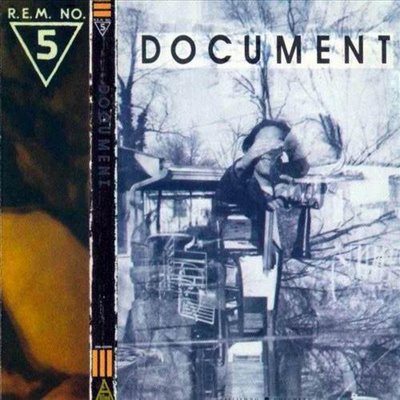
In the second of our occasional series looking back rather than forwards, Martyn Coppack reassess the impact of one of REM’s finest moments.
Although the remit of Echoes of the Past may be a chance to bring to the attention albums which may have escaped notice in the past it is sometimes necessary to remind people of albums which have been overshadowed by events surrounding it. In the case of my first choice for inclusion it is a couple of hit singles which, whilst remaining classic songs, tend to lead listeners away from the overall album. In a way, this article is a guiding post for the casual REM fan that may own the Best of collection or have never looked any further back than ‘Out of Time’ or ‘Automatic for the People’. Hopefully it will also act as a reminder of the music that was produced by this great band before they hit megastardom.
Many of you reading this will no doubt own or have heard this album. It is rightly regarded as one of their classics in a body of work containing many. You may be one of those people who just don’t like the band, that’s fair enough, but at least take the time to finish reading. I can pretty much guarantee that all of you will have heard at least two songs off this album. ‘The One I Love’ and ‘It’s the End of the World As We Know It’ are ubiquitous and have been heavily rotated at REM gigs, MTV, radio…they are part of popular culture. What we are here to look at are the other songs on this album. Songs which mark a turning point in REM’s fortunes whilst still retaining the garage rock influence which formed their sound. It is an album which sounds almost disparate in its delivery ranging from harmonic pop to off the wall almost jazz exploits and in-between, the building blocks of what would become known as the classic REM sound. If you own it, go ahead; put it on now before reading further.
The year is 1987. REM have steadily been growing in stature over the course of five albums (An opportunity not afforded to today’s bands – Ed). They have become the college rock darlings of America but remain an underground proposition in the UK. The glory years of ‘Losing My Religion’ are still a gleam in the eye of Michael Stipe and their music retains a rough edge hewn from touring up and down the country with the likes of Black Flag. ‘Document’ has just been released and Michael Stipe is sitting in his kitchen back home in Athens, Georgia having a cup of tea with Henry Rollins. A strange mix, you may think, but over the last seven years, REM and Rollins’ band, Black Flag have been touring partners and have unwittingly started a musical revolution in the US, the impact of which is still sending its shockwaves today.
The phone rings, it is the record company with the midweek sales figures. Stipe puts the phone down and asks Rollins what the figures mean. They are numbers he can’t ascertain in his mind. They are numbers which now mean that REM have moved from the underground to national acceptance. Stipe’s reaction…a nonchalant shrug and continues his cup of tea and discussion about hardcore music. It is this relaxed attitude that will carry the band through the biggest phase of their career and allow them to keep their integrity and not sell out. How did this happen? Well, a hit single certainly helped (and possibly the most misunderstood single ever) but then bands have hit singles all the time. There must have been something more that attracted people and so it is to ‘Document’ that we look for further evidence.
From the opening blast of first song, ‘Finest Worksong’, anyone who had followed REM up to this point would have nodded their heads and noted a progression from the last album, ‘Life’s Rich Pageant’ (another album which I feel belongs in this section of our favourite online magazine). Here was a song which built on the likes of ‘These Days’ and introduced a bigger production. With its grinding riffs and soaring chorus it set the benchmark for the rest of the album. It was a far cry from the garage rock thrash of ‘Radio Free Europe’, this one sounded like it was meant to be hollered out in stadiums across the world. Stipe’s lyrics were clearer too, although not much more understandable. It is, in short, a battle cry to the underground independent movement that times were changing.
Following this is ‘Welcome To The Occupation’, one of the most under rated songs in the REM canon. With lyrics signalling a political turn, it hinges on a chiming Peter Buck riff which defined REM’s sound back then and in the future. It is a strange song which is delivered almost monotonously until Stipe starts pleading “listen to me…” towards the end. Dark, brooding but filled with the pop sensibility that would influence countless indie bands over the next twenty years. ‘Document’ had set its stall out…REM meant business.
It is now that the first curveball is thrown. ‘Exhuming McCarthy’ jars the mood of the album introducing jaunty saxophones, overlapping vocals and bouncy keyboards. For those of you who have heard ‘Out Of Time’ this would be no surprise but back in 1987 it was a left turn for the band. It also allowed them to open the album up into something much more diverse from their previous efforts. REM could now take this album into new territories which were not altogether very pop friendly.
‘Disturbance At The Heron House’ returns to the mood of the first two songs (and remains my favourite REM song to this day). A song about revolution or the failure to act on it, it would become a familiar theme with its peak arriving on their most political album, ‘Around The Sun’. ‘Strange’ follows, a cover of an old Wire song, allowing REM to pay their respects to their heroes and also bring some symbiosis by integrating with another subversively political band.
Whilst a newfound political aspect does underlie ‘Document’, this wasn’t the first time that REM had dabbled with matters outside of music. ‘Life’s Rich Pageant’ had included themes of conservation, one which would come to the fore on their next album ‘Green’. Maybe it was being touring partners with Henry Rollins and his crew that instilled this stance into the band. It is also more than possible that it was a riposte against Reagan’s America. ‘It’s The End Of The World’ is almost comical in its delivery but suits the mood of a new America, one which has had enough of all the craziness.
Which leads onto ‘Fireplace’ and its plea of “crazy, crazy world”. Totally unlike anything else on the album, its free flowing saxophone ending taking the song into jazz territory, it marks second half of an album which contains some of the least played, yet more original songs, in their oeuvre. ‘Lightning Hopkins’ builds itself over an almost hip hop beat into a sort of sub-Talking Heads missive. Obscure lyrics are met with singalong harmonies and the guitars are kept to a minimum. It is only when the next song, ‘King Of Birds’ starts, that this starts to make sense. This is the sound of a band breaking out of their previous set boundaries and embracing a sound which will open much more possibilities. The introduction of sitar predates the acoustic loveliness of ‘Out Of Time’ by four years but would not sound of place on that album. It will be this experimental edge which will seduce the masses in what must be one of the biggest ironies of modern music.
Fire plays a big part in ‘Document’. From the well known verse in ‘One I Love’ to the title of ‘Fireplace’ we are once again introduced to it in ‘Oddfellows Local 151.’ Carried by Mike Mills bass part, it is almost funky and its lyrics of meeting at a “firehouse” are wilfully obscure and could be about any number of things. Why does the word “fire” turn up so much though? It is certainly not lazy songwriting as this is something that REM could never be accused of. It certainly fits in with the political and revolutionary feel of the album. What it does more than anything is tie together a group of songs which looked at separately would never wilfully fit on an album together. It is almost as if the fire is a signal of rebirth as well. Much as fire opened up more possibilities for cavemen, here it is a symbol of REM discovering new paths of music.
So there we have it, how many of you have just rediscovered the joys of this album once again? Do you think it really deserves to be introduced as a “lost” album. I have made my reasons for including this album and through the course of writing this have listened to it a further three times. Each listen has brought forth more aspects which I would have liked to have written about. Maybe I’ll keep that for another day…in the meantime I am going to listen to the extra tracks on the re-issue which highlight another part of REM which deserves mention, the live show. Thank you for reading, and next time I will write about something a bit more obscure, I have some ideas but you will just have to wait and see.