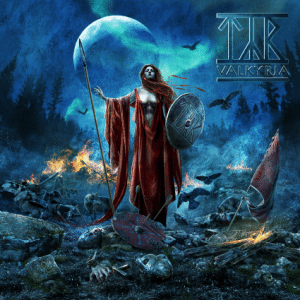
Faroe Islands natives Týr are amongst the longest lasting line-ups in hard music, and are back with their 7th album Valkyrja
At this point it becomes a bit tricky to categorise this album. Yes it's a perfect representation of the metal genre. But it's also prog, a song cycle, oratorio, or indeed a romantic era ballet opera. The album retells the Valkyrie saga of northern European mythology, from a single vikings point of view; and delivers this big story, with big sounds, and perfect harmonies. Almost everything constructed like the most academic of classical scores, whilst under lain with the signature Týr sound. Valkyrja took over a year to write and record, with lyrics and melody lines coming last, whilst under the gaze of Jacob Hansen of the Hansen studios in Ribe, Denmark.
It is simply... perfect.
Delving into the album in a little more detail:
Opening track ‘Blood of Heroes’ dives straight in with the bands signature back line, and leaves us with no doubt who we are hearing, whilst sweeping us up and signing us on for the ride. It serves as both overture and scene setting for Valkyrje as a whole, and steps oratorio style into our first character exposition with ‘Mare of My Night’. The story continues its sweep through the saga with ‘Hell Hath No Fury’, the balladic ‘The Lay of Our Love’ (which also features the voice of Liv Kristine of Leaves’ Eyes, in duet with Týr lead vocalist Heri Joensen); Before the pace steps back up with ‘Nation’ and ‘Another Fallen Brother’. We are stilled by the interjection of the glorious ‘Grindavísan’, the first of the albums tracks not in English.
‘Grindavísan’ is a fantastical mixture of classical choral tradition, baroque basso continuo, and the band's signature back line. In spite of the drive engaged, the track is sombre and slow paced, with the choral and lyrical guitar passages mirroring and playing off each other, stretching time and leaving the impression of a much longer piece. The whole begins and ends with the same unaccompanied hymnal chorus, giving both the sensation of this track as bridge between the over and underworlds of the saga (life and (point of) death) and acts one and two of the album itself.
Act two kicks off firmly with the journey to the dark side in ‘Into the Sky’. This is followed with the folk like (structure and instrumental sound) ‘Fánar Burtur Brandaljód’. At the end the pace returns to the metal oeuvre, and segues into the harder still ‘Lady of the Slain’. This appears to provide the conclusion of the saga in both sound and structure, until the title track ‘Valkyrja’ steps in, dropping the pace back and summing up the story, almost describing the preceding whole as a dream sequence. The language becomes much more modern, and we see the tale with modern rather than an ancient viking’s eyes. Then comes ‘Where Eagles Dare’ with a touch of the indulgent prog drum solo, and which acts as a pair in modernity to its predecessor, whilst pulling us firmly to the afterlife with the warriors of the tale. A summation to the album, this is the track where we are sat fire side with the bard holding court before the chief, firmly in the tale space.
A softer coda, the final track ‘Cemetery Gates’ is a reflection from the warriors point of view (possibly he was the story teller). He sees himself in old age and, believing that their daring deed has not paid off, that he has given his soul for no return save memories and a regret. He concludes that he will not ever be heading for Valhalla’s Halls. The sound returns firmly to the metal, with screeching guitar and vocals battling, and the impression that with his death the valkyrje swoops in for him as the only fade out of the album creeps in to claim us.