By Owen Coggins
Over the last few years, Sly and the Family Drone have built up a reputation for unconventional and radically participatory live performances: drums and cymbals handed out all over the place, audience members becoming parts of the crashing and lurching many-headed monster of relentless percussion noise. Here, on new recording Unnecessary Woe, the band make their first attempt to translate this deconstructive ethos into a ‘proper’ album.
First track ‘Handed Cack’ is five minutes of introductory hissing tapes and ominous clattering, reminiscent of some of Skull Defekts’ more abstract meanderings. It’s as if the lights have been switched off at the studio and everyone has gone home, and the discarded leftover small noises are tentatively emerging from the crevices to reclaim centre stage in the dark. The creeping scratches and hums start out like animal moans, become squeaking wheels, then morph into things stranger and less recognisable, the tiny details and infinitely varied grey tones stretched, investigated and transformed.
From these disparate echoes and rattlings, a reverberating, thudding beat hatches into the extended ‘Grey Meat,’ the most focused and insistent track of the three. The muffled but insistent rhythm collects around itself various discarded factory parts and bits of metal collected from the side of the North Circular, and sets off for an unknown destination amongst the darker corners of industrial estates and bleak urban parks.
The last track, ‘A Man That Could Look No Way But Downwards, With a Muck-Rake in His Hand’ is as drawn out as its title, seeming less focused than the other two pieces, and for the first period lacking the mysterious compulsive rhythms that make ‘Grey Meat’ such an interesting repeat listen. It can certainly be worth exploring areas of unmetered noises without an easy beat to latch onto, and done well this could fit with the slightly uneasy atmosphere that the Family Drone offer. But here the muttering and scratching stretches out for more than ten minutes without the mind-bending eruptions and dissolution of stable co-ordinates in, for example, Aufgehoben’s uses of some very similar noises.
At last, though, some collective muffled shouting rouses the mechanical beast, and another shapeshifting, many-faceted rhythm appears to propel us ten more minutes to the end of the record. The best parts here, as in the second track, are the places which show the band’s beguiling ability to create rhythms which are almost militantly industrial, but at the same time manage to swirl and mutate seamlessly into other shifting beats, destabilising the harsh metronomic tendencies with a playful but dark collective intelligence.
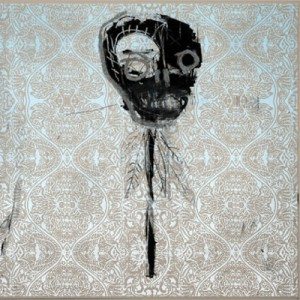
Overall the recording is more industrial-sounding than I expected, but like the best beat-driven industrial music, the listener is kept at an ambiguous and unnerving distance, suggesting strangeness and imminent catastrophe even in apparently comfortable metronomes and recognisable sounds. There are even slight hints of trancelike dance beats evoked, but as if uncertainly picked up at a distance, through traffic noise and late night drizzle. The tricky challenge of drawing a line between the band’s spontaneous live shows and a “first album” means that not all of this attempt is successful. However, this album is, like the striking artwork, a demented scrawl on some posh wallpaper, deeper and more arresting than it seems at first glance.