By: Martyn Coppack
There are certain key moments in a band’s life which end up defining them for the rest of their career. Most bands only manage one, whereas others become a byword for happenstance and live from day to day under an endless parade of media scrutiny as they lurch from one “happening” to another. Some moments are subtle, others hit like a sledgehammer, they all leave some sort of impact.
Perhaps the moments that mean the most are the accidental ones or the ones that you have no hand in altering. Def Leppard faced their fair share of these and one would have to be hard hearted to not to recognise how they rose again in the face of such adversity. Other moments become the defining point of a whole career and a band faces an uphill task in moving on. The loss of a key member tends to be the case here (although one could also point at a hit single that bears no relation to anything else in a band’s catalogue). They become the albatross around your neck and you’re forever destined to fight off those ever-tiring questions from lazy journalists and even fans.
Marillion faced this problem when their lead singer left. Having risen to the level of arena band on the back of a series of ever more successful albums, albeit forever labelled as unfashionable, the cards were marked and after what would be a final tour in support of their new album, Clutching At Straws, their singer Fish left the band. It was a moment akin to Peter Gabriel leaving Genesis. This was a defining point and one from which there was possibly no return.
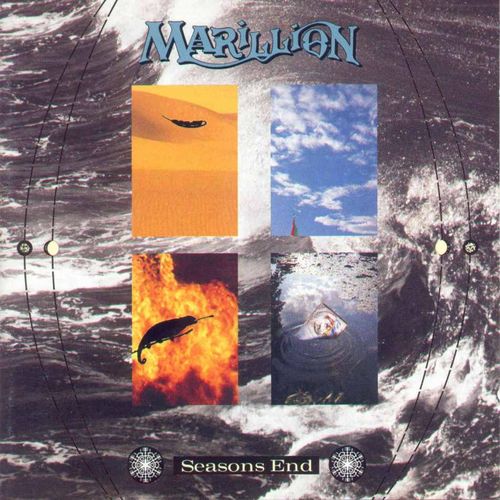 Like the proverbial phoenix from the ashes return they did though with new frontman Steve Hogarth in tow. No stranger to progressive music, Hogarth was enough of an unknown to not bring any baggage with him to the role and the first fruits of their labour, the excellent Seasons End, was both a link to what had gone before – with many of the songs having been in contention for the next album with Fish – plus a new-found freedom and thirst to explore. Even the cover indicated at this out with the old, in with the new and it would be the final call for the jester.
Moving on a couple of years and after an ill-advised (if not intermittently brilliant album) where they pandered to the record labels whim and tried to write hit songs, Marillion were at a crossroads in their career once again. Do they carry on trying to capture past glories and write pop songs or do they do what they really wanted to do. More than anything in their career so far, this would turn out to be a key moment and one that still reverberates for them today.
The decision they made was to forego any pandering to a hit single and instead create a piece of work which would stand up alongside their classic Misplaced Childhood. This would be a piece of work which, like that aforementioned album, would be a concept album – a suite of songs telling a story. It would be completely unfashionable and totally in thrall to progressive rock. It would in essence make Marillion uncool again. It would also be a masterpiece.
The concept of the album came from a news report that Hogarth had heard regarding a girl who was found wandering the Severn Bridge who had no recollection of who she was or why she was there. From this seed, Marillion created a fictional story which provided a back story to this event. Unlike their previous concept album though, which had a certain fantastical element to it amongst its political views, this album would be a much more emotional journey. It would be a brave move. The album would be called Brave.
Listening back to Brave now, it’s easy to see what an important part it holds in their back catalogue. At the time it was a complete side turn from Holidays In Eden, their prior album. If HiE had really been about Hogarth finding his place in the band as well as the other members trying to find a new way of playing, Brave would be the moment when they literally exploded with passion and incredible synchronisation. Go to a Marillion gig these days and watch the interaction between the members. This didn’t happen overnight but for that moment when they gained a new singer, it was Brave which cemented that legacy.
Brave is not recommended as a starting point for listening to Marillion as its 70 minutes are amongst some of the densest music they have ever committed to tape. Indeed, you would struggle to find anything more depressing and hard going in their library but by that reckoning you would also miss what amounts to their most fulfilling piece of work (and those words are not written lightly, this band have many highlights).
So what of the music? Well, it has an introductory sequence, a middle part and an end as you would expect. The opening part concerns the descent of our protagonist as she disappears into a netherworld of drugs and pain. A particularly striking sequence is the opium den when the band bring the music down to a whisper before striking out again as ‘Hard As Love’ makes a raucous entry. After this we get love and lives lost as Hogarth delivers a masterclass in storytelling set against a band who seem free from shackles once again and more than happy to indulge in their progressive tendencies. It’s hard to pick a single moment as the whole album depends on Steve Rothery, Mark Kelly, Pete Trewavas and Ian Mosley who create an emotional whirlwind of music as their ringmaster keeps things grounded throughout. It’s a remarkable change from the stilted Holidays In Eden, which relied too much on song structure and only really came to life on the final ‘This Town’ triptych.
One of the more interesting aspects of Brave was its use of a different ending on the vinyl version and depending on which groove the needle dropped into on side four, you would either get the uplifting ‘Made Again’ or the dark ending, which consisted of twenty minutes of waves crashing against the bridge. It was a gimmick but one which maybe highlights their new found independence with this being kept secret and so those early listeners wondering quite what had happened.
Whilst Marillion would go on to have many more key moments in their career, the release of Brave must surely count as the moment when they became the band they are today. Interestingly after this they attempted to move away from this sound on a further feature will look at the so-called “Castle” years. The band would continue to revisit Brave though, be it through an ill thought out film or during their weekend conventions when the whole album would get a play. It’s grown in stature throughout the years and easily stands alongside that other concept album they made as a defining point in their career. This one had no hit singles though. It’s an album which deserves to be listened to in one sitting and repeated listens introduce more elements to the story. Perhaps the final words should be as they are written on the album sleeve:
Play it loud and with the lights off.
Marillion will return for another Echoes Of The Past feature in the near future as we celebrate the work of an ever independent band.