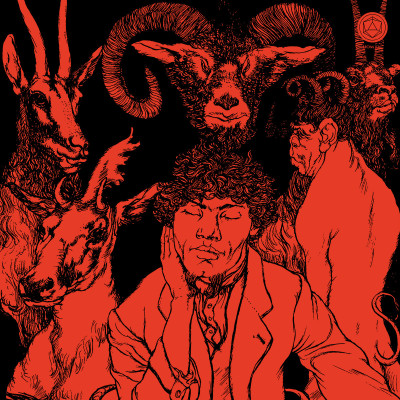
If there is any band that has deliberately strove to subvert expectations throughout their career, it’s Ulver. The wolves have explored every avenue available throughout their 30 years of existence to the extent that one has to wonder where Liminal Animals even fits – is it their 13th album? Do soundtracks count, or collaborations, or covers collections, or whatever ATGCLVLSSCAP was? Is it even an album in the traditional sense, given that the band had been steadily drip-feeding the tracks which would eventually comprise this collection over the past year?
Maybe the biggest surprise is that it marks another return to the noir synthpop sounds of The Assassination of Julius Caesar and Flowers Of Evil, marking one of the longest periods of stylistic consistency in the band’s career. Rather than simply repackaging old sounds and calling it a day, this feels like Ulver entering a period of stately reflection, digging out old snapshots from across their extensive past and piecing together a collage that remains remarkably cohesive when viewed as a whole.
Instrumentally, Liminal Animals won’t come as much of a shock to the system to anyone who has been paying attention. It’s a feast of bright, shimmering synths tinged with darkness, punchy basslines and Kris Rygg crooning at his soulful best, a voice so smooth and earthy that you’d swear a Norwegian forest on a crisp winter morning was singing directly to you. ‘Ghost Entry’ is a splash of pop perfection, palm-muted guitars rattling out a brisk disco beat as it slips in and out of ambient bliss and dancefloor-filling extravagance. ‘Hollywood Babylon’ adds a touch of menace to proceedings, a moody synth beat and a flash of 80s sleaze giving it the grimy charm of a giallo slasher, right up until Rygg’s defiant call of “Don’t fuck with America!” shows who the real target was all along.
Elsewhere, ‘Forgive Us’ peaks with a truly blistering performance from legendary jazz trumpeter Nils Petter Molvær, a flowing and energetic performance that calls to mind smoky, neon-lit bars; it makes Rygg and co.’s melodies seem almost rigid in comparison. Thankfully, the album’s two instrumental cuts abandon that clinical precision and stand as simply gorgeous inclusions, ‘Nocturne #’ harking back to Shadows Of The Sun-era ambiance and minimalist splendour, while ‘Nocturne #2’ is a sombre, gloomy little number that evolves into something almost wondrous, bright synth stabs and hazy swirls of sound (theremin, perhaps?) coming together to create a distinctive and enigmatic jam.
From a lyrical standpoint, Liminal Animals sees Ulver in a more literal mood than in recent years. While there are some motifs that have resurfaced, most notably on ‘Ghost Entry’ where Rygg’s tendency towards meta commentary (“Wolves wrote this / recorded this/ And today is Monday, June 21”) evokes the refrain of 2020 single ‘One Last Dance,’ the use of historical events and mythology as allegory are largely abandoned for a more direct approach. ‘Hollywood Babylon’ is a cutting assault on American culture as viewed from the outside, lines like “Stuff your face / Sing Hallelujah to the Lord” as blunt a commentary as Ulver have ever dared to utter, while the strains of paranoia on ‘The Red Light’ (“The new world order /Breaching the border / Swords of iron war”) likewise reflect the sense that this album is a natural reaction to a world that is becoming more fractured as it succumbs to cycles of violence and strife.
So, the burning question is whether or not this constitutes a great Ulver record, or merely a decent one, and much of that will likely come down to your individual perspective on who Ulver are (the Nattens Madrigal obsessives made up their minds about this album long before they heard it). For those who hoped that this time was when they would revert to their iconoclastic ways and rip up the rulebook once again, it might not set the world afire but it should still provide enough beauty, nostalgia and quality songwriting that they can’t rightly complain; for everyone else, it is another perfect example of wolves evolving, even if that development is a subtle one. It’s a little bit sleeker and glossier, but it also bears its fangs more readily and that alone makes it an essential listen.