Interview: Fågelle
There’s a freedom to how people approach music and art in Berlin as well and I wanted to bring that back with me. Now I am back I feel like I am in my own world. I feel very independent to do what I want and to really push my own ideas. There are definitely people around me who do interesting artistic stuff but we’re not in the same niche.
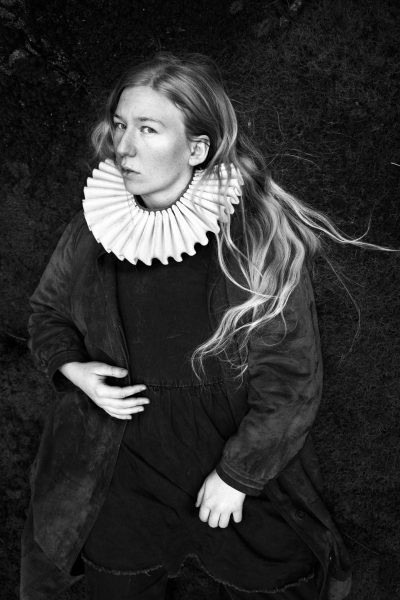
Sooner or later, everything returns to where it all began and the same is certainly true of Fågelle a.k.a. Klara Andersson. The Swedish composer and multi-instrumentalist has spent years living in Berlin and Gothenburg, honing her uniquely mesmerising blend of electronica, noise and neo-classical, but recently she has returned to her home region of Halland County in Southern Sweden. Her new full-length Bränn min jord is a tribute to that place, to home, and to the people who make up a community, utilising sound, dance, music and field recordings to create a beautiful yet ultimately invigorating snapshot of a region that has often gone neglected. David Bowes spoke to Andersson to discuss the record’s creation and purpose.
E&D: How have you found the reaction to the new album so far?
Klara: The record is a lot about my home region in the countryside and I feel like people who have been reviewing it or writing about it – well, some at least – have been reflecting on their own backgrounds. It’s so nice to open up a space to talk about something that’s maybe not so commonly talked about. That I really enjoy. It’s been given good feedback as well and people enjoy it for all different reasons, which is really nice.
E&D: You’re back in Halland now. Did you move back with an idea of making an album with this direction?
Klara: I moved back because for many different reasons but I think I was homesick. I was longing for my roots, to walk on the graveyards and see the names of my family members; to be where you belong, where you come from. This is a natural consequence of exploring that area again; wanting to see what was out there that I didn’t know already. I was really exploring my home region in a new way and finding people I did not know when I grew up there, which was really nice. It was organic.
E&D: With this album, do you feel it was a reflection of Halland in particular or more your own concept of ‘home’?
Klara: It’s very personal. I wouldn’t speak for Halland as a whole, that would be strange. I think that kind of local patriotism gets a bad rep sometimes because some people use it to not let other people in. I definitely think there’s a more open and inclusive way of being proud of where you come from. Also, you don’t have to be proud of it. You can just be like, “This is what it is” when it is good and bad. It exists and it matters and that’s maybe more important sometimes. It’s sad but I know a lot of the Swedish countryside, and countrysides all over the world, does not have representation. It’s often very generalised. You talk about ‘the countryside’ as one thing when actually, the more you zoom in the more different you realise that it is. Of course, because it’s different histories and different people. I also wanted to include a sample of, for example, the car culture that doesn’t have a good reputation, and some traditional folk melodies. The highs and lows.
E&D: I did spot that inclusion of EPA cars in the press release. Is that something that everyone in rural areas in Sweden grew up around?
Klara: I think there were some new laws passed not so long ago where you can make more normal cars into EPA cars so it’s much bigger culture now than when I grew up but definitely the moped, EPA car culture was there as well. It’s interesting because now, it’s how young people hang out. They don’t have a lot of meeting spots so they hang out in their cars in parking lots. That’s how they socialise and it’s their culture so I think it’s important to include.
E&D: Was it important then to have some of those recordings be made by the locals themselves?
Klara: In the village where I grew up I put microphones outside my parents’ house and drew cables from there. I was about to meet one guy but then his car broke down. I asked him if he had a friend as we had to do it that night. I had this remix I made of the song I wanted to be played through the EPA, so I had to drive into town and find someone. I walked up to these moped guys and I asked them if they knew anyone with an EPA car, they started calling people. It was really collaborative, somehow, and then they drove with me to my home village. I wanted to include them, it was nice and the guy who drove the car in the end, John Borglund, I met him at the release party and he got the CD. He’s thanked in the credits and everything. A lot of people played their parts in the making of this, it was really nice.
E&D: I did see you worked with a lot of people, musicians and dancers and the like. Was that a new experience for you? I understand that you typically see music as being quite solitary.
Klara: It was very new. It’s definitely a new point of view and it’s challenging sometimes but I really wanted to be open to that. I still have my own way of working where it’s hours and hours in the studio, very detailed, where it’s almost like sewing or handwork, that kind of craft. That’s still in there but I just wanted to be outside in the world and bring things in. It gives so much life to the album. The dancer Nathalie Ruiz, for example, she had these sketches of songs in her headphones and she was moving across this wooden floor. It was so interesting when I put that into the computer and laid it on, timed it up. It was all of these interesting percussive movements – a drummer wouldn’t do those things. It was very musical but in a different way. It was interesting and it gave me so much input. Also, the drummer Liam Amner gave me so much input in the way he grooves, his playing, and that really gave me a lot. It was definitely new working with people in that capacity but I really wanted to try it out. Also, it would have been weird if I wanted to be on my own doing a record about this area.
E&D: You did the ‘sound time capsule’ thing as well, which was compiled from 24 hours of recordings. How did that end up being used?
Klara: That was kind of its own project. It was definitely connected but I wanted to do that more as a sound art project, a document for the future. Maybe someday a hundred years from now a language researcher will use it to understand how we talked. You never know how material like that can be used. In the end, there’s this track where… if you don’t understand Swedish you don’t understand what she’s saying but it’s called ‘Stigen’ (The Path), where there’s a woman who is speaking, talking about the path. She’s making a metaphor to this place where she usually takes a walk, where it’s kind of very muddy and there are these signs that say ‘Don’t go off the path’ because you might get stuck. She’s talking about maybe you have to get off the path if you want to find your way home. That felt like such a beautiful metaphor for where I am right now, as an artist and as a person. That just came out of a conversation. We were recording and didn’t know who would come, and she came, read a poem she had written and then we started talking. It was a very strong, beautiful experience of meeting people and, at the same time, documenting something because that creates a sense of purpose, somehow. Even though you have super-casual conversations, it was very strong. People came with all kinds of conversation topics, things on their minds; it was a very cool experience.
E&D: Did you ever try anything like that anywhere else, like in Berlin or Gothenburg?
Klara: No, it just came to me that I wanted to do that. It would be totally interesting to do that in Berlin or in Gothenburg but this is a place that has its golden days behind it. It’s been the place where you move when you don’t have enough money to live in the city – that’s been the reputation. It is changing so it’s interesting that you have this ‘nowhere’ – what happens if you listen to that place? What does it mean to listen to a place that people think is completely irrelevant? Because of course, there’s so much interesting happening and so many interesting people there. I think that was the purpose of doing it in a place like that.
E&D: Do you find that you approach composition now in a different way to how you did in Berlin, for example?
Klara: Yeah, I feel very independent and I think Berlin has helped me with that. Being in Berlin also made me value where I come from, in a way. It’s a place of ex-pats and immigrants. Of course, there are people from Berlin and I know some of them but most people are not from there, so you all meet up and you sort of come together over the things you share and the things that are different where you come from. It really made me think about where I come from in a new way. You always see it because you’re not there anymore, you see it from a distance and that’s important. There’s a freedom to how people approach music and art in Berlin as well and I wanted to bring that back with me. Now I am back I feel like I am in my own world. I feel very independent to do what I want and to really push my own ideas. There are definitely people around me who do interesting artistic stuff but we’re not in the same niche.
E&D: One thing I love with this record is your way of bringing together organic instrumentation with these harsher, almost industrial sounds. Was that deliberate or is it something you naturally gravitate towards?
Klara: I think the acoustic things take up a little more space on this record than on the last two. You have a sense of a record or a song – what does it need, what does it not need – and I think I always want to be brave with the music I do in some way, not hide behind things, and then leaving things very acoustic and organic is sometimes the brave thing to do. But then sometimes going hard is the brave thing to do! I want to do what the song needs in every moment. But yeah, I think that’s such a beautiful combination, the very field recording-esque naturalistic mixed with electronic circuits, broken synthesisers – that’s the world I wanted to build, the palette. I love that. Also, the fact that I had certain types of spaces, the sound of rooms, the ambience of different places makes for a good canvas for those more sparse acoustic productions. You don’t have to fill it up so much. I have a tendency to fill things up in a very maximalistic way all the time so I really tried to hold myself back a bit.
E&D: Do you feel the same urge with live performances – to take up as much of the room, as much of the audience’s focus, as you can?
Klara: Definitely that. I don’t need it to be as detailed and full sonically. I feel like I am trying to kidnap people for the whole set. They will have to leave the room if they want to get out of it. It’s going to be as intense as possible as long as it’s happening. I like that. Live, you have these other colours to play with, the room and the tension, the silence and intensity. When I arrange the songs for live I almost feel like I am making a new version of the song. I can’t do a perfect replica live since I normally play solo, but even if I could it wouldn’t be the most interesting. I want to leave out the things that aren’t needed and just bring the essentials, keep it very powerful live.
E&D: What do you have in store for live performances? I see that you just played a show with Zu.
Klara: Yes, in Copenhagen. It was really nice. We’re planning some shows for the summer and especially fall. I think mostly Sweden in Spring, but it’s not completely set up yet. I will definitely perform this album, and others as well.
E&D: Are you quite comfortable with touring, or do you prefer to stay as a composer and work in the studio?
Klara: I really love both. They’re like complete opposites. When I’m in the studio I’m almost completely by myself, it’s very introverted, whereas touring is very extroverted. I really enjoy having both and would not like to have just one or the other.
E&D: Given that so much of this album is focused on home and roots, I was curious about your musical roots. What are your earliest musical memories?
Klara: We played a lot of music at home. My mom is very musical and loves jazz. She sings in a jazz band. Banging on the piano at home is probably my earliest; also, sitting at my grandfather’s electric piano and playing on that. Even though I play guitar on stage I feel like the piano is a safe space; to sit there and imagine things feels like home.
E&D: Do you have any other recordings planned?
Klara: I’m really excited to do some shorter projects. I’ve done three really big albums and for me they take three years to make, and I’m working those three years. It would be nice to do some weird, smaller projects and maybe some collaborations as well. Then I’m going to do a big dance performance with the dancer I started working with on the album. We’re going to do a show with Mats Gustafsson so that’s going to be very exciting. There’s a domino effect of working with this many people and I want to ride that out, see what comes out of it.