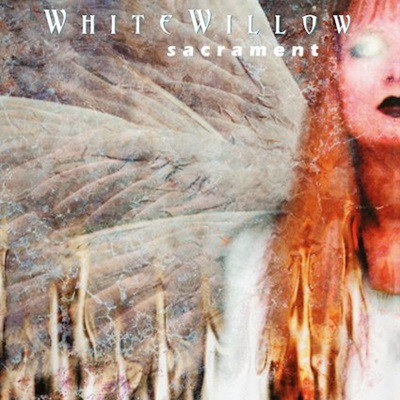
“I think it was a bit of a quantum leap from the first two albums”. Jacob Holm-Lupo describes in the 2014 notes from the Termo reissue of White Willow’s third album Sacrament. “We had rehearsed quite intensively for about a year before recording it, spending a lot of time on the arrangements”. There’s no denying that the band’s follow-up to Ex Tenebris was a leap forward to go into a delicate and complex release that the band originally released on Ken Golden’s label The Laser’s Edge nearly 25 years ago.
With its continuation of their catalog being in the hands of the Karisma label, it is time to give this album another shot once more to prove how much Willow are very well loved with their folky textures, doomy atmospheres, and progressive elements that’ll creep up behind you as if they’re telling strangely strange stories to scare their fellow campers shitless when it comes to the music.
The version of the band which had alongside guitarist, vocalist, and keyboardist Jacob Holm-Lupo, but vocalist Sylvia Erichsen, flautist Ketil Einarsen, bassist Johannes Sæbøe, keyboardist Brynjar Dambo, and drummer and percussionist Aage Moltke Schou. Michael Bennett’s design of the album cover says it all of an ice queen who’s on the brink of destroying everything that stands in her way.
Sacrament is best played in a darkened room with candles lit during the cold front between October and November when the weather starts to cool down with candles lit inside. ‘Anamnesis’ opens the album with a gentle, acoustic forest atmosphere as Sylvia’s angelic vocals walks into the beauty in all of its glory, evoking elements of Comus and Ketil’s flute improvisation of King Crimson’s ‘I Talk to the Wind’ for the first five minutes before it transcends into a brutal organ and menacing guitar line that speaks of the Phantom of the Opera.
Not the musical, but the book itself. Sylvia turns into this menacing character with her vocal lines as she sends listeners massive shivers down your spine before Lupo, Ketil, and Schou walk down the lair with her to see what kind of evil plan she has up her sleeves.
There are some nods to ‘Leaving the House of Thanatos’ in there as Willow continues the story by bringing it in full. When I think of ‘Paper Moon’ I think of the video game score to 2019’s Blasphemous that comes to mind Jacob envisions what the city of Cvstodia in all of its glory.
Once the keyboards spread massive amounts of wildfire from the synthesizers, Sylvia is teleporting its townsfolk across the universe with its warning that the end is near before taking several turns into Steve Hackett’s Voyage of the Acolyte that’ll make you wonder if he had written this piece for the band to give his stamp of approval to them.
After the first two tracks, they take a break from their electronic instruments into something medieval and renaissance-like with a waltz for ‘The Crucible’ to appear during its dance of death with unexpected twists that speak of New Trolls and Jethro Tull with wah-wah pedals galore thanks Ketil’s nod to both Ian Anderson and Vittorio De Scalzi. Followed by some wildly keyboard improvisation that have some Fusion syndication and Canterbury textures that’ll pop out of nowhere to get you excited.
Then, they head back to the forest once more as ‘The Last Rose of Summer’ starts to drop as the winter clouds starts to approach the Norwegian countryside for a break from the heatwave with its cottage side, waiting for the band to come in and several cups of tea and a delicious home-cooked meal that’s waiting for them.
With ‘Gnostalgia’ you can tell that Holm-Lupo is returning back to the Ex Tenebris years by proving to himself that he’s far from finished of the stories that he left off from the second album as he closes the book once more. Crossing over not just Comus’ First Utterance but Spirogyra’s Bells, Boots, & Shambles. The last four minutes is very much Sylvia envisioning the King who has now gone completely mental, can’t be sane as he looks outside of his kingdom before taking his life by taking a leap into the heavenly skies.
‘The Reach’ sounds like an eerie lullaby across the salty waters as if to hypnotize you to go into the ocean and head into an unknown city that has been undisclosed for a very long time with a sinister approach of ‘Ring around the Rosie’ which Sylvia repeats the nursery rhyme before the band take a deep dive into the obscure prog sounds of Marsupilami’s second and final album, Arena.
Lupo knows his source material very well and had listened to King Crimson’s Lizard for inspiration behind the closing track. But there are stronger binds to Camel, Gentle Giant, Unreal City, and of course the Italian progressive rock sounds of il Balletto di Bronzo that comes in handy. I was going to put Black Sabbath in there, but that would be too much of a cop-out for me to bring that up. This is the epic of all epics in which the band come together and duel with each other like there’s no tomorrow.
Karisma are halfway there with their continuation of White Willow’s catalog. But Sacrament is the album that puts you right in the middle of danger, horror, eerie stories coming to life, and the ascending nightmare that’ll take you closer to the edge and descend into madness.