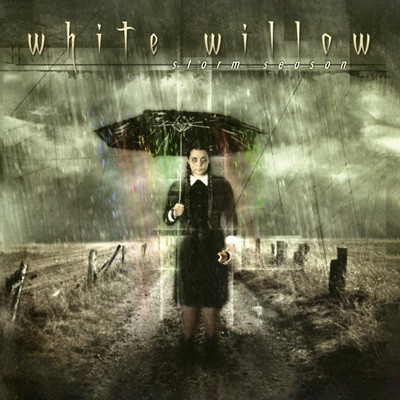
The continuation of White Willow’s reissue catalog from the Karisma label marches on. You feel that every time something magical happens inside Lupo’s head, you know that you are being a part of the Willow’s story. The band’s fourth studio album Storm Season blends in the massive thunderstorms that are approaching.
What Lupo wanted to was to make an album that was right in your face. “We wanted to create a stormy record”. Jacob explained to Bryan Reesman in the 2014 liner notes from Termo Records, “The heaviness wasn’t so much a pre-meditated thing as a natural consequence of wanting to make really dramatic music”.
White Willow didn’t want to be in the same league with fellow prog maestros Dream Theater and Queensrÿche, they wanted to be their own true form as of who they were when they formed in 1993. Storm Season marked a different taste in the band’s music. Blending in the folky, classic prog, hard rock, and an electronic approach to the fourth album which was originally released on Ken Golden’s label, The Laser’s Edge.
When Lars Fredrik Frøislie came on board to the Willow train, he and Lupo clicked right away when it came to keyboards. Lars’ usage of the mellotron, mini-Moog, synthesisers, Fender Rhodes, Wurlitzer, and the piano, gives it the electric jolt that is needed throughout the entire structure.
The opening flute ceremony Ketil does for the introduction on ‘Chemical Sunset’, sets up the dystopian nightmare that unfolds in front of the listeners eyes as Sylvia’s vocals detail the poisonous air, flowing across this once beloved city that was a place filled with beauty, has now become a battleground filled with destruction, greed, empathy, and betrayal.
If you think this all about love, peace, and flowers in your hair, think again. Lars’ Mellotron and Sigrun Eng’s cello arrangements, bring in the eruptive cannon blast that’s about to unfold thanks to the powder-kegging guitars setting up the clock-ticking momentum, never knowing on when the bomb will explode at any second.
The heart-beating pump throughout ‘Sally Left’ feels as if Willow’s continuing where they had left off on ‘Leaving the House of Thanatos’ from the Ex Tenebris years. You feel the ghostly figure of Sally, looking through all of the rubble that has been piling dust for centuries.
The mellotrons flow through the torture and pain she went through while it walks into some of the early Floyd counterparts, resembling ‘The Narrow Way’ textures on Ummagumma. You can imagine a young Jacob Holm-Lupo listening to this album, repeatedly for inspiration behind the second track and seeing the direction the Floyd were heading towards in their early years as an underground band.
And that’s what he wanted to do, pushing the envelope even further. After the first two pounding tracks, it takes a gentle, acoustic, lukewarm-folky approach with ‘Endless Science’. The passion pushes in these waltz-like dances Sylvia does by giving each of the band members, a chance to take it easy, go into these jazzy orientations with some classical, sun-rising approach.
Then, it backs into a brutal awakening for the ‘Soulburn’ to approach. Once they go into heavy riffs, all bets are completely off. White Willow go into this doom-metal prog-like charter plane that’s waiting for them. Finn Coren’s vocal structures, followed by Sylvia’s heart-pounding vocals, becomes a battle.
You feel the increasing temperature levels, the fire inside their souls, and the fight to be free from all of the trauma they’ve endured from. Once the climatic-midsection of the piece begins to hit, you know that they’ve in complete meltdown once the haunting images are brought to life.
White Willow details the scenery of Post-Traumatic Stress Disorder, into the very heart of it whilst Erichsen goes through the mystical forest, channeling the imagery of Marjana Semkina from iamthemorning with a mournful Hammond arrangement, bursting through the floodgates by staying awake in this atmospheric ‘Insomnia’.
The backward tape loop throughout the title-track, details someone inside Bludhaven in Gotham City, on the brink of collapse. The mellotron adds in more boiling temperatures to see one of the prisoners, prepare to go into an attack mode and make the prison, their own homing ground by ruling it with an iron fist.
The metal influences flow well as they burst the doors down with a massive bulldozer throughout the closing track ‘Nightside of Eden’. There are elements of Venom, Iron Maiden, Metallica’s Black Album-era, Boston, and of course, the Scorpions.
White Willow gets down to business once more when it comes to the new wave of British heavy metal, hard rock, and arena rock by imagining themselves, closing out the show with this song, getting audiences on their feet, singing along to the lyrical structures, knowing that their job is complete.
When the album was completed, the band had no idea how big it was going to be. “When we were done with the album”, Lupo explains to Reesman, “I had lost all perspective. So, I had no idea how it would be received. I remember being worried that both the heavier guitar sound and the dark atmosphere might put some fans off, so I was delighted when it was so well-received”.
The album sold over 10,000 copies when it was released 20 years ago. It remains one of those albums that you keep going back to see what kind of mysteries and hidden clues that Lupo has left behind for listeners to discover. And while it was the last album to feature Sylvia Erichsen before returning to the band with 2011’s Terminal Twilight, and the album cover itself bears some early striking resemblance of the Netflix series Wednesday, Storm Season is an album that refuses to die.