Even before we drop the digital needle on Ochre and Ash, an album which is designed to take the listener on a journey of life, ritual death and rebirth, there is a heck of a lot to unpack about Fauna.
They are pioneers of the so-called Cascadian black metal scene, named after the coniferous mountain range in the Pacific Northwest of the United States where they reside. They are shamanistic, atavistic and formed as an “antidote to the alienation of the human spirit” and to “open up spaces in feelings of continuity and familial connection with animals and plants can take hold, shaking us out of the sleep of scientific materialism”.
They also like hunting and since their formation in 2004 have had to defend themselves against false accusations of ecofascism and supporting ecoterrorism. The former rumour came about after they put a swastika-like rune symbol on an early issue of The Hunt (a concept album based around.. well, hunting). The latter sprung from various internet ne’er-do-wells extrapolating the former rumour – fuelled by the band’s forthright comments on land use and colonisation during live appearances (which they term as “rituals”).
Black metal is like that – it does tend to carry a bit of baggage, regardless of which end of the political spectrum a band may rest.
And this storied history and strong adherence to values which Fauna has make it even more disappointing when I discover that the album is dull.
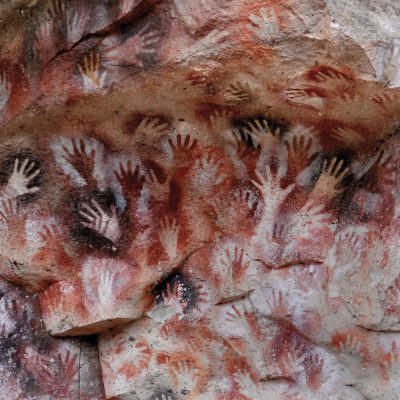
The concept of Ochre and Ash extends all the way to the cover art, which is a picture of a wall in La Cueva de las Manos (the Cave of the Hands) in Argentina. The hands are stencilled in ochre and ash and date back to about nine thousand years ago, a period when humans were hunter-gatherers, unimpeded by technology or science – and a time which Fauna have eulogised throughout their career.
And the weighty topic is matched by a girthy trio of songs. Although the album is divided into six tracks, it is meant to be consumed as three pieces, each of which start with unstructured sounding rituals, chants and rhythmic cycles, then traverse into squalls of black metal, which sometimes slows to the pace of funeral doom.
The intros, or first movements, or whatever you want to call them, are lengthy – the shortest is almost four and a half minutes long, while the opening one is more than six minutes – and apart from rhythmic percussion and small interludes of acoustic guitar, are borderline cacophonic. Call me a godless heathen who is too shallow for long meditative preambles, but it is a relief in each instance to finally get to some guitars.
But then when you get to the actual metal, you discover that it has the tone of being recorded under a thick mammoth hide. I know the trvest black metal is supposed to sound like it is being played through a sock via a cassette player, but even so. The production on Ochre and Ash make what could be some impactful atmospheric black metal into a foggy morass. ‘Labyrinths’, the most glacial of the three proper songs, could be a piece to get lost in with its extended section with near-clean guitars, followed by monolithic slabs of distortion and guttural, angst-ridden vocals, but the lack of a top end makes the listener question their speaker or headphone choice.
And as such, the production (and the lack of variation in ‘Nature in Madness’, the first track proper) makes 14-, 16- and 23-minute songs seem even longer. Which is a shame, because there are some genuinely redemptive and almost uplifting parts towards the end of ‘Eternal Return’, the final track, but many listeners would have got bored long before that.