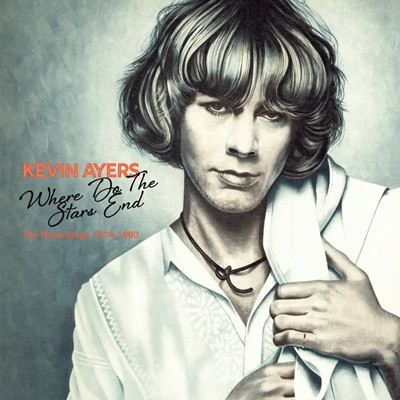
Where Do The Stars End: The Recordings 1974-1980 by Kevin Ayers
Release date: August 28, 2026Label: Esoteric Recordings
Continuing where All This Crazy Gift of Time left off two years ago, Esoteric Recordings now presents the next chapter in Kevin Ayers’ history. Where Do the Stars End is a 6‑CD clamshell box set covering his studio albums from 1974 to 1980, along with BBC radio sessions for John Peel and Pete Drummond, plus live recordings from Paris and Bremen.
By 1974, Ayers had left Harvest Records after releasing Bananamour, signing with Chris Blackwell’s Island Records for The Confessions of Dr. Dream and Other Stories and Sweet Deceiver. There was no bad blood with Harvest; as Shindig Magazine writer Michael Björn’s liner notes explain, Island simply made a better offer. And with The Confessions of Dr. Dream, Ayers nearly picked up where he left off after his Soft Machine years, though he had left the band in late 1968, the album revisits the surreal, theatrical sensibilities he helped establish in their earliest period.
Revisiting his Soft Machine roots, Dr. Dream channels the power and surrealism of his time on the French Riviera, where the band performed in 1967 during their early European dates. The album’s lineup reads like a who’s who: Mike Ratledge, Ollie Halsall, Michael Giles, Mike Oldfield, Doris Troy, Nico, Lol Coxhill, and producer Rupert Hine. Together, they help shape one of Ayers’ finest works.
The opening section of ‘Irreversible Neural Damage’ is a surreal nightmare, with Nico’s reverberating vocals evoking terror, schizophrenia, and the unraveling of a patient’s mind inside Dream’s laboratory. ‘Day By Day’ shifts into reggae‑funk warmth, honouring Syd Barrett’s lyrical textures with a joyful dance across the Riviera’s hottest beaches.
Halsall delivers a brutal, glam‑infused riff on ‘Didn’t Feel Lonely Till I Thought of You’, nodding to Lou Reed’s Transformer era and his own Patto years. Oldfield adds classical and bluesy touches to ‘Everybody’s Sometime and Some People’s All the Time Blues’, letting the Brazilian sun rise through Ayers’ melodies.
Ayers returns to Soft Machine territory on ‘It Begins with a Blessing/Once I Awakened/But It Ends with a Curse,’ reimagined here with a droning, Diamond Dogs‑era swagger and a dash of T. Rex. It’s chaotic, avant‑garde, and full of howls, screams, and an almost Alice Cooper‑like menace. ‘The Once Chance Dance’ briefly erupts into lunacy before Ratledge resurrects his fuzz‑tone organ, transforming it into a violin‑like Caribbean swirl reminiscent of Harry Nilsson’s Nilsson Schmilsson years.
The ‘Doctor Dream Theme’ closes the suite with a descent into a mental asylum where the inmates run the show. Ayers channels the darker side of Alice Cooper’s Killer era, portraying a man who will never be cured of his fractured state.
In 1975, Ayers entered the Sweet Deceiver period. Co‑produced with Halsall, the album leaned toward a more mainstream sound while retaining his whimsical charm. Although he enjoyed working with Ollie and Elton John, the direction pushed by Elton’s manager John Reid, aiming for fame and commercial success, left Ayers unhappy. Even Nick Kent, one of Ayers’ champions, dismissed the album in the NME, criticising its pop leanings and lighter lyrical approach.
Half a century later, Sweet Deceiver remains a different album, but not a bad one. You can hear Ayers preparing to leave Island and return to Harvest. ‘Toujours La Voyage’ is a romantic, gospel‑tinged drift across the Riviera, carried by Elton’s piano and Magnusson’s accordion. ‘Guru Banana’ is a jazzy, ragtime‑infused slice of vaudeville humour, catchy, quirky, and almost Betty Boop‑like, before the album shifts into a ska/reggae blast with ‘Once Upon an Ocean’.
After Island dropped him, Ayers returned to Harvest for his seventh studio album, Yes We Have No Mananas (So Get Your Mananas Today), released in June of 1976. Produced by Muff Winwood and featuring Rob Townsend, B.J. Cole, and Charlie McCracken, Ayers regained his footing. The album balances commercial appeal with Canterbury spirit. ‘Mr. Cool’ is a melodic pop tune with Halsall’s wah‑wah guitar adding funky sunshine to a tale of an arrogant romantic. ‘Star’ and ‘The Owl’ embrace doo‑wop and country‑rock textures, exploring fame’s cost and the sacrifices required to chase it.
‘Love’s Gonna Turn You Round’ feels like a return to Joy of a Toy, continuing the whimsical lineage of ‘The Lady Rachel’. ‘Ballad of Mr. Snake’ dives into smoky Parisian jazz with a roaring ’20s vibe before shifting into country charm, and ‘Help Me’ erupts with punk‑like urgency.
Ayers’ final Harvest albums, 1978’s Rainbow Takeaway and 1980’s That’s What You Get Babe, show him moving away from progressive and avant‑garde territory, exploring new genres with producers Anthony Moore (Henry Cow) and Graham Preskett (Mott the Hoople, Edwin Starr, Alan Parsons). Living in Dejá, Spain, Ayers distanced himself from the musical fashions of the era, searching for a new identity.
These albums contain wonderful moments: the doo‑wop title track ‘Rainbow Takeaway,’ the classical waltz ‘Strange Song,’ the funky pop‑reggae twists of ‘Goodnight Goodnight’ and ‘You Never Outrun Your Heart’, the film‑noir mystery of ‘That’s What You Get,’ and the existential rocker ‘Where Do I Go from Here’. He even honours the 1947 novelty tune ‘Cigarettes, Whiskey, and Wild Wild Women’ with ‘Money, Money, Money’, before closing with the Brazilian‑tinged farewell ‘Where Do the Stars End’.
The BBC sessions and live recordings included here are a real treat. Highlights include a powerful organ‑driven version of ‘Didn’t Feel Lonely Till I Thought of You,’ a tender acoustic ‘Lady Rachel’, a joyful ‘Shouting in a Bucket Blues’, and a flute‑improvised ‘May I?’ from Bremen. You can hear the German audience’s awe as Ayers shifts from mellow introspection to raunchy energy, especially on ‘Observations’ and the wah‑wah reggae pulse of ‘Mr. Cool.’
Listening through Where Do the Stars End feels like tracing the arc of a man who spent the 1970s searching for a place where he truly belonged, drifting between labels, countries, genres, and identities, yet always returning to the gentle strangeness that made his music unmistakably his. This box set doesn’t just preserve that story; it lets you live inside it. If Esoteric continues into the 1980s and beyond, the next chapter will only deepen the portrait. For now, this collection stands as a vivid map of Ayers’ wandering star, and the glow it left behind.