 By: Stuart Benjamin
Effa Lente | website | facebook | bandcamp |
Released on August 14, 2015 via Bandcamp
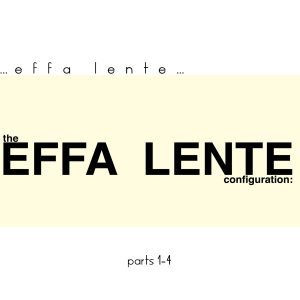
Effa Lente is the nom de plume of Irish multi-instrumentalist and former Graveyard Dirt axeman David Alfred Reilly. The Effa Lente Configuration: Parts 1-4, is Reilly’s début, an album with only one track clocking in just shy of 45-minutes and split into four movements. Don’t let the one-long-track concept put you off (regular readers of Echoes and Dust won’t be and are well used to such lengthy opuses) as there is enough light and shade, enough musical texture on this record to keep the listener involved from the first to the last note, and anyway, there are longer records out there – Dopesmoker by Sleep runs to an hour I’m sure, Philip Glass’ Music in Twelve Parts clocks up over three hours. Like Glass, Reilly is a classically trained musician and this training shows in each of the movements that make up The Effa Lente Configuration. It’s orchestral in scope, epic of vision, and plays with our expectations of linear storytelling through music.
The Effa Lente Configuration was, we’re told, inspired by the episodic films of Quentin Tarantino where the first thing you see isn’t necessarily the start of the story. Similarly the listener is parachuted into The Effa Lente Configuration at a point which could be the beginning, or the middle, or the end, it’s hard to tell. It’s also hard to tell if we are in a rock album? Or are we in a film soundtrack? Are we in a modern symphony?
While we question the reality of what we hear, Reilly weaves his music in a careful, multi-layered, tapestry; a tapestry where the unravelling threads could lead anywhere. But what threads they are: proggy-keyboards in full blown pomp are contrasted against icy tolling bells playing a single mournful note, grand jazzy runs along the piano are countered with some incredibly heavy, claustrophobic guitar. There’s also great subtlety here, no instrument outstays it’s welcome or becomes at all show-offy, everything has its place and is carefully plotted out. Like a symphony, or a soundtrack The Effa Lente Configuration exists in it’s own world with it’s own rules, and does so remarkably successfully, each movement is distinctive enough to be different, but has enough thematic motifs to draw everything together as a whole.
Only at the end does Reilly break the fourth wall – in a voice appearing to be sketched out from that great troubadour Tom Waits – with a seemingly banal flight captain’s announcement that wouldn’t be out of place on the 17:50 EasyJet flight down to Malaga. Our flight time has been 37-minutes he says, just as the track reaches its 37th minute, and he hopes we can join him for another trip. We certainly will. He also comments about the turbulence along the way, possibly a sleight-of-hand nod to the dynamics of the music we’ve just heard. It’s a humorous poke at our listening experience and is judged just right.
It would be foolish to try and describe this album to you. One of the features of a single track record is that points of reference are difficult to find. On a conventional record songs start and end, mostly, on here the changes in pace are about the only things to hold onto as the gaps between each movement are microscopic. We’re almost as trapped in the listening to the music as a passenger is trapped in the economy seat on a charter-flight. There’s nowhere to go, you can’t get off until the end. You have to buy your own nuts.
This could be a terrible thing if the record stinks, but it doesn’t. Reilly is a virtuoso player and arranger who holds your interest and draws on any number of musical influences, making them his own. It does recall the soundtracks of John Carpenter in places and the work of classic period Goblin. Reilly might not be the first artist to conceive of a ‘soundtrack-without-a-film’ album, but like all good soundtracks the music here engages with you emotionally, it makes you feel something – fear, anticipation, tension – it’s all here and feels very palpable even from the very first listen. I wouldn’t be surprised if Reilly picks up some film scoring work after this, but even if he doesn’t I hope he continues to make albums as dense and as layered as this great record.
Get it, crawl into it, and lose yourself in it for hours.