 By: Si Forster
John Carpenter | facebook | twitter |
Released on April 15, 2016 via Sacred Bones
When it comes to talking about influential artists I grew up in awe of, John Carpenter is pretty much at the top of the tree. As a kid, his films frightened me more than any other – The Fog’s knocking on the door in particular left quite an impression on me, and Halloween III’s Silver Shamrock theme will always terrify me. Central to each of his films of course were the soundtracks, visceral synth-created pieces that added to the tension of each scene in an utterly unique way, as the creator of the sounds was also the creator of the words and the visuals, making Carpenter a unique element in his industry, delivering the total cinematic experience from a single vision.
Recent rears have quite rightly seen his soundtrack work re-evaluated and re-loved by a new audience thanks to the enthusiasm of the Death Waltz Recording Company’s stream of quality reissues coinciding with (or possibly kickstarting) the vinyl renaissance, so it was both apt and welcome that John dusted off his old equipment and bought some new stuff to bring us Lost Themes in 2015, a collection of new material that would definitely have made my “Best of 2015” list here if only I hadn’t done it in such a last-minute panic and gotten confused by the 2014 date on the record itself…
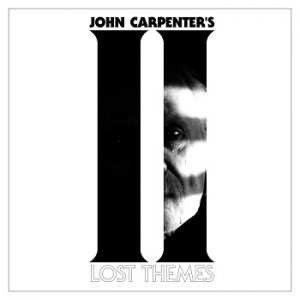
Lost Themes was made in the spirit of having fun with music but without the usual pressures he faced while creating it (as opposed to, say, improvising Halloween III’s score with Alan Howarth on the fly), and it – along with a subsequent Remix album – proved to be such a success both in terms of sales and creativity that a second volume was a happy inevitability. Created as more a a unit than his début album (John Carpenter’s first solo record was made when he was 66 years old), Lost Themes II once more sees John working with his son Cody and godson Daniel Davies but here they are creating together rather than with Lost Themes’ improvisation by internet. That said, it’s totally Carpenteresque throughout, and couldn’t possibly be anything else.
Lost Themes II’s greatest charm lies in its familiarity, as if it didn’t sound like John Carpenter it just wouldn’t be as much fun. Opener ‘Distant Dream’ is so preposterously 1980’s epic that my sole thought when listening to it is “I want to see this film NOW!”, and that’s exactly how it should be. What is also inevitable appears on Track 2, ‘White Pulse’ evoking the theme to Halloween. But (and it’s an important one), what Carpenter does with his own signature is rather beautiful as the pensive, terrifying keyboard runs are transformed into something altogether gentler and haunting before heading off in a couple of altogether stranger directions.
Without the stop-go terror and action of accompanying visuals, Carpenter is able to expand his musical vision towards more complex and personal themes without having to stop building his pieces up to an inevitable sudden stab. This would probably take a bit of getting used to if this applied to other composers in his (or any) field, but what we’ve been treated to between his late 1970’s to late 1980’s pomp is a period where he has been so influential to so many other electronic artists over the years that this just feels like the picking up of the reins, and he in turn sounds as though he has also learned a trick or two from those who have been so influenced by him, as well as parking huge electric guitar power chords over the top of a lot of proceedings here to ensure that, although this is a perfectly valid record for 2016, it was conceived in a brain from a gloriously different era. Even the gentle acoustic pickings at the end of ‘Angel’s Asylum’ remind me of the sensitive bits of any number of late-’80s Thrash albums than anything remotely pastoral.
The shining highlight comes right at the end, and it’s also the least like anything John Carpenter has ever done. The vast sweeping notes of ‘Utopian Façade’ evoke Vangelis’ Blade Runner score, adding synthesised string progressions to a host of layers, and the end result is staggering, and also shows that John isn’t averse to picking up a few bits and bobs from other artists.
Lost Themes II isn’t just a sequel, it’s a piece of work in its own right that pushes established ideas way beyond what anyone could reasonably expect from someone who is so -rightly – set in his ways that he is his own genre. More please!