Last time around in the new Music vs. Noise column, Benjamin Bland argued that drone was, above all, music as innovative art, but that doesn’t mean that the style has not also found a home in poppier climbs...
Of all the forms of experimental music out there, it may seem on first glance that drone has the least place in the realm of ‘pop’ music. It is, by its very definition, music that is prone to lacking the developed melodic and rhythmic tendencies of rock and roll. Despite this, drone actually holds a crucial place in the sounds of many a more accessible band.
You see what tends to separate many a band nowadays is not so much their ability to pen a good tune but what they do with that tune. Whether it is always acknowledged or not, texture has gradually become almost as important to most forms of pop music as its cornerstone features. Artists that are able to incorporate impressive drone influenced soundscapes seamlessly into their songs may not always be recognised as sonic innovators but their ability to do so can undoubtedly help them stand out from the crowd.
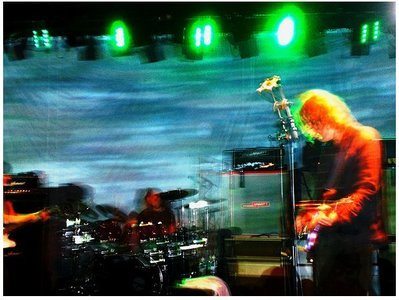
The world of shoegaze is an obvious region in which this point can clearly come into play. My Bloody Valentine have, whether intentionally or not, largely defined their sound around the use of drones. Their music is ultimately compositionally simplistic, revolving around repetitive phrases and sustained use of delay and reverb. Leaving aside the layering on of vocals, the entire ‘Loveless’ album is essentially constructed upon a series of gently fluxing, pulsating drones. What arguably separates My Bloody Valentine from other shoegaze acts is not so much the fact that they utilise drone elements, however, but the way in which they build songs out of them. To put it simplistically, their drones are, largely if not exclusively, more texturally interesting and harmonically intriguing than the vast majority of their genre contemporaries.
Following My Bloody Valentine’s path in some respects, Yo La Tengo drifted from their previous, unremarkable, college rock esque sound with their 1993 album ‘Painful’ by implanting their charming pop with some beautifully realised tonal minimalism. The opening track to that record, ‘Big Day Coming’, is almost exclusively drone based, with only some sparse playing and Ira Kaplan’s vocals accompanying the soft seabed ambience that holds the song together. The band has largely relied on the formula ever since to inject many of their finest tracks with that extra special element. It is perhaps the reason why the band continues to impress twenty years after ‘Painful’ was released.
Whilst My Bloody Valentine and Yo La Tengo’s use of drone is impressive, it is perhaps more easily incorporated into their hazier songwriting styles than into many others. They have used drone to, essentially, create wonderful pop records but drone has also been used to genuinely innovate in many other genres. Take well-known landmark records such as Aphex Twin’s ‘Selected Ambient Works Volume II’, Nine Inch Nails’ ‘The Downward Spiral’, Radiohead’s ‘Kid A’ or Sonic Youth’s ‘Evol’. All four, in differing ways, use the unparalleled textural control offered by drone to accentuate their sounds and propel the music in new, highly original, directions. Slightly more off the mainstream path and you find drone experimentation in the work of artists like jazz torturers Bohren & Der Club of Gore, post-rock pioneers Godspeed You! Black Emperor, progressive music icon Steven Wilson and arguably the most uncompromising musical power to arise in the last thirty years, the legendary, genreless Swans.
Go even further back of course and you find the influence of experimental early minimalist composers like Stockhausen in the work of the earliest popular rock bands, including The Beatles and Pink Floyd. In fact, even before ‘drone’ became a genre in itself, and before it started to take on the determined boundary breaking attitude that it has today, its influence has been felt. Throughout the entire history of contemporary popular music the drone has subversively weaved itself into the foundations of the pop and rock that we love today.
More exciting than looking backwards, however, is to look to the future and see the many ways in which drone, which is itself ever progressing, can continue to influence and accentuate the strengths of many other forms of music. It may be almost invisible and it will probably feel almost motionless, but trust me; it’s going to be quite the ride...