“. In this world, it leaves a bad taste in the mouths of those who don’t want to hear the truth. And, sadly, in this world the truth is never real.”
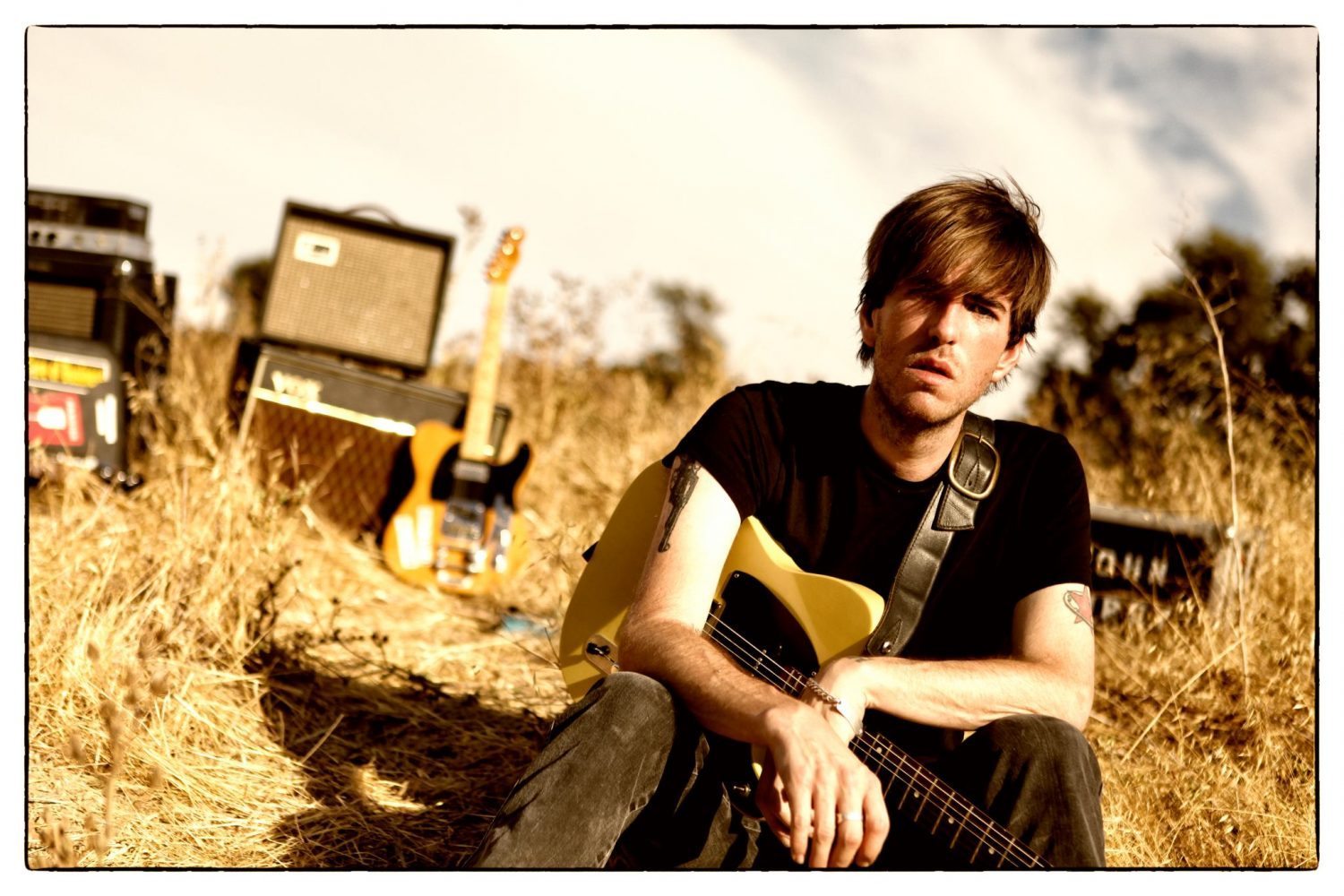
There’s a deep throbbing confessional heart at play over in America at the moment. Politics may take the front seat and the usual bating is taking place. Amongst the real people, there is a need to search and find answers to where a world so gone wrong, can be placed in some sort of context, and out of this a daily living and understanding can take place. Religion is falling apart at the seams and the quest for a new righteousness is taking place. Music is the conduit through where much of this soul searching is taking place and in one of the boldest statements of the year, if not since Joni Mitchells ‘Blue’, comes ‘Graceless Age’ from John Murry.
In a year when even the biggest of American superstars has questioned the validity of life, John Murry has taken this a step forward and released an album which, although mightily personal on one level, resonates with a deeper meaning on a more subconscious level. Bleak, dark, depressing are some adjectives but then that’s denying the beauty, valour and above all, rewarded faith that comes from repeated listens. From the slowburning self-immolation of ‘Little Coloured Balloons’ to the soaring ‘Southern Sky’, it is an album steeped in American folklore but also one that strikes a contemporary nerve. Truly extraordinary in parts, I felt it deserved a deeper understanding.
“I am still the same motherfucker I was before anyone paid attention. I’m just not the fuck-up I was, I suppose.”
Your new album delves deep into a dark American psyche. Is this the sort of ground where you feel comfortable? Judging from the grimness of your previous album of murder ballads (‘World Without End’) you do seem at home here.
To be completely honest, I don’t know where I feel comfortable. Sonically, I can feel it when it’s right. My brain bars me from letting my heart accept the sonics as enough, though.
Before his death, Albert Camus sent a letter to his wife – the remembered portion being when he wrote, “ I cannot find a comfortable place to lie in this bed.”.. This was at the height of French disdain for him and continued attacks on his insistence that we ought give a damn about one another and do away with ideologies that “fix” the world in some psychotic Hegelian way (Sartre, in all his stardom, didn’t agree – because he was the fraud Camus understood too well – the Cartesian in sheep’s clothing). His work wasn’t well loved in France at the time. He was despised by most. Not Faulkner, removed from the world of intellect-as-weaponry, who wept when he heard of Camus’ death.
History now tells a different story, but the journals from the time don’t. He was attacked on the most base and absurd levels; for using correct grammar he was called “bourgeois”, for calling Stalin a fascist he was branded a “conservative”, for being dignified in the way he treated others he was crucified. He wrote to his wife, “You are forgiven for your happiness and your successes only if you generously consent to share them.”. How could he share them, though, with a public that despised him for being a reasonable and decent human being?
I wonder if Springsteen felt the same when those cops tossed their badges onstage in protest because he had the decency – nay – the generosity of spirit and the courage to call those who took Amadou’s life murderers. They are.
I suppose I must refuse to feel any comfort anywhere. It isn’t this world that’s headed to hell in a handbasket, it’s the basketweavers that have created an environment in which the only decent response is to follow Camus’ advice: “Freedom is nothing more than a chance to be better”. ‘World Without End’ was personal in a way that is hard to explain. I was terrified of mortality and attempted to exorcise that terror in song. An acceptance of death is perhaps a good thing, but to fight against death as if it can be beaten is, to my mind, of equal importance. I think we’d all be better off if we both accepted what we fear and fought it like the Don Quixote’s we could all be. What would we hate and hurt over? A “legacy” we are building that is utterly delusional? Pain that we bring upon ourselves and others? For what? Acknowledgement? Accolades? Money? Bloodlust? We are either doing the work of a God we will never know exists or we are doing as we please to do no more than please ourselves. Forgive me, but I find meaning in too much – I suppose I look for it everywhere, even when it doesn’t exist. And I find it in Freud too often (or so I’m told): “Man is more moral than he knows and far more immoral than he could ever imagine”.
Deeper thoughts are at work in Murry’s mind and work and a sense of non-conformism and a demand of a right to greater truth. Whatever that truth is, we may not know but perhaps Murry thinks this can only be found through analysing himself. ‘Graceless Age’ is a very personal, soul baring album in parts heightened by the ten minute epic that is ‘Little Coloured Balloons’. Here Murry takes a closer look at an event in his life, which may or may not have served as a turning point. Either way you look at it, death has made an impact.
It is difficult not to read very personal aspects in these songs. How much is ‘Little Coloured Balloons’ influenced by what happened to you? Does it act as a sort of catharsis.
‘Little Colored Balloons’ is an odd one. The story is all very true; truer than even those ten plus minutes allow. I did want to get “it” out, you’re absolutely right in thinking so. I wanted to expose the demons within myself, the false cloak every junkie wears. But I wanted to insist that something be heard; that I have been in love with Lori for years and hurt over our separation – albeit a necessary one given my demons – and that I didn’t know how to temper the hurt any other way than by doing what I did. I overdosed and was clinically dead for several minutes. I’m not who I was then. Quite literally, I believe. Anyone can write a song about that. Hell, we fetishize addiction (especially heroin addiction) in musicians nonstop. We act as if we aren’t doing so because what we admire is the leaning towards absolute self-destruction; we all crave the end as much as we despise it. I wrote and recorded it some years ago, so in hindsight am able to see it for what it is. And I am ok with it. There’s an inherent indignancy in it. An acceptance of darkness and a longing for a light; one shrouded in indignancy and frustration. It’s a love song. Not a drug song.
And this where the crux of the album lies, in its mix of light and dark. ‘Graceless Age’ may be a bleak ride but then all great music has that dark heart which eventually become blackly comic.
It is not all darkness though. You inject a sort of salvation into your music. Is this a result of your upbringing or a newfound freedom when exploring your musical background.
Thank you for seeing that, I hope the salvatory elements outlast the darkness. I was raised in a very Methodist family in Mississippi. A strange one, even for the South. I’m adopted, so on the record you can hear my mother recounting the story of when I was adopted and they picked me up from the hospital. I know nothing of my biological family but feel a kinship to my family that is as real as any others’. With it comes confusion, though. Why don’t I look like them? Why do I feel different than them? The simple answer is the real answer: because I am.
Why, I don’t know. Prior to my father’s generation, every male was either a Methodist Minister or a Doctor (or both). My namesake and great-great-grandfather, William Faulkner’s grandfather on his mother’s side, was the first Methodist Minister in Mississippi. He was also adamantly opposed to a number of things, perhaps a bit too opposed to a bit too much. A moralist given free reign as “the” patriarch with the moral high ground. Marcus Aurelius wrote the Bible Mississippi reads, whether anyone sees it or not. Walker Percy was keenly aware of that. I stumbled upon him because his wife and my grandmother (the most amazingly interesting and entertaining and loving person I know) grew up together. My grandmother also grew up in Ruleville, just steps from Dockery Plantation, and used to go on carriage rides with Joe Rice Dockery through the high cotton and tar-paper shacks that sharecroppers were forced into. She found it all repulsive and still does. At 91 she is still telling everyone who’ll listen (and she’s too good a storyteller to not listen to) that she is a socialist and recently in her Sunday School class announced that, “At this point in time, I believe being a Republican is nothing more than a character flaw. Thank you.”. Her genteel warfare is brilliant!
John Young Murry and Col. W.C. Falkner appear as the amalgam that is Col. Sartoris in William Faulkner’s writings. The bullet-riddled monument is real. All of it is, really. If “real” is what it ought be: partially unknown. But the character is an idealized version of the two men. John Young Murry didn’t use his Confederate title after the War. He was opposed to both slavery and secession until Yankee soldiers raided his home, took his family’s Christmas meal (including the popcorn on the tree), and did as they pleased with his land and family. He joined the fight to protect his home. He was a surgeon, though, and at Shiloh performed amputations on both Yankees and Rebels. Likely, in his mind, as Christ would’ve done. He was also a tee-totaler, so I find his obstinance obnoxious, but I’ve got the amputation kit he used under my bed and treasure it, nonetheless. I’ve been allowed the distance necessary to see The South as I needed to, I suppose. I learned how to sing in our church choir and went there four times a week growing up. Much like Percy, I realized at a fairly young age that no one there really had faith or doubt or anything resembling anything I wanted. Nothing that looked like salvation. Nothing that looked like grace. But they all dressed the part!
I read The Moviegoer, then Kierkegaard and Unamuno and Graham Greene in California. I converted to Catholicism. When people ask me if I am a Christian, I generally attempt to gauge what response they want and give the opposite. “Because it is absurd, I believe”. I try to believe, I suppose, but not as a lukewarm white Southern Protestant or a deluded Catholic married to dogmatic rules. A priest once told me that Catholicism wasn’t terribly popular in prisons. You can’t accept Jesus into your heart and all that bullshit and just “get saved”. We owe debts. We pay in blood. We are always working out our salvation. To live in doubt is to live within the realm of a possible faith. That’s all it is, though: a possibility. The “forbidden fruit” is consciousness.
I tend towards the Spanish artist and philosopher Miquel De Unamuno’s thought that: “Consciousness is a disease”. He was a Catholic, albeit a truly Peter-like one. A man of doubt begging for the solace of faith who begged with the full knowledge that faith was a farce and doubt is the constant. I wonder often about his life; how it felt to be him. How it felt to die at the feet of fools for a land he knew and loved, and to do so with the dignity and courage he chose – in his time – and in choosing his death, perhaps he chose his redemption. He often spoke of martyrs not displaying faith but giving others the courage to try. He gives me that courage. As do innumerable others. He died trying with the intent of living on.
Why do we protect ourselves from ridicule? Why are we afraid? I think dying for those minutes allowed me the strength to try and create as me and does still. What must I be afraid of? Death? I’d prefer to not die anytime soon, but I refuse to accept the end; whether it come tomorrow or in 50 years. If it’s death we face, then it’s death I’ll fight; against all odds and knowing death is “the great leveler”. I don’t know. I worry I often sound like an arrogant fuck. I assure you, I am the fool unknowingly playing that part if my words come across that way. All I know is that I don’t know. I used to think I had a handle on something. Now I’m certain the railing is loose on the stairs… Bob Frank told me once that, “Man invented the wheel and we’ve been rolling downhill ever since.”. I assure you: Bob is as confused as I am. But he’s trying. I want to keep trying, too. To what ends, I don’t know. Maybe it’s in the trying that I’ll learn to forget the ends. I don’t know. I know that much and, honestly, nothing else of any consequence.
As we can see, passion reeks out of Murry and this intense search for an answer is engraven on a history which we may have read about, but never actually lived. It is this history which has impacted so much on American culture over the years and permeates down the ages in its literature and music. A line can be followed from The Carter Family to The Band, through to ‘Graceless Age’ which envelops this musical past. A seamless blending of styles which in some circles has become known as “Cosmic” Americana.
Musical influences – there are a wide mix of rich seams running through your work which bring to mind Southern rock, gospel, blues and even Elton John. What are the influences that drive you musically?
I learned to love Skynyrd by moving to California. It took distance from The South to learn to love what I was adamantly and idiotically against. Ronnie Van Zant was as misunderstood as they come. Duane Allman is an absolute genius. I feel I can embrace the Hill Country music I grew up with here in a way I was not allowed to in The South while growing up. Fat Possum was still a really young label when I was becoming an adult. As a kid, they didn’t exist. Because they didn’t, R.L. Burnside and Junior Kimbrough and Kenny Brown and the like didn’t exist outside of North Mississippi. There was no Jon Spencer and the Dickinson boys had yet to show the white world what they were missing. I feel blessed to have come up at a time when I could see those guys do what they did and see it before it became a farce forced on them. Kenny is still going strong, though, and he amazes me.
Cary Hudson was my earliest guitar hero, truth be told. I used to call Cary from payphones outside bars and ask if I could get in even though I was too young. He’d always figure it out and later let me open for him. I still think he and Kenny Brown are the best white guitar players in Mississippi I’ve seen. Or at least the ones that influenced me the most. The stuff I think that’s influenced me most sonically is such a cluster-fuck of sounds. I love Don McGregor and Bob Frank and Tom Heyman’s fingerpicking. I dig Duane Allman and Hill Country stuff and Delta stuff a ton. I also really, really love the way Tim (Mooney) and I worked and the sounds we found. A lot of that was him and a lot was my obsession with noise and bands like Slowdive, Ride, Mogwai, Arab Strap, My Bloody Valentine, enablers, Russian Circles, and the like.
I really love tons of what people call “spacerock” and “shoegazer” stuff. I listen to music in weird spurts. I get obsessed with some things for a long time and other things I find years later. Jim Ford is a big deal to me. As are The Afghan Whigs (mainly ‘Gentlemen’ and ‘1965’). Spiritualized and Jason Pierce’s work has moved me a great deal over the years. The Elephant Six stuff like Neutral Milk Hotel was a big deal for me at the time.
I also really dig hip hop but am real particular about it. There’s cool shit in Oakland, but West Coast shit gets on my nerves. I think ‘Stankonia’ was likely the best rock and roll record of the nineties. They fucking reinvented the wheel. I love all the Atlanta and Memphis stuff and a good bit of the New Orleans stuff from earlier days and the more recent stuff from Kentucky and Alabama. I also think the NYC stuff sounds way better than it used to.
I won’t lie: I love Bob Dylan and Bruce Springsteen and Tom Petty likely above all else. When they do it well, they marry sonics and lyrics in a way I find to be truly beyond what’s done these days. They’re the rightful kings these days. I honestly only like really early country like Jimmie Rodgers. Then the outlaw-era stuff and the earlier “misfits” era stuff out of Nashville. I can leave the rest, mostly. Merle Haggard has been a big influence, I suppose. Bob Frank has, too.. Right now I am really into Neil Halstead’s newest, Carlos Forster’s “Family Trees”, and am revisiting a lot of records I think I missed… I can’t say enough about how much Stax and Motown have affected me.
Elton John! My Wife says she hears it, too. That’s funny. I dig Elton John, but in a kinda “that dude’s pretty punk rock” way. I guess I oughta listen closer. Oh yeah: a band that influences me heavily still is The Connells, though outside the South they seem to have garnered nothing near the attention they deserved. And Joe Strummer is a bit of a hero to me, for a number of reasons. I am sure I left a ton out. I really dig rock and roll…. But I like it all on different levels: sonically or lyrically or emotionally or all of it, and can listen to it that way. Some friends say they can’t. I kinda take what I dig and leave the rest. I really don’t care what most other people listen to these days, not because I’m a dick, but because I just don’t hear “it” in music much anymore. Nobody’s making “Layla and Other Assorted Love Songs” anymore…
A run through of influences which are sure to excite Echoes and Dust readers, it also shows the disparate strands that go to making a modern American classic. It may be unusual to see such British luminaries as Spiritualized and Slowdive mentioned, but then we have to remember the impact that such bands had on college radio throughout the 1980’s and 90’s. It is through their sounds that we eventually get the feedback drenched dislocation that covers ‘Graceless Age’.
Does landscape and art influence too? There is a strange dichotomy of “the city” and “the open space” throughout ‘Graceless Age’. Where do you feel more comfortable?
Absolutely. Books certainly have had a great influence on me. I have an addiction to Don Quixote and see it as a manual for living. Also Graham Greene, Philip Roth, Percy, Kierkegaard, William Faulkner, William Styron, Gabriel Garcia Marquez, Unamuno, Dostoevski, Tolstoy, Camus, Montaigne, Borges, Laing, Freud, and on and on… I really read too much for no real reason. Sincerely. It’s like an addiction. Right now I like Denis Johnson’s Train Dreams and also The savage Detectives is amazing. Visual art is something I’ve always had a hard time with. I see things I love but can’t explain. I love Goya, Bosch, William Eggleston, and understood Pollack when I saw it in person. I can’t connect to it in the way I can the images in my head, though. And I try to keep those for the songs. Specific filmmakers have influenced my songs directly: Terrence Malick above all – especially The Thin Red Line, Herzog next, then David Milch. I like a lot of movies, though. I just feel at home with those peoples’ work, like I understand it easily. It speaks to me and for me.
The Dichotomy between the city and the country is one I’ve been at war with myself about since birth. I grew up in place filled with natural beauty but also filled with ignorance and hate. So I often can’t help but equate the two. It was a simpler life, though, in many ways, and I long for that. But not there. The city both terrifies me and I find it intriguing; cultures run into one another and people fight as if they are dying. I don’t really feel comfortable in either. Cities are the new deserts, in a sense, and I can hide out here. But it doesn’t always feel that way. And I miss being a kid and moving through woods and past creeks and not feeling afraid. We all carry knives now, I guess…. I would like to know where home really is. I don’t know that I’ve ever felt at home, even in Mississippi, a place that is a part of me and a place I am a part of. I’d like to.
‘Graceless Age’ – this title sums up a post 9-11 age in some respects and also brings to mind the fire and brimstone of the Old Testament. Is faith an important part of your writing? If so, is this a faith inspired by Gospel?
I think Seeger said something like, “I have no hope, but I could be wrong.”. I’d say, “I have no faith, but I could be wrong (and I hope I am).”.
Mine isn’t a faith of certainty, it is one of doubt and confusion. I am certain, though, that I am not above anything or anyone and that, when it’s all over, we all go into the same dirt. There’s a faith inherent in knowing that: something, even if it is nothingness, is greater than us. Maybe I feel like it’s true sometimes, too. I feel like I died and got another chance.
There was no light or story to tell. But I died and then I was alive. I won’t take that gift for granted, whether granted me by God or EMT’s. I have read the Bible a great deal, especially as a child, and a lot of theology. I am Catholic. So yes, I do often look to that book for many things: morality likely second to lyrics, though. Ok, that’s half true. I believe Jesus Christ is utterly misunderstood. Springsteen told it well on his last record and on virtually all his others. Too bad nobody listened. Dylan did on Oh Mercy and “Red River Shore” and innumerable others. There’s the Jesus we have made into a false idol and then there’s the real Jesus.
Maybe this helps: when you convert to Catholicism, you go through RCIA, a process towards accepting Communion as an adult and becoming a Catholic. When you do take communion, you’re given a name that you can choose from the names of those beatified. I chose St. Thomas. The Priest asked me if I meant “More” or “Aquinas”. I told him I meant “the Doubter”. He asked if I meant “the Apostle”. I asked him why he needed to differentiate. I still wanna know the answer to that.
Which once again shows the dichotomy and the blindness in the heart of people. A blurring of values seems to take place when confronted with such big issues and one mans red becomes another man’s blue. Truth and fiction are perfect examples of boundaries becoming blurred and I wonder if there is any of this at play on ‘Graceless Age’.
Tell me about the stories behind some of the songs on ‘Graceless Age’. Are they all influenced by truth or are some based purely in fantasy?
They’re all influenced and based on truth, but truth is only good in so far as it can be used to convey a greater emotional truth, I think. A couple of the songs, like “Things We Lost In The Fire”, were mostly written and I finished them in the studio. I wrote most of that song and “Photograph” pretty much entirely about ten years ago.
That’s the oddest bit, really. I talked of fire and heroin before I had ever seen heroin or our house caught fire, which happened in late 2007. “Southern Sky” was also written prior to the fire. How all that happened, I don’t know. It’s a bit discombobulating. I’m not saying there is anything “supernatural” about it. The really direct references to heroin were written later on “Things We Lost In The Fire”, but the “belt in your mouth” line wasn’t.
“California” is the one that has the heaviest feelings attached to it for me; I remember writing it right before Lori asked me to leave. I played it for her when she came home from work one day. The damage had been done, but that song wasn’t ever written to be recorded. I just wanted her to hear it. I remember thinking she might understand if she heard it. But I’d already hurt us and destroyed things to a degree I still don’t understand and one I’m simply grateful to have been allowed her forgiveness. Telling the truth isn’t enough: yes, I got my family back. But not because I made a record. Because I changed. Everything on that record is true, but a lot of the “truth” made no sense to me when I wrote it. A lot of it didn’t feel “whole” until months later. I doubt the record a great deal. Right before he passed, Tim Mooney told me in the most un-Tim-like way to not be afraid to write from the place I wrote from. I asked him where that place was. He said, “uh… Your unconscious.”.
There’s truth in that, I think. What Tim taught me, what a dear friend he was, what a dignified and misunderstood man he was, I’ll not be able to explain. Perhaps, ever. I think people weren’t paying attention while we made records until he died. Neither of us cared. We were just making records. I wish to Christ he were alive now. He deserves the credit I am getting as much as I do.
I’d not like to leave out Kevin Cubbins, though, who was an absolutely integral part of this record’s creation. We have a way of fighting it out and coming to a conclusion, where Tim and I just kept going and going because we had to. I still have to. We were in the middle of another record when he passed. The last lyric we recorded, that he recorded, was “put away your notebooks and your ballpoint pens, I let y’all right the beginning, now I say how it ends. when it stops getting dark and becomes too real, the world disconnects, but the phone call is real.”. He loved without condition and I miss him immensely. I’d no idea what a true friend I’d had until he was gone and I wish to Christ I could go back and be a better friend to him. Maybe I was. I don’t know. I do know this, though: I knew Tim Mooney and he was the most decent man I’ve ever met, faults and all. Because when Tim cared, he fucking cared. I pray I can be as giving in spirit and as righteously indignant as he was. He taught me a lot. I’d heard Mark Linkous, but Tim played me “Vivaladixie…” for the first time and I was hooked. It sorta all made sense when I first heard that record and then “Good Morning Spider”. I felt like I’d found a kindred spirit or something. He mixed the hallucinatory and the real and created something more than “real”, larger than what a microscope or a satellite can transmit or detect. He was able to evoke pain and love in one breath. He made love sound vicious and the vicious sound beautiful. I certainly feel a kinship there.
And the same is true of Jason Pierce, in many ways, though Tim couldn’t tolerate much past “Ladies and Gentlemen…”. What we hid from each other, though, was a deep-seated and embarrassingly “fanboy” love for The Clash and Joe Strummer. Finally, one day Brady Potts was visiting and Tim kinda just wanted to play “London Calling”. Then we talked about The Clash for a year or two or three. And “Layla and Other Assorted Love Songs”. Tim gave me the record and I kinda scoffed. Then he gave me a book about the making of it and I really listened to the record. I was sold. It’s as close as anyone can get to whatever we’re trying to get to… It was his idea to do “Thorntree In The Garden” and mine to make it a piano tune. It works, I think, as a closing song on both records for the same reason. There are a lot of truths about The Graceless Age I can’t tell and, honestly, simply won’t to protect other people I care about. But there’s plenty of signposts I intentionally left behind…. The words are never really the words. And “The past is never dead, hell it isn’t even passed.”.
Passionate words with heart worn on sleeve, Tim’s impact on ‘Graceless Age’ should never be misunderstood and it is left to wonder how to follow up such a tremendous (and lest we forget, debut solo) album.
Where would you like to take your music next? Do you see it getting darker or has carthasis been done and can we expect a summery album?
I wanna make a rock and roll record. Tim and I were. I wanna finish it. I don’t think I have really said all I wanted to on The Graceless Age. It was a cathartic process, but not consciously so. I felt it as such later. I’d like to create more directly, I suppose. I want to see how it works when I’m not strung out, too…. The record we were working on is maybe angrier but also less indignant and more self-deprecating. I didn’t censor myself, so the lyrics are emotionally more telling, I think. I don’t know. I do want to focus more on melody and expansive sonics. Of course, all that takes money (or the time to do it without money), so it’ll be in transition for awhile, I imagine. The darkness will persist as long as life remains veiled in death. But it doesn’t necessarily have to feel as heavy.
I wonder, because I created The Graceless Age, how dark it is experienced as being by others. Kevin once said it was claustrophobic in a good way like Big Star’s Third and inaccessible in some ways for that reason. I think he doesn’t see it that way now, but when he said “it hurt to work on this”, I know he meant it. Tim and I had to do it, though. I had to do it. Summery is likely a good word, though. I kinda wanna do that; make something with the weight of meaning something but with the feel of something more warm and catchy – catchy in a good way. Like “Summer Babe (Winter Version)” (lest I forget that Malkmus, for reasons unknown to me, is kinda my hero, too….).
What music inspires you today, do you see what is labelled as “cosmic Americana” as such a scene or are we just living in ripe times for American music? Is this a revolt against the plasticity of modern pop music?
I actually don’t like what is generally called “cosmic Americana”, to be honest. I do have the keys to the room Gram died in, but only because my daughter accidentally took them when we stayed there a few years ago. Cost me $50. I think all rock and roll is, at its core, derived from Southern music that came from all over the place. In the South I see tons of great “roots” stuff. Out here, though, it’s like a fucking costume party. People fake Southern accents. It’s a fucking joke. Mojave 3 were sonically, along with Scenic, the purveyors of what sounded the most legitimate to me. And Peter Bruntnell’s (I think) first record. Two of those are British! Like how the Stones had to show Americans how they were fucking up rock and roll, kinda…. And I dig Calexico and early Beechwood Sparks stuff. And Father John Misty, who I’d not heard until recently.
I like the older stuff; The Byrds, Gram Parsons, The Flying Burrito Brothers, Little Feat, and all that, but I still think the wellspring is in Mississippi. Not California. I think all those people kinda know it, too…. I guess I see the costumes out here too much. They make me angry. I wanna see a return to real music that moves people. I’m sick of the ironic hipster bullshit. I wanna hear electric guitars and melody and heartfelt lyrics. Are Dylan and Springsteen and a handful of others all that’s left? I doubt it… I just don’t pay close enough attention to much of anything “popular”, not because I mean not to, but because I feel inundated by choices. Too many choices. And most are bad. It’s like looking for needles in haystacks. Anybody with a laptop can make a record. So they do. And then it is measured against things like facebook appeal and I don’t get this “new world order” of technology. I don’t want to, I guess.
Regardless, I dig the Beach Boys as much as I do “Nebraska”, so I think the next record will be interesting. Good? Who knows…. But interesting, for certain. Oh: Bob and I are working on something, too…. One record we made kinda got ignored. Likely our fault. But we want to do another with Brady Potts, who did the Brinkley record with us and Tim. I wanna record badly. I kinda feel homeless without that studio space to enter and create within. Tim gave me that space. I’m figuring it out, I think. Trying, anyway, and will until it feels right. I can’t give up now.
Maybe this is where the truth lies in ‘Graceless Age’ as well, this urge to not give up. In a year of rather excellent albums from a variety of genres, this one has stood out against the crowd with its sheer weight of vigour and valour. Confessional, bleak and uplifting, it is an album which will stand the test of time.
Interview by Martyn coppack.