INDOOR SOUNDS
At home with Dumbsaint: writer E.M. Trocchi cosies up with the filmmaking four-piece and sees how the pieces fit.
Words by E.M. Trocchi, images by Christina Mishell Maras.

From left to right: James Thomas, Nick Andrews, Michael Tokar and Brendan Sloan.
Tomorrow, Friday 7 August, Sydney instrumental four-piece Dumbsaint will release its second full-length album, Panorama, in ten pieces.. It’s an impressive record, filled with powerful arrangements and strong performances. In his review on music website The Sonic Sensory, writer Robert Garland proclaims it “the year’s best instrumental effort”, while Mitch Booth from Metal Obsession calls the release a “thrilling” journey that “demands attention”. It’s the product of eighteen months of hard work and a small fortune in production costs, but the fifty-three minutes of music that will become available to listeners later this week only constitutes one half of the Panorama project. During the final weeks leading up to the album’s release, in between chasing publicity opportunities and applying for tour funding grants, the band has been quietly, steadily working away at an equally important component of the work.
A sullen man in a dark suit stands, looming over two nervous-looking young women. His lips move. “It’s time”, a subtitle reads. James Thomas, the tall and uncombed bass guitarist and founding member of Dumbsaint, shifts in his seat. “He kind of appears from nowhere, doesn’t he?” He says. Beside him, in the glow of a gigantic iMac screen, Dumbsaint drummer and filmmaker Nick Andrews strokes his beard distractedly, pondering the sequence. We are sitting in Andrews’ bedroom, in a sharehouse on a hilly street in Camperdown, where the two bandmates are editing a new short film to play in conjunction with a track from the new album called Communion. The track is a weighty, dramatic piece, with one of the most densely-layered guitar sections on the record. The pair is reviewing a moment in the film when the entrance of a new character happens to coincide with the arrival of a very gloomy, down-tuned guitar riff.
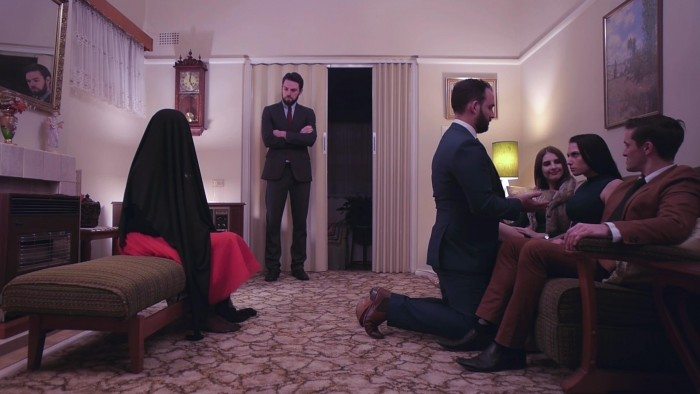
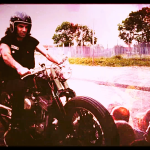
A scene from “Communion”
“Originally, on that riff, I had this shot…” Andrews begins, as he switches windows and brings up a previous arrangement of clips. He talks us through the sequence as it plays: “On that chord there, right, it started on this, and they looked up. And I laughed.” He turns from the screen to face Thomas. “I laughed because it was one of those rare moments where the music and the film interacted in a way that looked too coincidental, or like it was playing too much to the music.” We watch the earlier edit, and Thomas hums in agreement. “Like, the turn action is on the riff,” he remarks. “I see what you mean.” “Yeah, it’s like… Ooh, spooky boogie man!” They both break up laughing.
Communion is the second video that the band will be previewing ahead of the album’s release, after first single Cold Call went online in early July. While the album has been completed for some months now, work on a feature-length film that will eventually accompany the record is only just nearing the halfway point. To call this production a giant music video would be a disservice: Dumbsaint is a multifaceted experience; a band whose art only fully emerges on the live stage, where the music forms a dynamic soundtrack to the video projections, and the two forms interact to create new moments. Since forming in 2009, the band’s credo has always been that “each song is a short film, and each screening is a musical set piece”. After experimenting with longer, multi-stranded stories in 2014’s three-part series Disappearance In A Minor Role, the filmmaking band has decided to push the format a step further. At the time of this writing, shooting is almost complete on the album-length narrative film – a sprawling, virtually silent movie comprised of loosely connected short stories, all revolving around a twisted suburban neighbourhood at night. With twenty-eight actors and at least two dozen locations, Panorama, in ten pieces. is Dumbsaint’s most challenging and large-scale work yet.
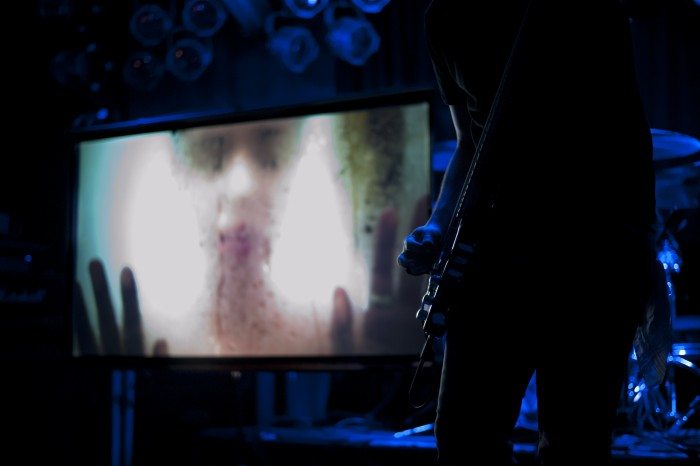
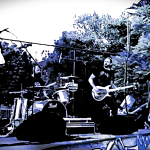
Performing live in 2013.
After clicking at the film in silence for several minutes, Andrews plays back a slightly reconfigured version of the scene. “Feedback, please?” He mumbles through his hand. After a long pause, Thomas brightens up. “Can we watch it one more time?” He asks. They re-watch the cut. The bass player has an idea. “What if you go to the Hannah close-up, then she looks up, and then you cut to the shot of Rosie, when she’s looking up as well. So now you’ve got both of them looking up at something, but we don’t know what it is…” They try the reordering of the shots. “See what I mean?” Thomas says, encouraged. “How his entrance is sort of anticipated, rather than abrupt?” Andrews nods. “So now what do I do about this gap?”
“This isn’t a lot of fun,” Thomas tells me later. “The process is laborious and slow, but with occasional sparks – moments when you unexpectedly find yourself caught up in the film. You have these “aha!” moments when you see an edit coming together, creating this world.” His bandmate feels similarly. Editing is “a long process of trial and error,” Andrews says. “The fluidity of a string of movements hinges on how well your choice of coverage comes together.”
Andrews’ approach is very orderly and pragmatic. “My rule is to shoot simply and edit dynamically,” he tells me. “It’s important to sculpt your original idea first before experimenting.” With looming deadlines –Communion is scheduled to premiere on prominent Australian entertainment site TheMusic in a matter of days, and most of these new films are to be performed at an unofficial album launch show only one month away – their workflow must be strict and streamlined. The atmosphere is sometimes stiff, and the process mechanical. In the rehearsal room, however, Dumbsaint is a very different machine.
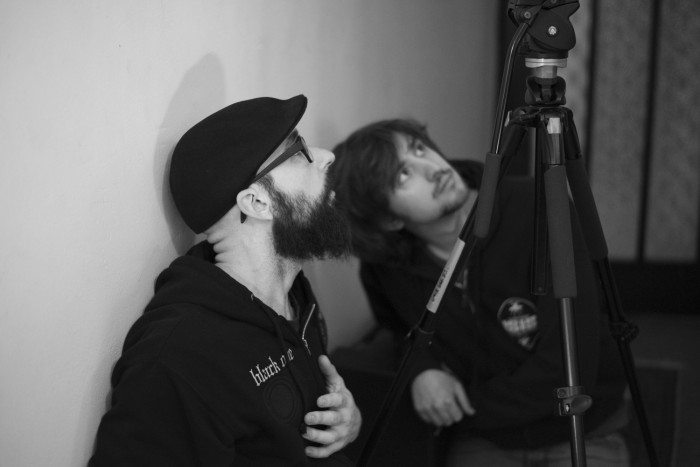
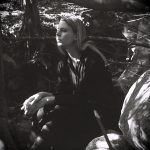
Andrew and Thomas, on set in May.
It is a week later, and we are assembled in the band’s regular room at a cavernous rehearsal space in Marrickville. The quartet – including guitarists Michael Tokar and relative newcomer Brendan Sloan – is practicing ‘Of No Return’, the nine-minute track that forms the slow-burning climax of the new album. When the run-through is finished, there is silence. Andrews did not nail the ending. “We’re playing these a lot better than we were before recording,” Thomas offers. “We’re going to need to play them a lot better,” Tokar counters, flatly. “And we will!” He quickly adds. There is a low mood in the room, but it doesn’t last for long. Within minutes the rehearsal room is revived with a familiar guitar chord sequence, which inevitably leads the band into an impromptu butchering of ‘One’ by Metallica. Sloan takes the vocal line – an incomprehensible Hetfieldian grumble which steers the performance into uncharted dreadfulness.
“We’re really dickheads in the rehearsal room,” Thomas says. “Or, at least, I’m a dickhead… I might be the biggest dickhead.” Sloan is more restrained. “There’s a lot of mischief for such serious music,” the new guitarist concedes. It becomes clear very quickly that, although Sloan has only been playing with Dumbsaint for less than a year, he has already become an integral part of the group.
“I came into frame at the end of the writing and demoing process, and at a very stressful time in the band’s history,” Sloan explains. “Despite all that, I don’t think it took longer than two or three weeks to figure out how I’d fit. James, Mike and Nick have quite disparate styles musically, but they’re all equally critical to the sound of Dumbsaint. I try to fill in the gaps as much as possible with wider harmonies, thicker rhythm playing. Musical glue, I guess.” Hearing the material come to life after several months of playing together has provided them with proof that the line-up is working, he says. As a long-time fan of the band, Sloan admits “it doesn’t quite make sense to me that I’m playing these songs week after week,” but that he feels “privileged to have stumbled into it.”
Once the band members have composed themselves after the ill-fated Metallica cover, they tune up and Tokar begins playing the light opening guitar line of ‘Communion’. It’s a different experience in the room: the layered riff section is more stripped back but just as murky, with the distorted bass chords and Andrews’ uncharacteristically splashy drums adding to the thickness. The build to the heavy ending is more aggressive, and there is an almost violent quality to the capsizing guitar chords that draw the track to a noisy close.
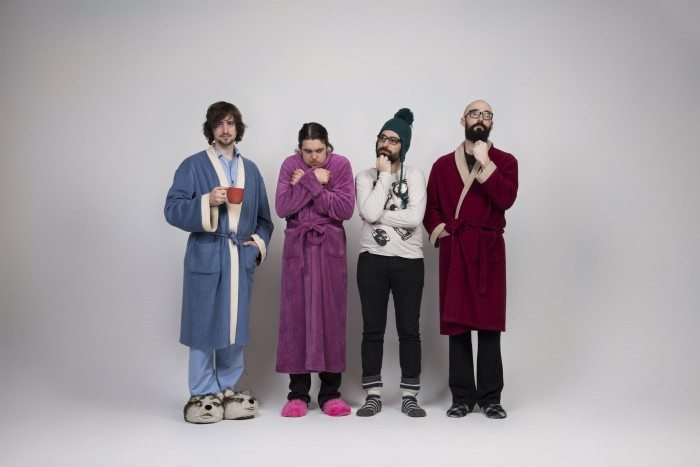
Residential noise artists: Dumbsaint, 2015.
A few days later, I am given the chance to see the finished film for Communion. It’s an uneasy watch; a dark tale of secret auctions and depraved rituals, cloaked in shades of blue and red. The problems with the earlier version have been smoothed out, and the scenes play well. Unlike ‘Cold Call’, which compressed a dialogue-heavy vignette into a tight four minutes, this new film utilises the slow, plodding tempo and varied structure of the album track to build its story gradually. It seems to move more like a collection of film scenes than any of Dumbsaint’s previous work. Each section of the track develops and resolves like a musical movement, allowing the band to mark out distinctive acts within the micro-narrative. Watching the seven-and-a-half minute short film, I’m struck with the impression that this is how each of these scenes was always meant to play out – each line, gesture and even raised eyebrow, married to the ebb and flow of the music. Having been told of the band’s challenge to make “the grind of the whole filmmaking process appear like it’s floating and effortless”, I can see that the hard work has paid off here.
The video’s startling final moments leave much to the imagination, and reveal very little about what will come next for these characters. After speaking with the band about the project and sitting in on editing sessions, the abrupt cut to black that closes the short film is a frustrating conclusion. It is immediately clear, however, that Communion is a significant step forward for Dumbsaint – as musicians, and as visual storytellers. And this is only the beginning: as the second short story taken from Panorama, in ten pieces., the new video is only a taste, a brief glimpse into a much larger work. I’ve been assured by the band that the disparate pieces “will all fall into place” when the whole is revealed. Two pieces down, eight to go.
Panorama, in ten pieces.? will be released on August 7 on LP, CD and digital formats in Australia through Bird’s Robe Records and Art As Catharsis Records, with a limited cassette tape release through Grimoire Cassette Cvlture. Pre-orders are available through here.
You can find Dumbsaint on Facebook, Bandcamp and on their website.