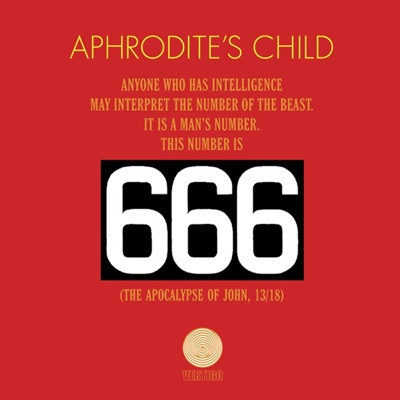
666 (The Apocalypse of John 13/18): 50th Anniversary Deluxe Edition by Aphrodite's Child
Release date: November 8, 2024Label: UMC
“I never understood the phenomenon of celebrity, waving a hand contemptuously. I wasn’t interested in being photographed or reading myself in the newspaper”. Vangelis describing to Mark Powell in 2016 from The Synth Issue (72) in PROG Magazine on how success and fame made him uncomfortable. It’s hard to believe that both Demis Roussos who left this Earth nearly ten years ago, followed by Vangelis in 2022.
Both left an incredible legacy. Vangelis, who sold millions of albums worldwide, followed by writing scores for films such as Blade Runner, 1492: Conquest of Paradise, La Fete Sauvage, and of course Chariots of Fire for which he won for best original music score at the Academy Awards in 1982.
Demis, who would later be known as the Kaftan king in the ‘70s, sold over 60 million albums and hits ranging from ‘We Shall Dance’, ‘From Souvenirs to Souvenirs’, ‘Forever and Ever’, and ‘My Friend the Wind‘. But it’s the band that deserves a massive amount of recognition.
Aphrodite’s Child, who started out as a psychedelic pop band, launched back in 1967 in their hometown in Greece. And their third and final studio album is where they went from pop to prog-rock territory with 666 which has been reissued in its 50th anniversary release as a 4-CD / 1 Blu-Ray set, containing the 2022 remaster done by Vangelis, the rare 1974 Greek LP mix, and a Dolby Atmos / Up-mix sound of the album he had done before he passed away.
Even though starting as a trio, releasing two studio albums between 1968 to 1969, the foursome recorded two tracks (‘Plastics Nevermore’ and the B-Side ‘The Other People’) before Silver had to fulfill his duty in the Greek Army until he was out of the military, returning to the band in 1970. The trio unleashed hit singles from ‘End of the World’, ‘Rain and Tears’, ‘It’s Five O’Clock’, ‘Spring, Summer, Winter, and Fall’, and ‘I Want to Live’.
By the end of the ‘60s, Vangelis got fed up playing the pop songs that the band was known for. He wanted to get out of that system drastically and was up for challenges that was heading his way.
In 1968, when the band were preparing to go to the UK, the trio weren’t allowed entry due to the work-permits, and then later on they stayed in Paris due to not just the transportation strike, but the student riots that occurred in May of that year when they were protesting against the war in Vietnam and other political situations including the Cold War. It inspired Vangelis at one point to leave his home country and then leave the band.
According to a Shindig article in issue 134 by Martin Ruddock, Vangelis explained to Sounds magazine in 1974, “I didn’t want to stay in Paris but, because of the ’68 uprising, I couldn’t leave”. Then a year later, an encounter with filmmaker Costas Ferris (Rembetiko, 1983), who’d written a script for a movie called Aquarius and offered the Floyd to do the score.
But they turned him down, same thing with Vangelis. But there were two other options that would mark Aphrodite’s Child’s final studio album. One was about the Passion Play themes on Jesus Christ who is seen as a Superstar after being sacrificed. The other, The Apocalypse of St. John.
And so, the story based on the Book of Revelations was chosen. Inspired by films and albums such as Citizen Kane, Rashomon, The Who’s rock opera Tommy, and the Beatles Sgt. Pepper, the story takes place inside a big circus show, representing the apocalypse.
Acrobats, dancers, animals, you name it. While the presentation is wowing the audience, something terrible is happening outside. The real revelation of the apocalypse is happening, created by God himself.
It becomes this big, massive panic as audiences believe that what’s going on outside, is part of the show. However, the narrator himself, whips up into a frenzy. As the big tent disappears, the clash of the titans battles it out to see who will win in the climatic end of the story.
For Vangelis, he didn’t want the album to be a spiritual representation of the swinging ’60s, but all of its creative dark side that was going on as he whips it up during the two-year process, he recorded with the band from 1970 to 1971 at Studio Europa Sonor in Paris.
Take for example the opening introduction ‘The System / Babylon’ opens up with a chant “WE GOT THE SYSTEM / TO FUCK THE SYSTEM!” repeated nine times as it goes into a fanfare with Koulouris channeling his Pete Townshend rage on the guitar as the preparation for the end to occur thanks to Demis singing about the fall of Babylon the great.
Inspired by Abbie Hoffman, who was a part of the Youth International Party, wrote a manifesto entitle “Fuck the System“. It’s the irony and sarcasm that puts it in its place. But behind ‘The Battle of the Locusts / Do It’ which expands Silver’s fretwork in the 1974 Greek mix, he pulls out all of the stop signs, revealing something metallic, heavy, and harder to the bone.
The two tracks would later be sampled by Finders Keepers founder Andy Votel and his tribute to the swirling label entitle Vertigo Mixed in 2005. There’s the Hendrix plug in which puts it to the wah-wah pedal, going in full blast. Pounding drum work from Sideras and Roussos’ bass work, they give Silver a lot of star time on his guitar to reveal his intensive fret lines.
And let’s not forget ‘The Four Horsemen’ as well. The famous repeated phrase; “The leading horse is white / the second horse is red / the third one is a black / the last one is a green”. Demis sings in this desert-dry atmospheric landscape revealing the representation between conquest, war, famine, and death. Hearing the 2022 remaster which had been overseen by Vangelis, you can hear the Synths rising and rumbling to prepare for doomsday whilst Silver takes over with his wah-wah pedals as the scat-like vocals in the background gives everyone a countdown for the disaster that’s about to occur in any second.
The early Floydian-landscape behind ‘Aegian Sea’ does resemble some of the construction in which the Beatles had used during the Abbey Road sessions with an electric harpsichord on the psychedelic track ‘Because.’ You feel the loneliness, the city in its ruins, the slowed-down spoken dialog of John Frost (“I saw the souls / I saw the martyrs / I heard them crying / I heard them shouting / They were dressed in white / they’ve been told to wait”.)
There’s no turning back once you leave this world whilst he returns to become the master of ceremonies on ‘Seven Trumpets’. “Ladies and gentlemen! / Seven trumpets / the sound of thunder! / Seven trumpets / the threatening anger! / Seven trumpets / the trembling voice! / Seven trumpets / You got no choice! / Seven trumpets / the seven angels! / Seven trumpets / THE MUSIC CHANGES!”
As the rumbling bass pounds from the segue behind ‘Altamont’, all hell breaks loose in this massive freak-out while Harris Halkitis’ tenor sax improv and clock-ticking vibes that Vangelis does on the vibraphone and Roussos’ scat takes center stage whilst the tent disappears is flown away as the battle between art imitating life is revealed for audiences to see.
Frost comes into the narration detailing “Those are the pictures / of what was / of what is / of what has to come / We are the people / the rolling people / the why people / the waiting people / the wanting people / the tambourine people / the alternative people / the angel people”. Richard Ashcroft’s band The Verve would later be inspired by 666 and would name one of their songs ‘The Rolling People’ off the band’s third studio album Urban Hymns released in 1997.
Then, Vangelis takes his synthesisers and world-percussion grooves with eerie vocalisations, going to this nightmarish terror as Frost imitates one of the Daleks from Doctor Who; “THAT. WAS. THE WEDDING. OF. THE LAMB”.
Once he returns back and says; “NOW. COMES. THE. CAPTURE. OF. THE BEAST!” It all becomes this sounding effect of chains being hit, bringing the seven-eyed monster to its cage with Indian-tribe bass drums to bring the late, great Irene Papas going into this erotic craze on ‘Infinity.’ This was one of the tracks that Mercury Records desperately wanted Vangelis to remove, but he refused.
Originally, the track lasted around 39-minutes. Yes, you heard right. ‘Infinity’ lasted 39 minutes, but it was edited down to 5-minutes. So, once you heard Papas saying “I was / I am / I am to come I was”, she is really getting down to business with the pounce of heavy drums to create this insane asylum as Irene screams, shouts, cries, pants, and go into this shivering effect that’ll make your skin crawl.
Then, the final showdown is in preparation with a soulful cry of a 4-minute version from the Greek Mix on ‘Hic et Nunc’, returning Aphrodite’s Child to their psychedelic pop roots. Between Michel Ripoche’s tenor sax, crowd cheering “Here and Now!”, Silver’s heavy guitar work, expanded piano solo, it all leads up to the 19-minute climax, ‘All the Seats Were Occupied’.
It starts off in this middle-eastern arrangement, setting up the desert-y effects Vangelis and Silver make preparations for this dynamic funk-rock effect that’s about to occur. Once the raga atmosphere takes place, it turns into a concrete form of music where each of the songs from the album intertwines 13-tracks from the album where sax and kazoos join together to head into this intense showdown between the act and the reality that’s occurring.
Once the dialog speaks the titled-line, the sax throws into this chaotic end with a heavy crescendo as the band whip it out once more to bring the climax in a massive mushroom cloud with heavy percussion’s and Papas groaning before the world is destroyed. As the dust settles, Lukas comes out with Vangelis with a beautiful ballad ‘Break’.
Vangelis’ scatting backing vocals, represents to poke fun of the doo-wop genre, Lukas looking through the rubble, Silver coming in to lend a helping hand with his instrument one last time, they look through dark, grey sky, knowing they are the last survivors left before ending with Frost’s, “DO IT!”
Heavier, maddening, and mighty, this is the album that didn’t just broke the door down, it remains a cult classic after its release in 1972 on the swirling Vertigo label. There are the prog-like textures, funk, hard rock, atmospheric, avant-garde, folk, psych-pop, it’s the circle that brings everything in full for both the band and Vangelis’ swan-song. If you want proof, just ask both Steven Wilson and Tim Bowness and their love of the album, covering 1972 from the Album Years podcast.