Interview: Cwfen
The nature of the kind of song that the band is writing at this stage necessitates a more discretionary approach to how you use your instrument and that has led to the most satisfied that I have ever been with the results because I’m considering my options more carefully before throwing everything at the wall and hoping that it sticks.
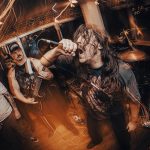
In terms of global history, 2025 is likely not going to be remembered in the fondest of terms but it did bring a wealth of good tunes from all corners of the globe, not least from Glasgow’s Cwfen. Though they’ve been around for a few years and have a wealth of live experience under their belts, it’s been the release of their debut album Sorrows that has brought them critical acclaim, award nominations and has made them one of the most talked-about bands in the UK right now. As they prepare to head out on their first solo headlining tour, David Bowes spoke to Agnes Alder and Guy DeNuit about the record’s creation and impact.
E&D: This has been a crazy year for you, hasn’t it?
Agnes: Not half! It really has.
Guy: Winding back to when we went into the studio to record the album, which was in June, at that point we had no media profile, we didn’t have a label – we did have a couple of nice reviews from our early shows which was very encouraging – we didn’t have any support anywhere. We actually wanted to record an EP but ended up tracking stuff so quickly that we thought, “Well, we’ve got studio time, why don’t we just track the rest of the songs that we’ve got and see what we can do with it all?” We only decided to do an album during recording. We hadn’t even thought that far ahead. That’s where it started and by the time we actually finished recording – we recorded it in a few days, took it away and listened to it, made some changes and then we did the final touches, and then we put it out – but from the time we started recording the album to when we released it, we had a label, a booking agent, a press agent… it all snowballed pretty quickly.
Agnes: It happened pretty fast. There’s almost a Sliding Doors moment where you wonder, “What if? What else could have happened?” I don’t think this is what any of us expected but there was a moment when we started recording the album that we all realised it was bigger than we thought it was. We all felt something in the music that we were making and the way that we were working together that this could be a thing. As for how big a thing, we still have no idea but could we have foreseen the events of this year in terms of the reception the album has had? No. In terms of the opportunities that have come our way? Absolutely not. In terms of the amazing feedback, reviews, award nominations? Unreal.
Guy: Also, just how nice people have been. People approach you and say that they heard your song, or they saw you live, and it meant something. That’s huge.
Agnes: The fact that now it means something to people. They were our songs before we recorded them and now people have lived with them for the best part of a year. They reach out to us with these deeply personal things about how the record got them through some of the most difficult periods of their lives, what they have heard in it, what it means to them, which has imbued it with this extra significance that makes it even more special to us now. That then makes it that bit more exciting to take it out on the road in December, now that people have had the album in their ears for a good few months. It’s been an incredible year. Not one that we could have planned but it has been a surprise and a delight the whole way.
E&D: Is there anything that has really surprised you or that has felt especially surreal?
Guy: For me, just being afforded the opportunity to work with people that we were fans of. Like, if you could go back in time and tell your younger self, that kind of thing, who you’ll have an opportunity to work with like, the Faetooth tour was a huge win. We were a fan of that band and then we heard that they were coming to Europe for the first time. Like complete chancers, I sent an email to their booking agent and said, “Hey, you don’t know us but we love Faetooth and if you are looking for a support band we’d love an opportunity.” They got back to us and said, “Actually, I have heard of you guys.” What?
Agnes: How? How does that happen?
Guy: It’s a ‘pinch yourself’ moment where you think that maybe you’re being a bit overly eager but the feedback we’ve had has been… it’s those kinds of moments where you realise that people you’ve never met, or never thought you’d work with, have heard of your band. That seems surreal. Delightful but absolutely mental.
Agnes: Every opportunity that’s come our way, every show has been amazing, everything has been surreal but in a really gorgeous way. A couple of the things that have almost made the hair stand up on the back of my neck are when we have turned up to play shows in cities that we have never been in before, and there are people in the front with their eyes closed singing every word to every song, or there’s a bunch of people standing wearing your t-shirts. They’ve not just heard you before but they’ve bought your record, bought the merch and have turned up at the show to see your obscure little band from Scotland, singing your songs and wearing your shirts.
My other favourite thing that continues to delight me is the Cwfen shirt tracking. People go off to festivals all over the world and sending us pictures of fans in the wild! I got sent one of someone who was standing with Witch Club Satan, who are awesome, in a Cwfen shirt. Those two things abutting, that to me is amazing because it still feels very much like we’re just doing what we were doing anyway, what we like doing, and now suddenly people are looking at it. People love it enough to wear your shirt to a music festival, where people are going to judge your music taste based on the shirt!
Guy: The fact that we’re now somebody’s choice of, “Look how cool I am, I’m wearing this t-shirt!” is an honour.
Agnes: It’s amazing and it is fun, and it’s funny, and it’s surreal and lovely. It encapsulates how we’re all feeling. We’re definitely at a point now where the work has stepped up in terms of what the band is asking of us. We have to have band meetings now to decide all the things that we have to do, and you have to run it with conscious effort now because we’re doing it around our lives, planning shows and tours, merch, making records, writing songs. You can’t do it just by seeing how it goes any more and so that has been something we’ve had to fold into our lives as it becomes much bigger. Are we all comfortable with it getting bigger? Yes, because we love doing this, and it’s worth it, and we love playing music together but now we’re reconfiguring our lives around this bigger band shape than any of us ever expected.
E&D: How did you end up working with Kev (Hare, producer)?
Guy: That was a connection from back in the day. I used to play in a band with our drummer Rös and we played with Kev’s band Black Sun. We were nothing like Black Sun but we bonded with them, especially Kev as he’s a lovely guy. We knew that he had served tenure over at Riverside Studios and had become a huge part of the fabric of the running of that studio. I’ve met loads of people since then who’ve either recorded with or been taught by Kev. His reputation as a producer has escalated. When you’re friends with a bunch of musicians and some people say “I’m a producer, I’ll record your band” it can either mean that they have a swampy studio out in the east end with a 4-channel interface and a couple of borrowed microphones or it can mean that they’re actually dead good at their job but it’s trying to figure out who’s who. Kev’s name kept coming back up, his reputation is getting solidified by hearing some of the stuff he’s worked on and the nice things people have said about working with him, so when it came time for us to pick where we wanted to do it, he was our first thought. He’s a total winner and he’s got this killer studio out in the countryside so we should speak to him, see if he has availability and if he’d be interested in working with us. We asked him, he was, and that was it. He was literally the first person we thought of, because we were friendly with him, because his reputation was so solid and also because he just happens to have one of the best studios in the country. Having been to a few studios now, very few places tick as many of the boxes as Kev’s place does. It’s in a gorgeous, isolated spot in the countryside. It’s a converted farmhouse, it’s a beautiful location, really well kitted out.
It’s residential, so you stay over, which we really benefited from – the fact that we, we were able to go there and draw a veil between us and the world for a few days to just get on with one thing. Ignore the emails, put your phones away, let’s just be us and do what we do, and see what results we get.
Agnes: We’ve spoken about this before, the idea of a third space. It’s not your house, it’s not your studio, it’s not somewhere you come home to; you’re just in a separate space and the only thing that space exists for is for you to do one specific thing. You don’t break it up by leaving at the end of the day, you just stay and coexist together t in this space where you’re eating together, you’re socialising together, you’re making music together it creates this beautiful form of uninterrupted focus. It’s somewhere completely new so it doesn’t have the trappings of “This is my house, it’s also my work, or my job” and in hindsight I think that was essential, especially because we’d gone in with an embryonic idea of what we wanted to do. We knew all of our songs inside out and had ideas about arrangement but we hadn’t gone in there with the express intention to record an album. We were well-rehearsed and because we were in this space and had the luxury of time it created the right conditions for the album to emerge so much so much so that we’d do it again in a heartbeat. We’ve done this in the past where you travel in, record stuff in the day, go home and turn up the next day. It’s not the same as living, breathing in the studio, being together as friends and as a band. Spending the evening cooking together and sitting with a bottle of whisky or a few beers and listening to music together so that you’re all feeling yourselves in the same way so that you can go back in the next day. It was really special. We think the album was very much a product of that environment and that relationship with Kev. The chemistry was great from the get-go. He’s very patient, and very good-humoured with us as well. We went in with ideas that maybe went against production best practice. We’d go beyond the point of what is comfortable with reverb, absolutely crank it, or “What happens if we stick a weird microphone over there? Let’s go with that!”
Guy: We had to have Kev help us rough things up a bit. He’s so technically good at his job that when we would record anything more abrasive or atmospheric, he would capture it perfectly. We’d hear it back and think, “Actually, that’s too perfect. Can we go back and do it worse so that it sounds angrier, or dirtier?” and he’d say, “Yeah, ok.”
Agnes: A perfect example with me is that I realised I don’t like to do vocals static, standing at a microphone stand. When we play live I move around an awful lot and it turns out that is very essential to the kinds of noises that I make. I found that when I was standing very still in the trappings of the vocal booth, it felt static. It wasn’t coming out like my voice. What we decided to do was tape two very different microphones together, give me a very long cable and I’m just going to wander around, jump and crouch and do weird shapes with my body and that’s going to help me get the sounds I need for the record. He was very trusting and that’s not something that always happens with a producer or sound engineer. They want to do things their way because they have a way that they do it and he was able to trust the process with us enough that it became a really nice back-and-forth. Kev’s skills were essential to the way the album sounds. He wasn’t the type to just go home. It takes as long as it takes. It was a really fortuitous, really serendipitous bit of chemistry where the stars aligned on so many fronts. I don’t think we could have recorded this record anywhere else or with anyone else.
E&D: You went in without the intention of recording an album, but did you already have all of the material down or was there anything that developed during the recording process?
Guy: We had eight finished songs that were where we wanted them to be and we ended up recording all eight. The only reason that there’s only seven on the record is that we had to be able to fit them on both sides of an LP. They were all rehearsed and we’d already performed all of them live. They were pretty much our set so the idea wasn’t so much to not record an album because we didn’t have enough material, it was that budget-wise we had only planned to record four songs. But when we got in the studio and saw how quickly the workflow was going, we still had time left so we thought, “Should we just throw down another couple and see how that feels?” By the end of the initial period that we recorded with Kev, which was four days, we’d recorded all the drums, all the bass, 75% of the guitars and some of the vocals. On the second phase of the recording, when we went back a few weeks later, we then finished the guitars and vocals and had some time to clean up the mixing of the album – the placement of microphones, echo effects on the vocals. There was no spontaneity in the songwriting, that had already been taken care of.
Agnes: It certainly wasn’t that we didn’t feel we were ready to record an album or that we couldn’t, it’s just we hadn’t put that pressure on ourselves to go in and do that. It was more that it was going nicely so let’s see where that takes us, which can only come when you’re very comfortable with one another and trust each other very much. It’s a big decision to go from four songs to twice as many.
Guy: Do you know what stops you from being able to record eight songs instead of four? Disagreement. As soon as you have any disagreement in the room, tools are down and nothing happens. Looking back, that we were able to do that is that there was never a point where there was never any dead weight. Everyone was pulling their weight.
Agnes: It was very much a mirror of how it is when we are in our rehearsal studio. We’ve all been friends for a very long time and no-one feels like they’re treading on one another’s toes. It’s so chilled. Someone once asked us what the most difficult point of recording the album, and there wasn’t any, it was just getting the money together to do it. It was a very relaxed environment which is funny for music that can be so dynamic, so raw and chaotic and feral and a bit jaggy. The background to that is just good vibes in the band where it is extremely relaxed and that got us through tour as well. We don’t argue, there’s no tension. It’s just very easy.
We have a few rules. Rule number one is that no shit leaves the shop. We all want to do quality work and do the songs justice in the recording and live so we want to be well-rehearsed and we want to give people a good show. The other one is to do this for as long as it is sustainable and feels good for all of us. If all four of us are having fun and it’s worth the time and investment and it’s worth rearranging our lives for, ransacking our bank accounts for, then we will continue to do it. So far it’s ‘tick, tick’. That very ad hoc framework keeps us honest as well so that if something doesn’t feel quite right, i.e. a show opportunity or a decision that needs to be made, it keeps us right. Friendship comes first. Prioritising those things allows us, at this point in time, to keep it relaxed, fruitful and productive, resulting in good music.
E&D: How do you feel that you’ve developed as live performers so far?
Agnes: I did not consider myself a singer or a frontperson until very recently. I’ve sung my whole life, like in choirs or in bands, but I was always in the background, the person off at the side doing a bit part or the alto in the corner of the choir, and I loved it. I would sing at home and in the car, I taught myself to scream in the car and in the shower – sorry to the neighbours – but I never thought that I would be in a position where I would be doing it on stage. I wanted to. I have a whole mood board on Pinterest of people that I look at before I go on stage just to get a bit of courage from them. I’ve always loved the showmanship and the performance part of it but never felt I could access any of that myself because I’m not an extrovert by any stretch of the imagination. I think I’m quite deeply introverted. The persona that comes out on stage surprises me as it is in no way reflective of the person that I am. What’s been interesting for me is learning to let go of the guitar. I’ve always had the safety of a guitar. When I first put it down, I thought “I don’t know what to do with my body. This is so strange.” One of the reasons I move around a lot and become quite kinetic on stage is that I can’t stand still, because my human suit doesn’t fit very well and it looks weird. It’s been this lovely self-reinforcing flywheel of doing a performance and it feels instinctual and then I see photographs or videos that people have taken and I’ll say, “Who’s that?” because that is not how it feels to me. That has allowed me to relax into a lot more. I feel ten feet tall when I’m on stage and I love it. That’s not really something I’ve been able to access in any other areas of my life. I’m only just starting to not feel like the girl in the band. Apart from my very first band which was all female, I have always been the only woman in the band. When that’s the dynamic and you’re turning up to rehearsal rooms with tall guys, you do feel quite different, quite self-conscious that people are watching you and judging your skills. I’m only just now starting to let go of that imposter syndrome a little bit. This year has been transformative in terms of how I think of myself. I always thought that I just played around. I had written stuff, it was fine and enjoyed it, but now to have the validation of songs that I’ve written, that we’ve written, and have people loving them and to have people praise my voice, which I thought was alright, and seeing myself in that frontperson role has changed how I feel about what I bring to the stage musically.
Guy: I think how this band has been really good for me as a musician has been that I’ve always been, as a guitar player and as a songwriter, a bit of a maximalist. I’ve always thought ‘more is more’ and that was my approach. I’ve always been a bit busy upstairs when it comes to ideas and have will maybe over pollute songs by trying to force too much into them. What I’ve been able to get my head around working with the other people in Cwfen and as part of the writing process is how to strip things back and make them as melodically and technically simple as they can be while still trying to convey a clear idea. It feels good to be able to use all of the busyness and energy that you’ve built up over the years and then filter what’s actually useful, what’s going to be good in a composition, even if that at some point is not playing the guitar to allow the other instruments to come forward. There are points in some of our songs where I am literally stopping playing guitar for some of the song because that’s what the song requires, or not having a distortion pedal on. We’ve not got anything that I would consider a guitar solo in any of our songs. There are some countermelodies, some little motifs but it’s usually a piece that’s repeated like in a classical musical sense rather than an eight-minute ‘November Rain’ solo halfway through a song. The nature of the kind of song that the band is writing at this stage necessitates a more discretionary approach to how you use your instrument and that has led to the most satisfied that I have ever been with the results because I’m considering my options more carefully before throwing everything at the wall and hoping that it sticks.
Agnes: It’s restrained but it’s also a confidence in your ability. It’s coming back to that imposter syndrome, showing everyone what you can do, and when you’re all doing that – and we know we can all do that – you write shit songs. You busy them up. Maybe that guitar melody might give more breathing space if it was a harmony in the vocals, or if we took that rhythm and put it in the bass; being able to make judicious decisions about the things we have to bring and not just hoard them to ourselves. We’ve actually become quite egalitarian which is weird for us as a pair of guitarists who are usually quite egotistic. It comes from that trust in one another and trusting decisions in the songwriting, whereas when I was younger and more precious or controlling I would have written worse songs because I would have wanted to demonstrate everything that I could do or should happen in the songs at any one time. It’s been a real exercise in stripping things back. We have lots of good ideas but another rule we use is ’What’s the event? What’s happening in the song?” If it’s the same thing over and over then it’s a very boring song, or if it changes too much then it’s too much for the listener. We’re at a point where we’ve been doing this for long enough as musicians that we’re able to trust our judgement a bit more in terms of the songwriting choices, even to the point where that eighth song, even though we couldn’t fit it on the album, we didn’t want to include it as we didn’t feel it had been given enough time for it to be the best representation of us. We have a couple of songs that have been in development for a while where we’ve thought that it isn’t quite right, put it on the back burner and it’ll present itself at the right time. We’re not rushing ourselves and it’s allowing good stuff to rise to the top.
E&D: You mentioned last time that you’re particularly influenced by literature. What were you drawing from this time around?
Agnes: Oh my goodness, so many things. I read a lot and I’ve been on a bit of an Agatha Christie and Poirot binge right now. It won’t make me write any songs but it’s delightful. I read a lot of very heavy books, and I read quite broadly – literature, history non-fiction, political non-fiction, genres like sci-fi and speculative fiction. There are a couple of songs where I’ve drawn inspiration from passages in books or poetry but it’s more of a – I don’t want to say literary sensibility because that sounds much more up itself than I intended – but I’m a words person first and always have been. I’ve always written stories from being very young. I learned to read when I was very young, I had parents and grandparents who liked to read to me, and that was my great solace. Books and writing were how I expressed myself and which has now ended in me being a lyricist; that’s another thing I’m starting to consider myself as but it still feels like a weird label to apply. What I love about books as opposed to film is the development of character, of scene and of nuance; the fun that you can have with language, how you can say the same thing in different ways. It’s a very expressive process and music is the same in many ways. I’ll sometimes write a song completely, music and lyrics, and then think, “No, I have to dial up this aspect of it” or “I need to pare it right back and simplify.” I think those skills have been learned from being a broad reader. For example, there’s a song that I’m working on lyrically and musically in tandem, and I’ve written a set of lyrics where I’m thinking “I really like the idea of this but what would Ernest Hemingway do it? How would you strip that back to its essence, or how would you complicate it to make it slightly more veiled and cryptic?” Again, those are skills that have come from reading so many different ways that different writers approach their material.
Books and writing were my first love as I didn’t get a guitar until I was seven – words came first and then music – and I think that will always be a thing for me. I’m often inspired to write music most by books, places or history. I’m never going to just write a love song, or be like, “Here’s how I’m feeling, I guess it’s time to go and write a song.” I’ll sometimes read something and then feel this intense need to get whatever that feeling is that spoke to me out of my system and put it into song form, and the thing that does that most is books.
Guy: I don’t write much lyrically, it’s more musically but for me it’s history and watching documentaries about history. Trying to recreate a feeling of a memory a place or a time. For me, it’s movies and not books.
E&D: How are things coming with album number 2?
Guy: Under some decent amount of headway. We have the unused song from the first record, a couple of unused demos from before we recorded album number one, there’s been a significant amount of activity writing new songs in the last three months; we’ve probably come up with a half-dozen quite solid ideas, three or four of which have been rehearsed and are almost up to giggable standards. We may or may not be looking to insert one or maybe two of those songs into our upcoming UK shows in December and January. We’re very fortunate in that we have now been stepped up to being headline status and there’s an expectation of how long a set would be considered to be appropriate in that position. I know that we play longish songs so we’re never going to be able to play a short set if we want to deliver a decent amount of material, but at the same time we don’t want to bore everyone to sleep by playing too long.
Agnes: We also don’t want to be, like “Oh, you guys loved the album? Here’s this new material.”
Guy: The set will probably be the album and maybe one more.
Agnes: No encores though. We’ve had this discussion recently on whether to do encores and I don’t think any of us actually like them. I like to go home on a high after you’ve played the best song at the peak of ability.
Guy: In terms of album number two, if we were only aiming to fill two sides of an LP again, there’s probably already enough material already for that.
Agnes: But again, no shit leaves the shop.
Guy: I’d like to overshoot so if we only had seven or eight songs on an album, we should probably write twelve. We are already at seven or eight songs but we should probably write a few more so that we can cherry pick a little bit.
Agnes: What we’ve also found out with album one, when we recorded our very first demo way back, we realised that as soon as we started playing them live they became much heavier. Our sound changed and that happens when you play them live because you respond to the energy of the room, you make decisions on the spur of the moment and we want the chance to play any new material live as a testbed. Music is for the people, right? It’s for the audience so if you play something and it doesn’t land, it’s probably not right for a record. We want to encapsulate that special feeling of seeing us live in record format. We don’t want it to be a vanity project where we just give the songs that we think are great. It’ll be important for us over this next year, we have a lot of opportunity as we have a lot of shows to play, to try things and experiment, and then turn them into better tunes.