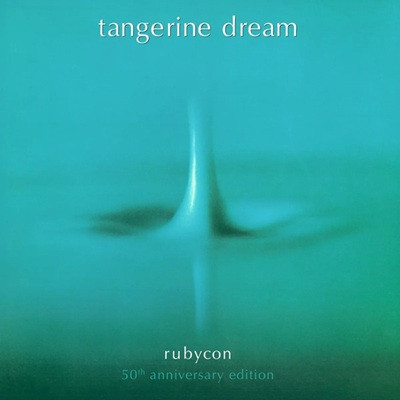
It is Halloween, October 31st. The year, 2025. I’m going for my afternoon walk when the weather is perfect and relaxed, not hot, but cool. I’m a cold weather type of guy with my iPod Touch in hand, feeling the relaxation surrounding me, not knowing what I will play next. When I went ahead and press the “play” button on Tangerine Dream’s follow-up to Phaedra entitled Rubycon, I’m taking to a whole other world that is beyond light years ahead.
This 5-CD set reissued by the Cherry Red sub-label Esoteric Reactive, consists of the original album, two live shows they did; One at the Rainbow on October 27th of 1974, and at the Royal Albert Hall on April 2nd 1975, two of the shows were introduced by the late, great John Peel who was a true champion of the band and played their music on Radio 1. Two of those shows originally appeared on the 2019 box set, In Search of Hades: The Virgin Recordings 1973-1979. And the Albert Hall show originally appeared on the first volume of the Bootleg Box Set in 2003 on Castle, then reissued by Esoteric Reactive in 2012.
Going back and revisiting Rubycon was like a breath of fresh air. It’s one of those albums that just grabs you and takes you into this lost world with decay, nightmares, and terror that’s waiting for you to hold on to your dear life. For Edgar Froese, Christopher Franke, and Peter Baumann, they would create an innovation into the world of electronic music taking synthesisers, organs, mellotrons, and sampling, making it sound like it’s the 25th century and into the future.
Let’s not forget they had four albums during their time on the Ohr label; Electronic Meditation, Alpha Centauri, Zeit, and Atem as they were developing and improving the wonders by taking their music a step further than being known as a krautrock band. And when Froese signed a five-year contract to Richard Branson’s Virgin Records, it marked the beginning of the golden-era for them.
Let’s go back to 1974. Phaedra reached no. 15 in the UK Charts and the band prepared their first UK tour between October and November of that year. They were in the Melody Maker that ranked them as the most promising bands in the world, according to Wouter Bessels liner notes in the reissue. The first part of Rubycon begins with a bell-like Moog from Franke, followed by Froese’s oboe sound from the Mellotron, it’s very much floating in space, where you are drifting alone in the middle of our solar system, so you can get a feel of what is about to happen.
It has this ocean-like ambient world as Peter would create this lushful, turned classical beauty like seagulls hovering across the blue sky with the sun coming up for a brand-new day. It is as Franke describes to Karl Dallas in 1975 in his in-depth analysis as a part of the tour book promoting Rubycon: “It’s very liquid”. There’s the choir, the feelings of a meditated vibration, almost Vangelis-like, but true to the core.
As the wind begins to drive away, the choir sets up the intense vibration from the sound of the gong moves into the rumbling fire, starting to spread from the Synthi-A and Mellotrons galloping across the plateau. The Leslie adds in the drama with terrorising effects which speak of their film score to William Friedkin’s 1977 unsung gem Sorcerer, based on the French classic The Wages of Fear.
Man, do they know how to use the VCS3, spreading across the Mellotrons near the horizon. It takes you deeper into the unknown in many ways that Tangerine Dream has given its listener their output. I could tell they had paid attention in what Pink Floyd were doing during the time they were making Atom Heart Mother, Meddle, and their magnum opus Dark Side of the Moon for inspirations.
With the sound of piano strings being strummed, droning pounces, the first part comes to a close. Then, we get to the second part where the droning hum starts to vibrate all around us with its ominous shudder. You feel as if you’re in a dream.
Think of it as if we’re in David Lynch’s world of Eraserhead, but with its black-and-white dystopian twist. There’s a sense of wonder until the synths rise from their tomb and go in for the kill like a daring drive off into the night, not knowing when the bomb is going to explode at any second. But this isn’t just Eraserhead, think of this score being used in Nicolas Roeg’s 1976 cult classic, The Man Who Fell to Earth starring David Bowie.
The shifts keep getting higher and higher with heavier tones and going back and forth through your headset as it gets tighter each time the trio pull some crazy-ass shit in front of us. Why do you think Bowie and Iggy were next-door neighbours with Edgar Froese during the time David was getting himself cleaned up in Berlin when he was making those three albums (Low, Heroes, and Lodger)?
As soon as the waves crash in the 11-minute mark it begins to calm down from the fortress of solitude that Baumann, Froese and Franke have endured but return to the early Floyd sounds of Ummagumma that brings to mind, which is quite useful on the fourth part of ‘Sysyphus’ from Richard Wright. And bits of Vangelis synths during the 666 sessions into the mix to close it up.
Another part is an extended version from the first part of ‘Rubycon’ which has been mixed by Steven Wilson. According to Bessels, the tape was discovered in one of the session reels for Phaedra, although it uses the ARP 2600 synthesiser it goes back to November/December 1973. It may have been the band were using tapes that were done during the Phaedra sessions while they were recording Rubycon at the Manor in January of 1975.
It gives listeners an insight of a work-in-progress of the opening section and how they were re-fining the finishing touches of their latest work. The two shows, which I’ve talked about earlier, takes you into the seat and witnessing a band giving audiences, a trip they’ll never forget between the Rainbow and the Royal Albert Hall.
Recorded by the Manor Mobile on CDs two and three, the two-hour show is an incredible documentation, witnessing the momentum and incredible rises as you can be in awe of what Tangerine Dream were doing. This is how we vision themselves as not just the pioneers in the Berlin School of Music, but the true masterminds of Electronic Music during the 1970s.
Next up, is the full-length performance they did at the Royal Albert Hall on April 2nd, 1975. It’s always great to hear Peel’s voice when he introduced the band at the two venues. Peel himself was a true champion of Tangerine Dream and described them as the best of “Kosmische Musik” groups he heard.
As he described in an unnamed Sunday newspaper on May 23rd, 1997 writing about his four influential artists he was writing about, “Tangerine Dream…are a band I think deserve at least more credit than they generally get”. When they were performing at the Albert Hall, Froese and Franke contacted their friend from Agitation Free, Michael Hoening to sit in for Peter Baumann because he embarked on this road trip to the middle east without letting them know.
While Baumann was spotted backstage, Hoening sitting in for Edgar and Chris at the Albert Hall, which clocks in at two-hours in quadrophonic sound, recorded by the BBC and broadcasted two weeks later, you feel the energy, and the audience being hypnotised by the synthesisers setting foot into the arena. And after each part, the audiences erupt with cheers and applause asking for more.
You could tell they’re cheering them on, but once they get back into their magnetic keyboards, they keep quiet and be in awe for what kind of unexpected momentum that throws at them. Like Phaedra, Rubycon is another magnum opus that is put together and more well-constructed in its two-part suite.
The power of those three individuals, it is one of those albums that stays with you, becoming the soundtrack of your life, and is the masterpiece of all of the electronic sound Tangerine Dream has given to us.