Can music be beautiful if, instead of emotion, it offers the listener emptiness?
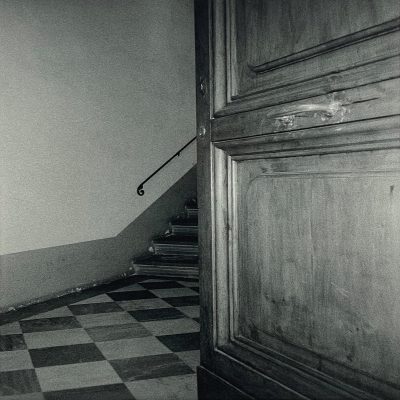
That was the question I found myself asking while listening to The Moth, the debut album by the American band Cancer House. At first glance, it sounds like slowcore, but it does not quite behave according to the genre’s rules. Their music places us in a tight, unstable space that seems constantly on the verge of collapse, or of swallowing itself whole. The only thing holding it back from total disintegration is the faint, almost living outline of a rhythm, leading the listener nowhere.
Slowcore is usually associated with slow tempos, minimalism, recurring melodies and restrained vocal delivery. Yet the genre does not always dismantle song form. On Low’s I Could Live in Hope, that form is still recognisable, even if verses and choruses are stripped of their usual dramatic function. With Duster, by contrast, structure seems to dissolve into lo-fi texture: the melody is blurred, the sound feels murky and distant, and the vocal is buried deep inside the song. In both cases, slowcore does not so much describe a feeling as stretch it out over time, turning the song from an event into a state.
Cancer House go further still: using the logic of slowcore and elements of post-rock, they translate music from the language of emotion into the language of space. That space is best described by the band’s own name: a house afflicted by some internal disease. It decays under the pressure of its own illness, yet that same illness is what keeps the remnants of life inside it intact. The sensation is strange, and at first even frightening: as if everything around you were slowly rotting, while the music does not merely sound but pulls you into that decay like a swamp. The whole album feels viscous. Its melodies do not unfold freely; they move with effort, as though trapped in their own environment.
Already on ‘Camera Obscura’, Cancer House establish a sense of depth. The guitars linger in long reverb and layer upon each other: one has not yet disappeared before another begins to surface above it. At times, this makes the melody seem to move along a displaced trajectory, while its fragile order is repeatedly disturbed by extraneous sounds: cello, recording interference, fragments of noise. This effect is especially striking on ‘In My Pocket a Letter, a Red Wrecked Line’, where the sound of interference seems almost to flow into the indistinct vocal.
The central song of the album feels like ‘Flowers Over There’, its most sensual and, at first look, most peaceful moment. Its short, repeating loop has a hypnotic effect: it holds the track in a soft, meditative circular motion, gradually gathering other elements around itself, percussion, blurred strings and a tender, drawn-out vocal. But as the melodies accumulate, a hidden unease becomes increasingly clear, eventually erupting near the end in a tearing scream. It sounds as though it was never meant to appear at all. It brings no catharsis, releases no accumulated tension, but simply rises from the depth of all those layers, an alien element suddenly discovered inside the song itself.
‘Bloodchimes’ continues the logic of the whole record with its stretched-out, oversaturated echo. This cold, almost inhumanly made sound seems to develop by itself: it does not lead towards a climax, does not gather into a clear structure, and offers the listener no resolution. Music here exists as a living process. It moves, expands, changes shape, but until the very end refuses to reveal where it might lead. Its space is a small room so dark that the darkness itself begins to draw the outlines of an interior, of objects, of images; a darkness into which it becomes frightening to submerge oneself completely.
This logic of living, unstable music brings The Moth close to Red Your Blues, an earlier album by another slowcore group, Picastro. They are connected not only by the use of cello, but by a persistent urge to disturb harmony, to leave the sound uneven and not fully assembled. Yet if, in Picastro, beauty rests on a fragile vocal line, string tension and an almost bodily tremor, then in Cancer House it dissolves into the very texture of the sound. On The Moth, this state no longer belongs to a single voice or instrument. It becomes all-consuming, filling every layer of the recording.
So why, for all its depth, its layering and its thick sense of unease, does The Moth still leave emptiness behind? Because this feeling does not develop here, it persists. It is given no cause, no climax, no way out; it simply spreads across the album until the listener stops registering it as a separate emotion. At some point, unease stops being the content of the music and becomes its permanent condition. The beauty of The Moth is born from precisely this deadened constancy: as though the crucial choice has already been made, and all that remains is to exist among its terrible consequences.