This fellow writer first heard Budgie’s music back in 2008, during the iPod era, when I stumbled across their music on a podcast devoted to bands that often flew under the radar during the heavy-rock explosion of the 1970s. I can’t remember the name of the podcast, but I remember the bands that were featured alongside Budgie: Bloodrock, Grand Funk Railroad, and, I believe, Sir Lord Baltimore. The music was fast, powerful, in-your-face hard rock, packed with amazing riffs that hit like a cannon blast. The song that grabbed my attention was ‘Homicidal Suicidal’ from Budgie’s self-titled 1971 debut, originally released in the UK through MCA, with Kapp handling the U.S. release.
There’s no denying that the Welsh band Budgie were the real deal. They gave the hard-rock genre a serious kick in the gut, particularly when it came to what a power trio could accomplish. The classic lineup consisted of bassist and lead vocalist Burke Shelley, guitarist Tony Bourge, and drummer Ray Phillips. Phillips remained behind the kit through Budgie, Squawk, and Never Turn Your Back on a Friend, before Pete Boot took over for In for the Kill! and Steve Williams joined for Bandolier.
Budgie would go on to have a tremendous impact on later generations of metal and hard-rock musicians, influencing bands and artists such as Iron Maiden, Voivod, Soundgarden, Queens of the Stone Age, the Melvins, Megadeth, and Metallica. Metallica’s version of ‘Breadfan’ appeared on the 1987 recording The $5.98 E.P. – Garage Days Re-Revisited and was later included on the 1998 double album Garage Inc. A live version also appeared on Live Shit: Binge & Purge. Metallica also covered Budgie’s ‘Crash Course in Brain Surgery’ on Garage Days Re-Revisited, making Budgie’s influence on the emerging thrash-metal generation impossible to overlook.
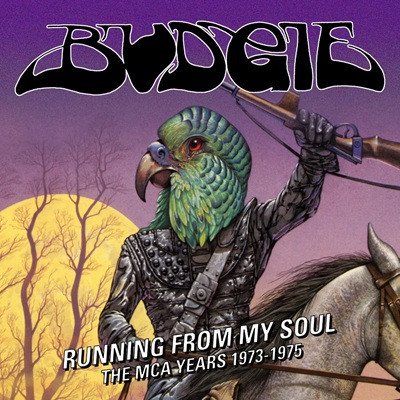
That connection makes Cherry Red’s forthcoming three-CD set, Running From My Soul: The MCA Years 1973–1975, particularly appealing. Issued through Cherry Red’s HNE imprint, the set focuses on three crucial albums from Budgie’s classic period: Never Turn Your Back on a Friend, In for the Kill!, and Bandolier. The original 2016 MCA Albums 1973–1975 set contained those same three albums, and the new edition expands that era with bonus material.
There is, however, one big disappointment: ‘Crash Course in Brain Surgery’ is absent because of licensing issues. Boo, hiss! Considering how important the song became through Metallica’s 1987 cover, its omission is noticeable. It would have been the perfect addition to a collection documenting this particular period of Budgie’s history.
Still, what is here demonstrates just how far ahead of their time Budgie were. These three albums capture a band that could move effortlessly between heavy rock, progressive experimentation, blues, folk, funk, and proto-metal without losing the power of their basic three-piece attack. You can feel the electricity, raunchiness, fire, and sheer physical force Budgie brought to the table.
From the moment ‘Breadfan’ kicks into high gear with Tony Bourge’s revved-up opening riff on Never Turn Your Back on a Friend, all bets are off. Burke Shelley’s bass and vocals are enormous, while Ray Phillips pounds away behind the kit with a performance that makes the entire track sound ready to burst through the speakers. When Shelley sings the opening line; “Breadfan, open up your mind, open up your purse, never, never, never gonna lose it,” he sounds like he is giving every ounce of energy he has to the performance.
The band’s take on Big Joe Williams’ traditional blues number ‘Baby Please Don’t Go’ is another highlight. Williams originally recorded the song in 1935, and it would go on to be covered by countless artists, including Them featuring Van Morrison, the Amboy Dukes, and AC/DC. Budgie’s version gets down and dirty, with Shelley’s opening wail immediately revealing how deeply the blues influenced the band’s sound.
Bourge, meanwhile, takes the song into a jazzy, metallic back-and-forth improvisation. At times, it sounds as if he is duelling with himself in the middle of a boxing match. His playing becomes fiercer and more volcanic as Shelley and Phillips lock into the groove behind him.
Then there are the more restrained moments. The folky, almost dreamlike textures of ‘Riding My Nightmare’ and ‘You Know I’ll Always Love You’ show that Budgie were not afraid to step away from the heavier material. Steve Williams’ drumming on ‘You’re the Biggest Thing Since Powdered Milk’ brings a progressive dimension to the album, while the back-and-forth guitar attack of ‘In the Grip of a Tyrefitter’s Hand’ demonstrates just how much humour and personality Budgie could inject into their music.
Budgie were more than simply a heavy-rock band. They could bring in folk-inspired passages when they needed a change of pace, use acoustic instruments to reveal a softer side, and then plug everything back in and crank the volume right back up.
The ten-minute closer ‘Parents’ is the album’s grand finale: heavy, folky, progressive, and deeply emotional. Its somber textures and gothic atmosphere give Bourge plenty of room to paint the track with his guitar. There are sadness and anger here, but also a sense of release, as Shelley reflects on family, absence, and the complicated emotions that come with growing older. The closing section leaves the album on an unexpectedly haunting note.
We then arrive at 1974’s In for the Kill!. Budgie’s fourth album takes the band into thicker, more aggressive territory, pushing further toward proto-metal and progressive rock. With Pete Boot replacing Ray Phillips behind the kit, the rhythm section takes on a different character. The band sounds heavier, stranger, and more willing to experiment.
The six-minute improvisational workout ‘Hammer and Tongs’ is an experimental, avant-garde, and wonderfully spaced-out journey. Pete Boot and Tony Bourge explore an ominous, almost cosmic atmosphere before the song eventually comes crashing back down to earth. There is something almost Kubrick-like about the opening, as if Budgie have wandered into the strange, weightless world of 2001: A Space Odyssey before suddenly remembering that they are supposed to crush everything in their path.
I immediately thought of unsung progressive-rock legends Gracious!, with a little Leaf Hound thrown into the middle of the pandemonium. How heavy and proggy can you get? In Budgie’s case, the answer is: both. That is what makes In for the Kill! so remarkable. The band were already pushing heavy music into territory that would become increasingly important to metal and progressive rock.
The nine-minute ‘Zoom Club’ is another monster. There are moments when Tony Bourge sounds almost proto–ZZ Top, particularly in the bluesy swagger of the guitar work, while the riffing keeps the song firmly rooted in Budgie’s metallic identity. The riffs are heavy, dirty, and muscular, with Shelley’s bass providing the stop-and-go momentum that keeps the entire jam moving.
And that is only the beginning.
The final two pieces, ‘Running From My Soul’ and ‘Living on Your Own’, uncover even more of Budgie’s obscure heavy-rock brilliance. They possess the kind of adventurous spirit that makes you want to dig deeper into the underground bands of the era and discover what else was happening outside the obvious names.
Closing out this era is their fifth album, Bandolier, released in 1975. It was the final album of this period before Budgie moved into their A&M years in 1976. In the United States, Bandolier was issued by A&M in late 1975, while MCA handled the album in the UK and other markets.
Listening to Bandolier, you can hear Budgie becoming even more adventurous. The album retains their metallic edge but incorporates funk, progressive rock, blues, and more rhythmic experimentation into the band’s sound.
The opener, ‘Breaking All the House Rules’, ventures into Hendrix territory at times, with echoes of ‘Manic Depression’ from 1967’s Are You Experienced. There are also moments that remind me of early Rush, particularly in the muscular interplay between guitar, bass, and drums. From there, Budgie slide into the funkier groove of ‘Who Do You Want for Your Love?’, which has a soulful quality without sacrificing the band’s heavier edge.
The surprising Pete Townshend-like attack of ‘I Can’t See My Feelings’ adds another dimension. Its garage-rock chord structure and Shelley’s bass improvisations are pushed further by Bourge’s wah-wah guitar, creating a funky, almost psychedelic stomp.
The mono version of ‘I Ain’t No Mountain’, included as a bonus track, is another welcome addition. It gives the song a punchy quality that makes it easy to understand why Budgie could move between hard rock, funk, blues, and proto-metal without sounding like they were simply jumping from one genre to another.
Then comes ‘Napoleon Bona’, which is presented as two parts but functions as one larger piece. The title is a play on Napoleon Bonaparte, rather than a straightforward historical account of the French military leader. Budgie approach the subject with the same mixture of humour and seriousness that runs throughout their music.
The first part begins with a more mellow, acoustic-folk atmosphere before the tension gradually builds. Then, once Tony Bourge’s guitar comes crashing through the door, the track takes on a much more aggressive character. You can almost hear the emerging sound of the New Wave of British Heavy Metal waiting around the corner.
Bourge takes centre stage, pushing the story toward its conclusion while Shelley and Williams keep everything moving underneath him. It feels like the closing chapter of one period of Budgie’s career and a glimpse toward whatever would come next.
Budgie were ahead of their time. They were too heavy to be comfortably filed away as progressive rock, too adventurous to be reduced to straightforward hard rock, and too early to receive the recognition that would eventually come to bands carrying the metal torch in the late 1970s and 1980s.
That recognition finally began to grow as later generations of musicians discovered them. The thrash-metal scene of the 1980s, particularly through bands such as Metallica, helped expose Budgie’s music to listeners who may never have encountered the Welsh power trio otherwise.
That is why Running From My Soul: The MCA Years 1973–1975 is such an appealing collection. Yes, the absence of ‘Crash Course in Brain Surgery’ is frustrating, especially given its importance to Budgie’s legacy. But the three albums gathered here tell an important story on their own. Never Turn Your Back on a Friend, In for the Kill!, and Bandolier show a band constantly pushing against the boundaries of heavy music while retaining the raw power that made Budgie so distinctive.
For anyone already familiar with Budgie, this set is another opportunity to revisit one of their most creative periods. For newcomers, it is an invitation to discover a band that should have been much bigger than they were.
Ultimately, listening to these three albums feels less like revisiting a forgotten chapter of hard rock and more like uncovering a piece of the future that somehow arrived too early. Budgie were already building the blueprint for heavier, stranger, and more adventurous music while many of their contemporaries were still figuring out where rock could go next.
The fact that their music still sounds this powerful more than five decades later is the greatest argument of all: Budgie didn’t simply belong to the 1970s, they helped lay the groundwork for what came afterward.