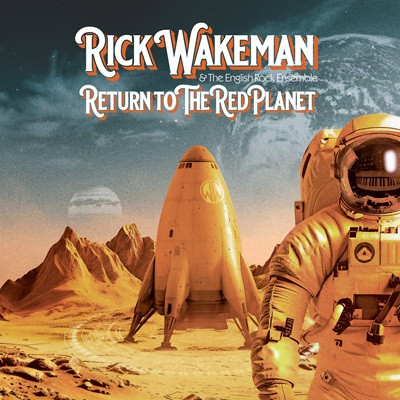
Return to the Red Planet by Rick Wakeman & The English Rock Ensemble
Release date: October 16, 2026Label: Madfish Music
Six years after Rick Wakeman took listeners to Mars with The Red Planet, released in 2020 during the upheaval of the COVID-19 pandemic, the legendary keyboardist returns to the Red Planet once again with Return to The Red Planet. Wakeman has certainly made a name for himself throughout his extraordinary career.
From his work with the Strawbs, David Bowie, Colin Scot, T. Rex, Cat Stevens, Black Sabbath, and Yes, to his extensive solo career and his work in film including the late, great Ken Russell, there seems to be no stopping him. His collaborations with Russell on films such as Lisztomania and Crimes of Passion further demonstrated how easily Wakeman could move between progressive rock, classical music, and cinematic composition.
Now, in 2026, Wakeman continues that journey with Return to The Red Planet, once again proving that there is still plenty of musical territory for him to explore within progressive rock. The album follows in the footsteps of his classic concept works, from The Six Wives of Henry VIII and Journey to the Centre of the Earth to The Myths and Legends of King Arthur and the Knights of the Round Table, the surreal beauty of No Earthly Connection, and one of my personal favorites, 1984.
That latter album, based on George Orwell’s dystopian masterpiece Nineteen Eighty-Four, featured contributions from Tim Rice, Cockney Rebel’s Steve Harley, Yes’ Jon Anderson, and Rufus’ Chaka Khan, among others.
And who could forget Wakeman’s return to the Centre of the Earth in 1999 with Return to the Centre of the Earth, featuring narrator Patrick Stewart and appearances from the likes of Justin Hayward, Ozzy Osbourne, and Bonnie Tyler? Wakeman has never been one to back down from a challenge, and there is still no sign that he intends to stop creating ambitious and adventurous music. Whether his music moves you or not, it is difficult to deny the power, imagination, and passion he continues to bring to progressive rock.
With Return to The Red Planet, Wakeman revisits the cosmic spirit of its 2020 predecessor while expanding the musical and conceptual journey. The Red Planet explored the Martian landscape through instrumental pieces inspired by its mountains, plains, polar regions, and enormous geological formations.
The new album goes even further, drawing inspiration from more recent photographs, research, planetary data, ancient landscapes, dust storms, and the geological history of Mars. Wakeman immersed himself in research and mission reports before writing the music, giving the album a strong sense of place and discovery.
This time, Wakeman is joined by the English Rock Ensemble, featuring bassist Lee Pomeroy, guitarist Dave Colquhoun, drummer Adam Falkner, and vocalist Mollie Marriott, daughter of the late, great Steve Marriott of Small Faces and Humble Pie. Together, they sound as if they are preparing to hurl themselves through the cosmos, making the jump to lightspeed and heading straight for Mars.
The album opens with ‘The Jezero Crater’, where dust storms collide and the wind begins to pick up. Wakeman unleashes a fanfare-like epic that recalls some of the grandeur of his King Arthur period.
It feels as though he is preparing to board his spacecraft for blast-off, with guitar and drums launching the listener toward the stars while Mellotron textures fly across the solar system. Mollie Marriott then moves into the spotlight with heartfelt vocals, accompanied by acoustic textures that seem to gaze through the stars as the journey toward Mars begins.
You can almost imagine the spirits of Gary Pickford-Hopkins and Ashley Holt looking down with pride as Mollie carries forward their legacy. Wakeman then launches into a concerto-like passage with an Italianate flair and an unexpected ragtime quality that recalls the adventurous spirit of his earlier work.
‘Bowie’s Vision’ is a tribute to Wakeman’s friend and fellow musical comrade David Bowie; the man forever associated with the Thin White Duke and Major Tom. It is also a deeply personal connection for Wakeman, who played the iconic piano part on Bowie’s ‘Life on Mars?’.
The piece begins with a mournful, almost militant drum pattern from Falkner, establishing the atmosphere while Wakeman’s Mellotron seems to send one final signal toward his old friend. Mollie’s vocals introduce a warmth and sense of loss, as if Bowie himself were still keeping an eye on Wakeman’s playing from somewhere beyond the stars. Colquhoun then enters with a Gilmour-esque guitar stab that shines brightly, introducing Floydian textures into the arrangement.
And then something happens in the final section.
A pipe organ emerges as though from a Gothic cathedral, with choir-like textures ascending from the heavens. Mollie’s voice welcomes the listener into this strange new world, while the music builds into a powerful fireball of sound and an ascending climax. The passage even recalls the symphonic-metal atmosphere of Edenbridge’s The Bonding. Wakeman has always been capable of pulling unexpected tricks out of the bag, and here he moves effortlessly from progressive rock into symphonic-metal territory.
That’s how he gets things done, done, done!
Meanwhile, ‘Noctis Labyrinthus’ evokes the spirit of Rock Progressivo Italiano. Wakeman conducts the ensemble through choir-like vocalisations, creating an expansive piece that seems to sit somewhere between the dramatic intensity of Metamorfosi’s Inferno, Murple’s Io Sono Murple, and the more symphonic side of Premiata Forneria Marconi. It gets the blood pumping as the listener prepares for another challenging musical expedition.
‘Noachis Terra (Land of Noah)’ takes us into one of the most heavily cratered regions of the southern hemisphere of Mars, an ancient landscape containing some of the planet’s oldest geological features. Wakeman slows things down here, moving into an ambient passage that feels like a landing on the red sands of Mars. Its moody, almost bossa-nova-like character gives the listener a chance to take a breath and admire the scenery before the journey continues.
Next comes ‘Witch Hazel Hill’, which feels like a roller-coaster ride. Wakeman gets down and dirty with the clavinet, channeling Kerry Minnear’s distinctive keyboard approach from Gentle Giant’s early work. The music roars and rumbles with the energy of another voyage into the unknown, recalling the adventurous spirit of Jules Verne. Colquhoun adds to the excitement with a cat-and-mouse guitar passage that almost feels like the soundtrack to the classic Bugs Bunny short Falling Hare.
Then ‘St. Paul’s Bay’ makes you want to stand up and dance. Its joyful rhythm practically begs for a sing-along in a British pub with a couple of Guinnesses before the music blasts off again. Wakeman’s keyboards then become the engines of the spacecraft, attacking asteroids and navigating through the cosmos one musical passage at a time.
With ‘Martian Dust Devils’, Wakeman settles into a lullaby-like arrangement with a new-age classical orientation. There is a clear nod to Isao Tomita’s Snowflakes Are Dancing, while the mysterious atmosphere brings to mind the question posed by Bowie in ‘Life on Mars?’. One can almost imagine the inhabitants of Mars watching from afar as Wakeman invites them to come forward and enjoy this strange, beautiful waltz.
More Mellotron and ominous guitar arrangements establish a rising, militant atmosphere as the spacecraft prepares to leave Mars and return home. The music then ascends into ‘Medusae Fossae’, named for one of the planet’s most distinctive geological regions. Colquhoun tips his hat toward the flamenco-inflected style of Ottmar Liebert, while Wakeman launches into a full-scale assault on the synthesisers, sounding like a mad scientist conducting bizarre experiments behind closed doors.
After the long journey, ‘The Epochs of Mars’ provides a sigh of relief. It feels like the crew has finally returned home after another extraordinary trip to the Red Planet. The epic fanfare returns, tying the album together while giving the listener a sense of completion.
Ghostly synthesisers create a Tangerine Dream-like atmosphere before classical piano enters with an almost courtyard-like elegance. Mollie’s echoing voice provides the final emotional lift, suggesting that there is still far more to discover on Mars than meets the eye. The piece brings the album’s journey to a hopeful conclusion while leaving the door open for another adventure.
Return to The Red Planet is epic, beautiful, surreal, and, above all, a tremendous amount of fun. Rick Wakeman has once again taken the familiar language of progressive rock and sent it into orbit. Six years after The Red Planet, he has found new inspiration in Mars, combining science, imagination, cinematic textures, symphonic grandeur, and the sheer adventurous spirit that has defined so much of his career.
With Lee Pomeroy, Dave Colquhoun, Adam Falkner, and Mollie Marriott alongside him, Wakeman proves that the journey is far from over. Mars may be millions of miles away, but in Wakeman’s hands, it feels remarkably close.
Here’s to many more adventures among the stars.