Cathedral’s ninth studio album, The Guessing Game, is arguably one of the band’s finest releases of the early 2010s. Originally released in 2010 through Nuclear Blast, the album has been described by Phil Freeman of AllMusic as the band’s “most psychedelic, progressive material in the band’s entire catalog”. It’s hard to believe that Cathedral called it a day in 2013, but what an incredible legacy they left behind.
Revisiting the 2010 release in a reimagined edition through Lee Dorrian’s Rise Above Records showcases a complete overhaul of the band’s masterpiece. Unhappy with aspects of the original mix, the band revisited the recordings with the help of longtime Cathedral collaborator Jaime Gomez Arellano, remixing the album in Portugal. For Dorrian, the process was like visiting an old friend he hadn’t seen in a very, very long time.
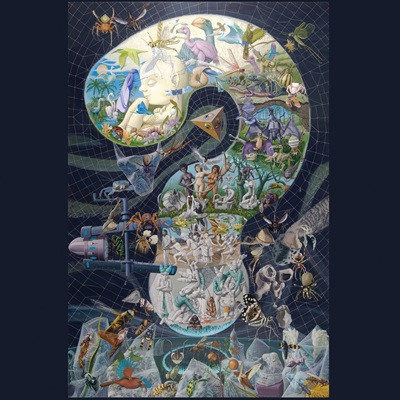
The original artwork by Dave Patchett has also been retained, with the presentation restructured to reflect the album’s musical progression and incorporate more of Dorrian’s ideas. Patchett’s illustrations come to life through the massive question mark that dominates The Guessing Game. Arellano’s remix draws on the original master tapes, presenting extended and previously unheard material that expands on the original 2010 release.
Take ‘Death of an Anarchist’, for example. The original 2010 mix, handled by Warren Riker, had to be trimmed to accommodate the limitations of the 2-CD release. The 2026 remix strips away some of the polished sheen in favour of a more aggressive, heavier arrangement that captures the ferocity Cathedral had envisioned. The band pushes the track to its limits, unleashing a galloping, brutally thrashing attack that hits like a kick to the gut. The extended outro adds to the intensity, creating a genuine electrical storm that recalls Van der Graaf Generator’s climactic assault on ‘White Hammer’.
The Mellotron on the title track might make you imagine Lee Dorrian using it as an alternate soundtrack to Ken Russell’s 1965 British television film The Debussy Film, starring Oliver Reed. You can hear elements of Gracious, Cressida, and Museo Rosenbach in the progressive-rock influences Cathedral had up their sleeve, proving that the band’s musical imagination extended well beyond the genre’s biggest names.
The opening track, ‘Immaculate Misconception’, showcases thumping metallic bass, pounding drums, Jacula-esque organ, an oboe-like quality, and a brief synth passage that helps create a chant-like nightmare as it begins to unfold. As I’ve mentioned before, Cathedral seem to be creating their own Ken Russell film before the listener’s eyes. The wildly flamboyant, over-the-top imagery makes you want to see, and hear, more.
The eight-minute bruiser ‘Funeral of Dreams’ knocks the original 2010 mix out of the ballpark. The pounding riffs, tidal-wave drum crashes, and Dorrian’s psychedelic doom vocalisations give the track an enormous presence. Then, the music shifts into a surreal, picturesque blend of folk and krautrock that evokes Amon Düül II’s Tanz der Lemminge. The result is a wonderfully quirky, avant-garde arrangement that captures Cathedral at their most adventurous.
We shouldn’t overlook drummer Brian Dixon, whose explosive playing adds another vital dimension to Cathedral’s legacy. During the opening 16 seconds of ‘One-Dimensional People’, listeners might think of Bill Bruford, but there’s also a touch of Bill Ward and Elvin Jones in the rhythmic attack. As the instrumental rises from the grave, it unleashes a torrent of terror, conjuring an occult-like doom landscape preparing for battle in a dystopian world of chaos and disorder.
Gaz Jennings leads the charge with his riffs, locking into Leo Smee’s metallic bass lines as Dorrian unleashes his inner Jekyll and Hyde on ‘The Casket Chasers’, complete with a snarling monster voice. The result sounds like something straight out of Tales from the Crypt, Heavy Metal, or Netflix’s animated anthology Love, Death & Robots. It’s the kind of gloriously over-the-top spectacle that would make the Marvel Cinematic Universe piss its pants and bow its knees to Cathedral. Now that’s how it’s done, done, done!
The crescendoing introduction to ‘Painting in the Dark’, driven by Jennings’s guitar lines and an epic wah-wah sound, hits with a celebratory rush. It has the makings of a beer-drinking, motorcycle-revving anthem inspired by the mighty Judas Priest, delivering the goods with plenty of swagger and power.
The album’s sprawling finale, ‘Journey into Jade’, brings Cathedral’s musical journey full circle. Drawing on the band’s extensive discography, it takes the listener on a roller-coaster ride through the sounds, ideas, and musical landmarks that shaped their career. There are plenty of Easter eggs for longtime fans to discover, making the track feel like a celebration of everything Cathedral accomplished over two decades.
At around the 9:32 mark, the track features the voice of Dave Patchett, the artist responsible for many of Cathedral’s album covers, discussing the themes behind the artwork for The Guessing Game. His reflections on religion even prompt a chuckle from Dorrian in the background, adding a personal touch to the experience.
Although we still miss Cathedral, it’s wonderful to see the band’s music receiving renewed attention and the recognition it has always deserved. This remix rekindles the fire in their legacy, revealing new details in an already remarkable album. For longtime fans, it’s an opportunity to rediscover a classic; for newcomers, The Guessing Game is an excellent place to start exploring Cathedral’s extraordinary world of psychedelic doom, progressive rock, and wonderfully eccentric musical experimentation.