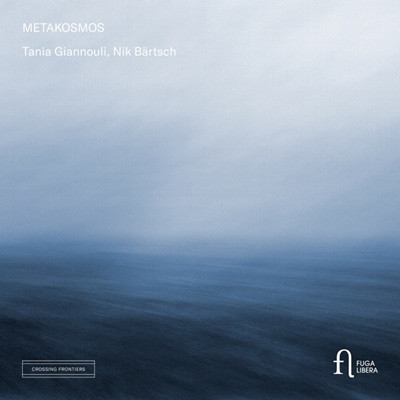
This is where I have to give Innerviews founder Anil Prasad credit for making me rediscover the music of Nik Bärtsch once again. After reading his interview with Bärtsch and pianist Tania Giannouli about their new album Metakosmos, on the Innerviews website, I immediately went out and bought the record to find out what all the fuss was about. After all, Anil has introduced me to some genuinely great music over the years.
Whether it’s Levin Brothers, Amir ElSaffar, Anouar Brahem, or Robert Berry’s 3.2, Anil has an excellent ear for both established and emerging artists. His interviews have a way of piquing my curiosity and encouraging me to discover music that might otherwise have passed me by.
With Metakosmos, I found myself taken on a passionate musical journey filled with beauty, meditation, surrealism, Bartók-inspired influences, ambient textures, and classical boundaries that seem ready to be pushed wide open. Drawing from Balkan musical traditions and the intimacy of chamber music, Bärtsch and Giannouli create something that feels both adventurous and deeply connected to their individual musical backgrounds.
According to Prasad’s interview with the duo, the seeds of this partnership were planted in 2022 when both musicians were artists in residence at Germany’s Enjoy Jazz Festival. What began as an idea for a collaboration eventually developed into a piano duo, with their partnership continuing to evolve through performances in Europe. Their musical chemistry is fascinating, particularly in the way they bring improvisation, precision, and spontaneity together. Listening to these two pianists interact, you almost feel as though you are sitting in the audience, witnessing something extraordinary unfold right in front of you.
Bärtsch brings an especially intriguing approach to the piano, incorporating percussion-like techniques and plucking the instrument’s strings to create unusual textures. This is particularly evident on ‘Intonal’, where a melodic opening gradually takes on a darker, almost ominous character. The two musicians build an atmosphere that suggests a world on the brink of collapse before eventually settling into the warmer, more classical surroundings of ‘Electric Sea’.
Their individual approaches to the piano make this recording such an eye-opening experience. You never quite know where the music is going to take you next, and that unpredictability is part of its appeal. On ‘Willow Wind’, the plucked piano strings create an almost overture-like atmosphere, transporting me to a lonely lighthouse surrounded by bitterly cold weather somewhere in the heart of England.
You can practically feel the tension building as the storm approaches. Darker musical connotations begin to emerge, with the sound growing increasingly thunderous and overwhelming.
Giannouli seems to establish a kind of musical shelter, as though people are rushing indoors to prepare for the worst before the weather takes a turn for the worse. It’s an incredibly cinematic listening experience, one that allows your imagination to run wild.
Meanwhile, the waltz-like character of ‘Glass Labyrinth’ takes you inside an abandoned mansion, where a ghostly dance seems to be taking place. Its eerie Art Deco surroundings feel untouched since the late 1930s or early 1940s, as though the building has been left behind by time itself.
There is something wonderfully mysterious about the way the two pianists create this atmosphere, allowing the listener to imagine the history and secrets hidden within those walls. Another centrepiece is their tribute to Hungarian composer Béla Bartók, which comes through on the closing track, ‘Bela’s Move’.
Both musicians have a deep appreciation for Bartók’s music, and the piece reflects that connection, particularly through its nod to the composer’s Mikrokosmos. The duo takes this inspiration and makes it their own, combining intricate rhythmic patterns, unexpected movements, and an adventurous musical language that keeps the listener guessing.
There is a fascinating sense of musical dialogue throughout the piece, as the two pianists move back and forth between one another, building tension and momentum. It almost feels as though they are composing a soundtrack to a battlefield, with each musical exchange representing another development in the action unfolding before the listener’s eyes. You can imagine the soldiers preparing for what lies ahead, knowing that once the battle begins, there may be no turning back.
Metakosmos may take a little time to get used to, but that is part of what makes it such a rewarding listening experience. Bärtsch and Giannouli have created a remarkable body of work that explores the relationship between classical music, jazz, improvisation, and world music while bringing their own distinctive personalities and musical backgrounds into the equation.
What makes this album so compelling is the way these two pianists challenge one another without losing sight of the beauty and emotional depth behind the music. There is always something lurking beneath the surface, waiting to reveal itself when you least expect it.
And that is where the real danger lies: just around the corner.