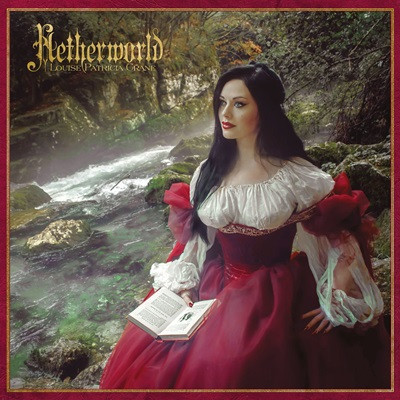
It’s been four years since Louise Patricia Crane had unleashed her 2020 debut album Deep Blue on her own label Peculiar Doll Records. This was at the time the pandemic was still going on. And it’s quite a debut for Crane to delve into her story-telling textures around that time frame. Well, her wings have finally spread as she prepares for another take-off with her second follow-up Netherworld.
Her new album delves deep into her musical background by going into those dark and hidden passageways to have her own individuality and her own self-guidance on who she really is. It’s a spiritual journey that the Netherworld embarks on. It’s a task that you as a listener travel with Ms. Crane to find your own voice, and find your own true self.
And with the help of collaborators including her partner in crime of Crimson’s Jakko M. Jakszyk, Mel Collins, and bassist Tony Levin. Followed by pianist and drummer Gary Husband, violinist Shir-Ran Yinon, and Nick Beggs (Steven Wilson, The Mute Gods). They know that Louise is more than just a multi-instrumentalist by playing guitar, keyboards, and using an EBow, she uses her voice to guide us into these parallel worlds that are filled with even more mysteries, waiting for us to be a part of her journey.
‘Dance with the Devil’ begins with a spooky introduction from Crane. She sets up the scenery with the waves crashing in the middle of Borrowdale with a beautiful Tolkien-esque location before the booming intense percussion exercise begins to kick in.
Not only there’s the flamenco approach, but the folky textures kicking in like a massive explosion with the Celtic backgrounds, swaying back and forth. There is some heavy brutality in the guitar textures, but Louise walks into deep and heavier territories that are worth investigating.
Meanwhile, ‘Tiny Bard’ returns again to the folky aspects which speak of Led Zeppelin’s ‘Going to California’, Peter Gabriel’s ‘Solsbury Hill’, and the acid folk unsung masters of Trees’ The Garden of Jane Delawney. There are moments on Netherworld where we see Crane delving into the themes of the struggle to carry on.
From the lost in time of hurling through the cosmos with a string quartet and soaring guitar solos on ‘Celestial Dust’, the Mellotron lullaby with its Kate Bush approach for the ‘Little Ghost in the Room’, and reflecting the loss of innocence, tackling the elements of Genesis’ Trespass-era with its Anthony Phillips structure on ‘Toil and Trouble’.
When I think of ‘The Red Room’ I don’t think of its psychedelic approach, but there are bits and pieces of Marillion doing a waltz-like theme during the sessions of Misplaced Childhood that comes to mind with Rush’s Geddy Lee handling in the production levels as Louise adds in that flavor to put in a mixture of both. Not to mention its warm sunbeam phase by walking on the beach with its crimson arrangements near the end.
Returning back to the woods once more, you feel the Frippertronics around its surrounding area for the return of the ‘Spirit of the Forest’ while ‘Bete Noire’ walks into the early 1950s in the heart of Paris with an eerie score to find the criminal who has left more clues for the mundy detectives to put the pieces together as you go through a trance of a jazzy waltz that is in the forms of Miles Davis, Radiohead, latter Floyd, and Stone Temple Pilots for the ‘Midnight View’ to happen.
Another crowning return for Crane to deliver another welcoming return after her 2020 debut during the pandemic. She’s here to stay, and she’s never turning back.