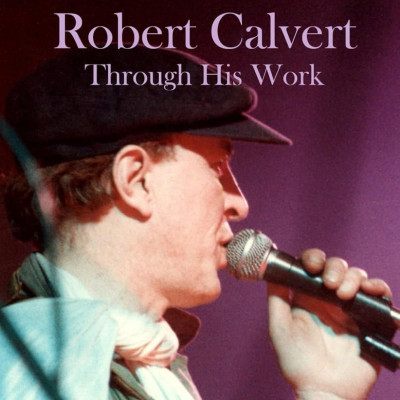
To those who have been following Timothy Forster’s series of essays on Robert Calvert, his new book, Robert Calvert: Through His Work, will be no surprise; but others are best forewarned that this is not a biography of the longtime Hawkwind lyricist and singer, but rather a more academic study of Calvert’s work in the context of its sociopolitical and cultural influences. For Forster, Calvert is a creator uniquely qualified to speak both to the moment in which he lived and wrote and to the future he would not live to see.
Forster sets out to analyze Calvert’s writing — in particular his lyrics for Hawkwind/Hawklords, but also his poetry and plays — in a set of contexts that includes ethics, temporality, futurology, politics, Calvert’s tendency towards collaborative work and his stage persona. He also explores Calvert’s theatrical work (both as actor and playwright) and his post-Hawkwind recordings, and provides an entire chapter focused on the Hawklords album 25 Years On. The book is fleshed out with many appendices and references, including the full transcript of an interview with music writer Joe Banks (first published here on Echoes and Dust).
Woven throughout the book are the ways in which the Thatcherian political and social environment both drove and inflamed Calvert’s creativity. For example, “Calvert’s opposition to imperialism and capitalism… and his concern over environmental matters came together in the lyrics of ‘Uncle Sam’s on Mars’… the song is a damning indictment of capitalist imperialism, in this case extra-terrestrial. Destruction of habitats, desertification, the hegemony of unfettered capitalism, americanisation are all referenced…” Calvert’s poem “True Brit” “is no jingoistic celebration of Britishness! In it he discusses the lack of nuance in the English language, the stratified class structure of British society, its internalisation so that ‘our class will cling to us, like the symptoms of an hereditary disease.’” Calvert’s frustrations with the ongoing push to monetize Hawkwind’s music, with individualism as opposed to collectivism, with racism and with neoliberalism, are made evident.
Forster includes a fistful of references to literary and political-literary influences as example of the ways in which Calvert both drew upon and commented on the culture around him. Herman Hesse’s book Steppenwolf, the American anti-marijuana film Reefer Madness, Roger Zelazny’s books Damnation Alley and Jack of Shadows all make appearances, as do William Burroughs’ The Naked Lunch and J.G. Ballard’s High Rise. A poetry book makes a connection to Bradbury’s Fahrenheit 451; a play, to a Jimi Hendrix song.
In the chapter on “Theatre,” Forster breaks from the non-biographical tone to helpfully outline Calvert’s work in that art form, something which may be unfamiliar to fans of his musical oeuvre. Calvert’s acting work included conventional acting, street theatre and performance art, and these clearly influenced Hawkwind’s concert stage shows. “Mine’s an acting job really, I have to embody what the music’s about,” he says. Forster makes a strong case that theatre was central to Calvert’s art; e.g. Calvert’s wife is cited as noting that “when he died he was going to actually go back to University to study drama” and that “[Bertolt] Brecht was a major influence” on Calvert’s work overall. Calvert himself noted that rather than listening to much music or going to many concerts, he chiefly attended “fringe theatre” partly in an effort to “keep [his] musical influences pure.” Calvert’s many staged plays reflect conscious connections with music, however; The Stars that Play with Laughing Sam’s Dice and Cattle at Twilight feature Jimi Hendrix and make references to David Bowie, and there are connections between Calvert’s “The Clone Poem,” used in “Spirit of the Age,” and his play Mirror Mirror.
As Forster warns in his introduction, because much of the book was originally published as a series of essays, there are a number of repetitive elements, but they typically appear in different contexts in order to underscore a variety of points. There are a few puzzling aspects here and there. For one, Forster elides a whole literature of science fiction dealing with androids as sex partners, citing only Asimov’s I, Robot series and Fritz Lang’s seminal movie Metropolis — both relevant, but not solely so, making it sound as if Calvert had effectively invented the subgenre. Calvert is referred to usually as “Calvert” but in some chapters as “Robert” (possibly an artefact of the way the book was assembled from individual essays). And it’s not evident why, throughout the book, he chose to draw so many references from Wikipedia rather than from primary sources.
But all in all, Robert Calvert: Through His Work makes a persuasive and comprehensive argument for Calvert as both an insightful futurist and a product of, and clear commentator on, his era. Forster’s thesis should add depth to listeners’ experience of Hawkwind/Hawklords, and spur fans to seek out Calvert’s extramusical work.