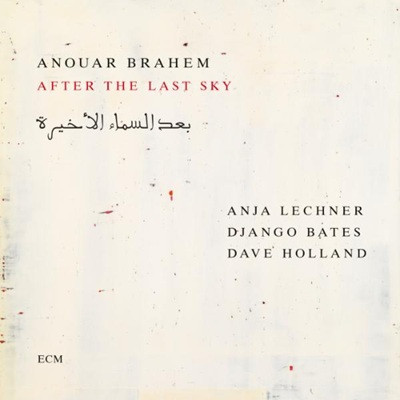
I have to give Innerviews: Music Without Borders founder Anil Prasad credit for mentioning about this next album on social media, a few months ago this year, and getting me back into this next artist that completely caught me off-guard when I was re-introduced to the world of Anouar Brahem’s music with his new album, After the Last Sky released on the ECM label this year. I first became aware of him when I bought the 2017 album Blue Maqams which consisted of Dave Holland, the late, great Jack DeJohnette, and Django Bates. And then, I completely forgotten about it and Brahem’s music, eight years ago.
Until now. Once I delved back into Brahem’s world after listening to After the Last Sky, I couldn’t stop replaying this album again. Listening to After the Last Sky, it takes us into this deep, underwater-like realm that Brahem himself along with Django Bates and Dave Holland’s return, followed by cellist Anja Lechner bringing into the fold, it pushes you into unbelievable results in which the quartet takes a steady approach between European classical music, jazz improv, and Arab music as a primary influence.
For Brahem, this isn’t just a return back into the Blue Maqams-era, it’s almost a continuation on where he left off and seeing where the direction, they’ll take us. With 10 studio albums in the can featuring collaborations Ofrom Lassad Hosni, Barbaros Erkose, John Surman, Klaus Gesing, Francois Couturier and Jean-Louis Matinier to name a few, Tunisian-based Brahem uses his oud, a Middle-eastern short-neck lute-type fretless stringed instrument, into the heart of his home country.
When you listen to ‘The Eternal Olive Tree’ the collaboration between Dave’s string bass and Anouar’s playing, is a very intense, turned mid-fast pacing collaboration that explored different edges in the landscapes they endure to prompt its listener to be in awe of what they’re about to witness. There’s also a sombering texture when Lechner’s cello brings in this saddening atmosphere detailing the chaos and the aftermath of a war gone horribly wrong on the opening track ‘Remembering Hind’.
With Bates’ piano hanging in the balance, in its minor and major keys, you get a sense you’re walking in the battlefield, detailing the gruesome scenery and the demise that occurred for a brief moment before the quartet brings in the desertry landscape into the fold when it comes to the ‘Endless Wandering’. Here, Holland, Bates, and Brahem set up the heavy winds in the heart of Egypt, walking towards a particular part of history in the ancient tombs that’s about to unfold.
For Anja Lechner, who has a classical background, marking the first time she appears on the album, she’s at the right place at the right time to work with amazing artist to bring Anouar’s album to life. ‘Awake’ has this spectacular sense of a dance-like structure in the arrangements in which Bates sets up the tempo for the others to create this composition in where the fire gets build up to a spreading amount of terror thanks to Brahem’s incredible improv on his oud.
They return to the fold on ‘Dancing Under the Meteorites’. It is a joyous celebration for them to enjoy and create more of the intensity that spread throughout the piece between Anja’s ominous sound, Holland’s bass work, and rain-dropping effects Bates unfolds to create the chaos to set up this clock-ticking momentum in which Brahem channels the sounds of Ottmar Liebert throughout his playing.
A powerful album released this year, proving ECM have taken it up a notch when it comes to world music on After the Last Sky. The combination of a four-piece on this wonderful gem, you never know what to expect with its welcoming approach to see where the next journey would take them in the years to come.