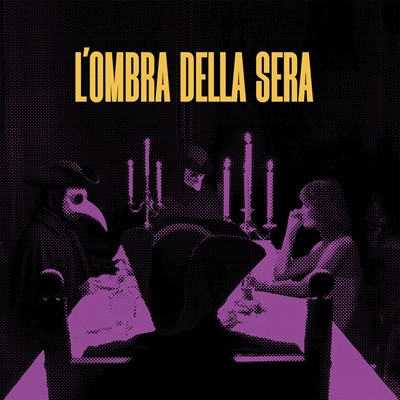
From the moment ‘Albert e l’uomo nero’ begins, you feel as if you’re hearing the opening pulse of Mike Oldfield’s Tubular Bells, only re‑imagined by Goblin and transported into a parallel universe where they scored William Friedkin’s 1973 horror classic The Exorcist. It sets the stage for L’Ombra Della Sera’s continuation of their sole 2012 self‑titled debut, now expanded into Segreti Nel Nero (Secret in Black), an alternate soundtrack to the late ’60s and ’70s Italian giallo cinema that so many people know and love.
But this is a different kind of cinema. In the ’70s, Italian television, still largely black‑and‑white, was a small box filled with sci‑fi, mystery, thriller, and supernatural drama. Shows that later became cult classics, Gamma, Ritratto di donna velata, Il segno del comando, La traccia verde, L’amaro caso della baronessa di Carini, and A come Andromeda, defined an era of atmospheric storytelling that lived somewhere between folklore, paranoia, and cosmic dread.
L’Ombra Della Sera, the alter ego of La Maschera di Cera (active since 2001 with six studio albums and an international following), channel that era with remarkable precision. Their sound becomes an imaginary TV show inside your head, woven from vintage instrumentation, analog synths, ’70s Italian prog, hints of Van der Graaf Generator, and early Genesis. Listening to Segreti nel Nero feels like stepping into a dream where these Italian sceneggiati, RAI‑produced adaptations known for their eerie tone, are resurrected with modern fidelity and progressive ambition.
Released on Black Widow Records, the band elevate their homage with a psychedelic‑progressive chamber approach, occasionally drifting into jazz‑tinged shadows. It isn’t just a unique album; it’s the alternate soundtrack we imagine when remembering the shows that shaped their youth.
‘Fantastic Fly (Racconti Fantastici)’ marches in with militant drums and an Adagio‑like solemnity, heading toward a battlefield of bass, mellotron, oboe, and moog‑driven terror. Even without knowing the original show, the music makes you want to seek it out and understand the world it came from.
‘A come Andromeda’, the Italian remake of the 1961 BBC sci‑fi drama, floats through cosmic synths orbiting harpsichords, choir‑mellotron effects, cello, and strings. It crystallises into a sinister, Monk‑like score, bass, electric keys, and howling saxes crying into the night.
With ‘Gamma’, the spirit of Ennio Morricone hovers over the arrangement. Sera honour the composer’s influence with passages of sadness, claustrophobia, and the sense of being trapped in a cell with no escape. Odd rhythmic shifts, spaced‑out synths, and drifting mellotrons evoke a planet where hope flickers but never fully ignites.
The Beatle‑esque introduction of ‘Ritratto di donna velata’ brings a dream‑like flute mellotron before saxes ascend like a stairway into the Milky Way. It’s quiet, moody atmosphere eventually tips its hat to Unreal City with ghostly synths in the final minute. Then ‘La ballata di Carini’ bursts forth with vocals calling to the gods from mountaintops, part Danse Macabre, part waltz‑on‑a‑tightrope, part 1930s cabaret collapsing into dystopia. It even evokes the surreal psychological landscape of the BBC’s The Prisoner starring Patrick McGoohan.
And then comes the towering epic: ‘Le venti giornate di Torino’, a 19‑minute colossus. It begins with spacey moog bleeps and blurps before cymbals and bass twist into a Van der Graaf‑like nightmare, plunging straight into Pawn Hearts territory. Its eight sections turn unpredictably, never letting you relax, urging you to keep a candle lit so nothing crawls up your spine. You can hear the band absorbing Van der Graaf’s discography, mixing it with King Crimson’s Lizard era and a touch of Murple’s Io Sono Murple, as if Stanley Clarke produced it in an alternate timeline.
Whether it moves you or unsettles you, L’Ombra Della Sera deserve immense credit for crafting their own homage to the Italian TV shows that shaped them. Segreti nel Nero isn’t just a tribute, it’s a resurrection. It’s the sound of forgotten broadcasts flickering back to life, of static turning into visions, of memories sharpening into something vivid and cinematic.
What makes the album linger is its dual nature: so beautiful, so disturbing, always shifting between dream and nightmare. You feel as if you’re standing in the studio with them, watching each passage take shape, witnessing a band that understands the power of atmosphere and the gravity of its influences. They channel the ghosts of Italian sceneggiati with such conviction that you’re reminded why these stories mattered, and why they still do.
In the end, Segreti nel Nero proves that L’Ombra Della Sera still have the fire, the imagination, and the daring spirit to transform nostalgia into something alive. It’s a work of devotion and craft, a parallel‑world soundtrack that pulls you in and refuses to let go. They haven’t just revisited the past; they’ve rebuilt it, illuminated it, and made it breathe again.