By Dan Salter
As soon as we'd had a bit of a play with the Musicjelly mixing player we knew this was something very cool but also something that a lot of time, effort and energy had been put in to. We were so impressed with the idea that we were desperate to know more so we spoke to the team behind the project; Zahara and Ben.
(((o))): Can you give us a bit of background on yourselves & how did you start working together? Is Musicjelly the first project you've done together or the culmination of a longer relationship?
We met at The Premises Studios in Hackney Road a few years ago, Ben & Tom (Repairman) had a large studio on the top floor where they were producing their songs. Repairman had released with Fierce Panda and just as they were getting calls from record labels to sign for an album the band dissolved. This knocked out Ben for a while but we started to collaborate on different songs, trials of personal projects. At the time there was a lot of discussion about the increased difficulties for independent artists to be signed and we were just enjoying the process of writing and jamming without any aims. When we formed a band together all those discussions took us to think we could explore releasing using video as a medium and released the first The Nyco Project EP (The New Machine) as an interactive app with the support of the Arts Council last year. Over the 3 years we kept working on the concept, it evolved into something we thought could be interesting not just for us but for many other artists and this is how Musicjelly started taking shape.
We work with Will Marsh and Andrés Pachón who started helping us build the installation two years ago- both very talented sound engineers who don’t fear getting their hands dirty with programming, recording artists, mixing or building a screen from scratch, or any other challenge that Musicjellly brings upon us (and there are many!). Sean Henry brings in his knowledge on app coding, and online Simon Riley helped us build the player, Tim Williams the library and we are at the moment working with Tom Szirtes, a brilliant programmer and DJ.
(((o))): Without giving too much away, can you tell us something about how the technology works?
We record artists performing an improvisation in the same key and tempo, turn them into audiovisual loops and sync them so that the multiple videos play back together in time as they are triggered by the audience. People can select different loops and mix & match them to create their own musical compositions at the same time that they discover the artists, instruments and locations where the improvisation was recorded.
(((o))): Where have you sourced the samples from? Has it taken a long time to put together & are you planning to keep adding to the libraries?
For the last three years we have been recording artists everywhere we go, always carrying a bag with the recording equipment, this includes festivals, undergrounds, streets, canals, halls, fields, art schools, parks, gardens, flats and anywhere else. For the inTRANSIT festival we're filming artists across Kensington & Chelsea borough to create an installation, online palettes and app that showcases its musical community and iconic locations. In the last two weeks we have been recording great musicians and spoken word artists at places like Sarm Studios (including Bob Marley’s old flat at the top) thanks to the kind help of Aaron Horn and colleagues, at the 606 jazz club with the support of owner Steve Rubie, Mau Mau and the Tabernacle at Portobello, Portobello road, the Troubadour, Cadogan Hall, the KPH in Ladbroke Grove run by Vince Powers (Hop Farm, Benicassim festivals), Sloane Square, Westbourne Green, Wormwood Scrubs…
It’s all quite intense work, recording and editing video and audio, adding all the loops into the different libraries, including the artist's biogs and links to their websites, preparing the installation productions… And it’s not many of us. We have now released a Musicjelly Recorder which we hope will help us with the process by enabling anyone to contribute with their own loops. The uploading process still needs to be automated but the recorder is the first step to multiply Musicjelly's possibilities without us having to trail the road and edit for months!
We’re also working on making it possible to have online access to the extensive library we have built so that people can create their own palettes online, modify volume and left/right panning and also collaborate remotely, have a personal profile to save the compositions and loops and a few other things.
Musicjelly showreel from Musicjelly on Vimeo.
(((o))): It's a lot of fun to play with online, how is it going to work for the 'live' installations?
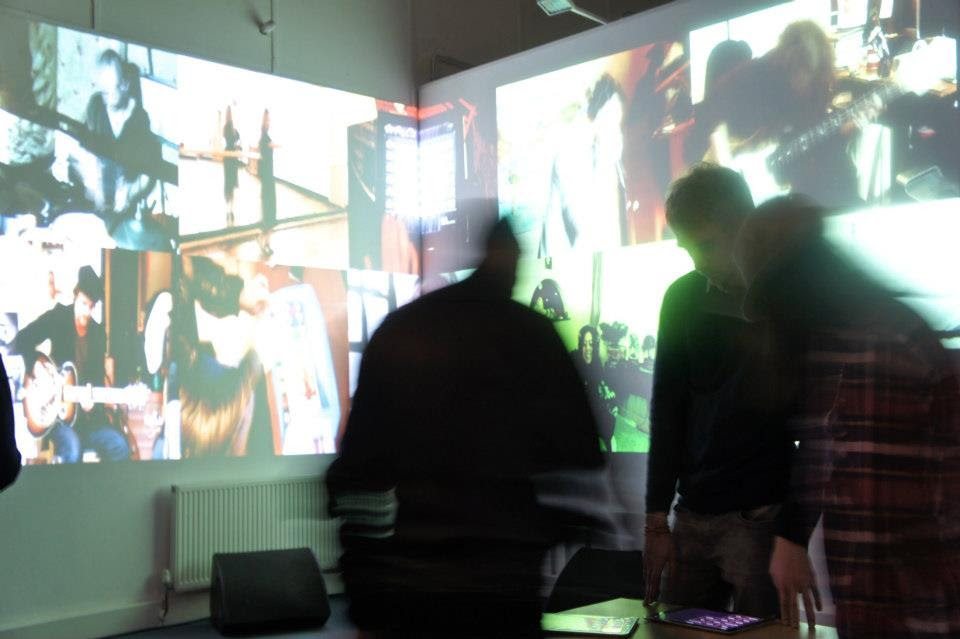
The palettes of loops both online and in the JellyMix app are more limited due to technology constraints, in the installation the options multiply thanks to a powerful set up that enables us to include many more variables. We place four touch-screens in front of the canvas where the visuals are projected, the touch-screens are the launch-pads of the audio-visual loops and they feature all the thumbnails of the musicians available on the system. To trigger a loop and the visuals of its original take, you just have to touch on a thumbnail, and tap on it again to stop it. When triggered, the loops always synchronise with everything else and will wait for the right bar to come in, as well as they will also leave in time, it’s very neat. They are organised in categories/channels and like in our player online you can add to the composition by choosing loops from different channels, or replace a loop with another within the same channel. The size of the projections depends on the space, we have projected the artists on Igloo’s 360º domes, on walls and also screens of all sizes. At the Barbican we set up a 6m screen, it looked amazing.
(((o))): If you'd have known at the beginning what a huge project this was going to turn in to, would you have done anything differently?
As with all new ideas we would have liked to avoid many steps along the line, test failures, hours of research, emails and huge unnecessary costs on dead-end experiments. We had never done this before, there weren't references to learn from as it was a very innovative idea. If we explained it to people they just looked puzzled, the only way to help people understand was by showing them, so test and failure was necessary to get there. We lost our way at one point and got stuck on a complex idea we couldn’t create...
Everywhere we looked said that what we wanted to do was impossible online, but we found workarounds and the way we did it made it actually great to play with. For sure with the right knowledge we would have worked faster. We would have also worked faster with appropriate funding, but could have also made a lot more expensive mistakes! Things are the way they are - we might have ended up doing things the way someone else wanted us to do them, instead we found people who supported us because they believed in what we were doing, this has really helped us keep on moving forward.
And we still rehearse with our band and have launched an interactive music video EP (The New Machine) that also integrated these ideas.
(((o))): Imogen Heap is very much at the forefront of interactive music technology at the moment and she's picked you guys to take part in the Interactive Sonic Playground next month. Is that something you're looking forward to?
Very much! We share Imogen’s passion for experimentation and being asked to be at the Roundhouse is a big deal! We also really like the name chosen for the scene we’ll be part of, the "Interactive Sonic Playground”, really fits with the personality of our project - It's pretty avant-garde to put up such thing in a contemporary classical music festival.
(((o))): Do you have future plans for Musicjelly beyond the installations you are doing and any plans for what comes after?
We want to make Musicjelly a playing and collaborative platform, that’s why we’ve released the Musicjelly Recorder. The extended library and personal dashboards will be accessible soon, and with that the possibilities to create with others will open up.
For inTRANSIT we will release a new app with the loops we have collected over the last two weeks and this autumn we’ll also release the second series of interactive music videos by The Nyco Project The New Machine II.
(((o))): Thanks for your time guys, we are looking forward to seeing it in action.
Musicjelly will be appearing at three locations over the next few months and we recommend you check them out if you can.
inTRANSIT Festival - 18th–27th July - Kensington & Chelsea
Reverb Festival - 21st–24th August - Curated by Imogen Heap at The Roundhouse, Camden
Music Tech Fest - 5th–7th September - London