By Simeon Ralph
It's no secret that I am thoroughly inspired by the genius (a word I use frugally) of Mr Andrew Falkous. From the gleeful sardonic racket of Mclusky, through the spleen liquefying riffs of Curses, and beyond to the lyrical experimentation of the latter Future of the Left albums; I could easily write an essay on the output of either band, stating they were the single biggest influence on me musically and get away with it...but I'd be a filthy fantasist if I did.
Fashoda Crisis have been around a long time now. April will mark our eighth year as a gigging band, and way back in 2005 a review of our first three track EP surfaced on the now defunct teletext page (it was like the Internet but without the porn, young 'uns). It said something along the lines of "anybody missing the scabrous punk of Mclusky would do well to check out this EP". I had only the vaguest notions of who Mclusky were at this point, I'd heard them do a Triple J session when I was travelling in Australia, and they made me chuckle, but I didn't make the connection. The review prompted me to investigate further, and I devoured their back catalogue with gluttonous glee...but the ugly truth remains, the comparison between us and they preceded my knowledge of them. Although they have become an influence on us, there was another band entirely that shaped the way I ham-fistedly approach guitar playing in a more profound way. If I hadn't discovered Urusei Yatsura when I did, I doubt I ever would have formed a band in the first place.
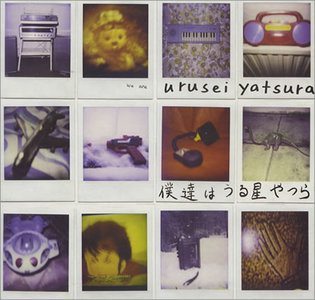
I haven't always been the jaded, cynical world weary music snob that I am today. I was young once and a late bloomer in finding my musical identity. I dabbled with the guitar here and there, but with no inherent musical ear I laboured through the ‘Nirvana Unplugged’ tab book and churned out feeble minor chord dirges with sixth form poetry lyrics. It wasn't until I arrived at University and was arbitrarily assigned an obese Welsh housemate with a predilection for eating curry straight from the wok and a Peel-esque music collection that I discovered how important music would be to me. I owe Marc Evans a debt that can't be repaid. I treated his CD rack as a library and it was he that first played me ‘We Are Urusei Yatsura’.
From the opening ringing chord and muddy riff of 'Siamese' I was hooked. Duelling gibberish vocals bouncing over, under and around a pop melody that has no right to share space with the umpteen wailing guitar lines. Urusei Yatsura could easily have been a fluffy pointless pop band, but they gleefully strangled each melody. The influence of Sonic Youth at their most accessible is always present, and at times their natural Glaswegian accents do veer to the other side of the Atlantic, but I am nothing if not forgiving when it comes to this band. They are just so fucking joyful. They gave birth to a beautiful litter of pedigree pop puppies and then contaminated the gene pool by breeding them with a flea bitten mongrel born of lo-fi fuzz, yelps and feedback squall stock.
They wear their influences on their sleeves; as well as the obvious nods to Sonic Youth, there is the Calvin Johnson tribute 'Pow R Ball' which begins with howling gang vocals, has a simultaneously throbbing, but loose, repetitive riff throughout and tongue in cheek lyrics with a mildly sneering delivery. If it wasn't for this track (and their cover of 'Bewitched', a later b-side) I probably would never have stumbled upon Beat Happening, another inspiration as they showed me that anyone can be a vocalist and who also opened the door to The Halobenders and their sublime album ‘Don't Tell Me Now’.
'Kewpies like Watermelon' continues the manic frenzy, throwing bellowed backing vocals, buzz saw distortion and toys jump into the mix, alongside the inevitable guitar hooks and gentler moments. Named after a Japanese anime, the band also make no bones about their geekiness. Indeed, they wear their outsider status like a badge of honour. On 'Phasers on Stun' they revel in it, "I was drunk at the comic convention", but the snide delivery cuts through the syrup and the way they effortlessly segue into the bipolar 'Sola Kola' which sounds like it was recorded in the toilet of some grubby long defunct venue sums up their musical pluralism. The album bristles with pace until this point, where it grinds to a barking halt.
'Black Hole Love' has the potential to be saccharine filler, it's a ballad of sorts, except the guitars emulate the lonely howl of a soaked and mangy alley cat, and the vocals could almost be Leonard Cohen, if Cohen had been born and raised in a Glasgow bus station. This change of direction continues with the downtempo 'Velvy Bood' (your guess is as good as mine), the velvet vocals are lower in the mix, the guitars are still interesting enough, but there is less layering. It's about as straightforward a song as you get from ‘We Are Urusei Yatsura’, but before you can get comfortable they dart straight back into mayhem with the perfection that is 'Plastic Ashtray'. All call and response vocals and a middle-eight of such wonky delight Stephen Malkmus would have been proud to have penned it. The descent into chaos of 'Plastic Ashtray' is probably where this album has its most influence on me. It was this song that introduced me to the unpredictable delights of attacking my guitar with a drumstick, of toying with noise. Of reaching into the guts of an instrument and yanking the noise out against its will. Almost every drop of blood I have shed on stages could probably be traced back to hearing this track and the snarky 'Death 2 Everyone' back to back for the first time.
Urusei Yatsura revel in noisemongery. By the time you get to 'Pachinko' and 'Kernal' the first time listener will have acclimatised themselves somewhat to the jolts and surprises on offer but still the mixture of man on guitar violence and blissful melody can still catch you off guard. For every poppy 'doo doo, doo doo' backing vocal there is a mutilated guitar squeal to counterbalance it.
The album ends with the bristling 'Road Song', it lunges for your eardrums. building and building, layering noise upon noise insanely before lurching to a halt and a talking doll refrain that is equal parts charming and sinister calls time on the whole thing. It's a fitting end to an album that bubbles with mischief. Throughout, Urusei Yatsura sound entirely like a band doing exactly what they want to do at all times and they do so with massive smiles on their pasty faces. Frequently outspoken in their views on the grinding gears of the music industry machine, for me they epitomise the DIY aesthetic. Sick of it all they eventually set up their own label, to release their third and final album and the post UY output of Projekt A-Ko has been self released. Vocalist/Guitarist Fergus Lawrie remains an inspiration and has since immersed himself in the Scottish noise scene, making a well-received documentary, dabbling in sound exhibitions and experimenting with improvised drone with Angel of Everything Murder. That uncompromising attitude and infallible integrity prevail in the face of commercial obscurity, and this continues to strike a chord with me.
Urusei Yatsura were one of those bands that will forever hold a special place in my twisted, calcified heart. They were not for everyone. They had a cutesy quality that could be viewed as bordering on twee to some of their output. But it's the dichotomy between this and the truly experimental noise wrangling that I find so compelling.
Simeon Ralph is in Fashoda Crisis and Universal Disappointment Sponge. Check them out for more noise!