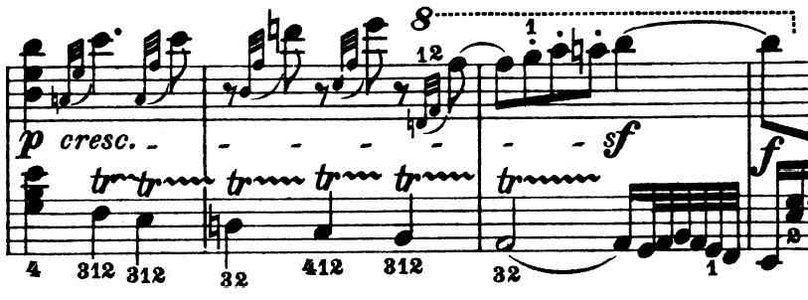
Throughout the entire history of music, the crescendo has been the choice weapon of all but the most subtle of composers. As listeners we crave the gradual increase of sound, to the extent that sometimes the slow onset of the climax teases us to breaking point. The greats of every age have largely depended on the crescendo, be they Beethoven or Sibelius, Davis or Fripp, Opeth or Radiohead. It’s, by and large, to continue the use of vaguely sexual language, what composers use to get their audiences off. Nothing else quite does the trick.
You may think it’s somewhat lewd to think of music as having something approaching an orgasmic moment of climax. Then again you may have already realised that, for both listener and player, the delirium of music at its most devastatingly breathtaking isn’t all that far removed from a sexual experience. That doesn’t mean you have to put Mono on in the background next time you have sex, but next time you reach the heartbreakingly powerful moment in ‘Moonlight’ where the crescendo gives way into some of the most searingly emotive noise imaginable, do think whether the release of the tension is really all that different.
What is it that makes the climax of a song so potent? In a sense the answer is as simple as that word “tension” again. The sudden dissipation of what the crescendo has obviously been building towards cannot help but be a perfect moment for emotional, or even physical, release; something that is both a relief and a joy after all the build-up. Having said that, surely by now the trick is starting to wear thin? Surely all the avenues for the crescendo and the climax have now been fully explored?
Well, in a sense, they have. In fact, they probably did so a long time ago, and this fact can be credited (or blamed, depending on your perception) for the arrival of minimalism as a serious compositional force. The likes of Cage, Schoenberg and Young effectively spent their careers pioneering music without crescendo and climax, but even they occasionally utilised the same tropes. Even many of today’s most drone-oriented artists are equally guilty of slipping down the old path of climax now and again.
This all suggests that, even taking into account the fact that mainstream ‘pop music’ usually needs crescendo and climax of some sort (however watered down and ineffective) to sustain traditional song form, artists and listeners still find themselves in need of release in the form of climactic musical moments. The whole post-rock genre is effectively built around the crescendo as a construct and, although some would claim that all the best bands in the scene went stale long ago, the fact that Godspeed You! Black Emperor and Sigur Ros have both recently released highly critically acclaimed albums on the back of their versatile use of the crescendo suggests otherwise.
The way the former use crescendos is more interesting than their Icelandic counterparts, largely because of their more varied instrumentation but also because of their emotive potency. Even in the two lengthy tracks on the recent ‘Allelujah! Don’t Bend! Ascend!’ record Godspeed form two distinct types of crescendo. ‘Mladic’ is urgent and bombastic, with its climax left unsettlingly incomplete by returning cyclical melodies until a slow seemingly unending drone fadeout. ‘We Drift like Worried Fire’ is far more mesmeric, culminating in a moment where all appears at peace in the mind of the listener, rather than the more unsettling result produced by ‘Mladic’.
Like all Godspeed’s material the influences from classicism are twofold, divided between the romantics and the more contemporary members of the avant-garde. Out of the two pieces ‘We Drift like Worried Fire’ is more traditional, in the sense that its climax marks the culmination of the piece. There’s not all that much difference in crescendo and climax use from, for example, the famous ‘1812 Overture’ of Pyotr Tchaikovsky. In fact, this is the standardised use of crescendo and climax, not just in post-rock, but also in a wide variety of contemporary musical forms. It really begs the question; has music really changed so little since then?
Find out next time...