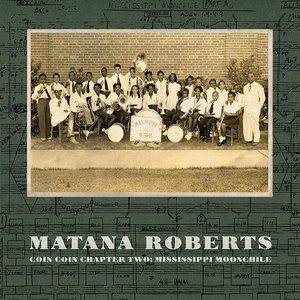
Sometimes you get sent albums that don’t so much blow you away by virtue of sheer quality but by virtue of how completely indescribable they are. It’s like entering an exam to find that the questions on the paper have nothing whatsoever to do with anything that you have studied; a “what the hell am I supposed to say about this?” kind of moment if you like.
The first part of Matana Roberts’ Coin Coin series, set to be twelve records loosely based on themes of ancestry and memory, was bad enough on this front. It was about as free as “free jazz” in the twenty-first century gets, essentially because it didn’t conform to the ironic rigidity of much of today’s supposedly boundary-less jazz. It also included conceptual elements and wildly diverse and divisive vocals as well. This latter element of Roberts’ unique sound has only been amplified on Mississippi Moonchile, with scat, spoken word and even the operatic taking turns across the album’s duration.
If this already makes Mississippi Moonchile sound difficult to nail down then add in the fact that, while its predecessor Gens de Colour Libres was a relatively straightforward eight track release, this one takes up eighteen tracks that merge seamlessly into one another. It’s almost as if the sole purpose of including “tracks” at all was to allow the song titles to further communicate the socio-political messages of Roberts’ material, given that the record flows comfortably as one fifty minute odyssey.
Talking of the message behind Roberts’ work, this is just as highly charged as the first Coin Coin chapter, and in many ways appears more so because of the increased level of disorientation on offer this time. Where most artists rely on lyricism, or at least heavily signposted musical elements, to communicate what they want to say, Roberts provides as much via her method as anything else. Her term for her compositional approach, “panoramic sound quilting”, carries with it numerous references to African-American history, and, in practice, the technique brings forth much of the tangled web of emotions inherent in the thematic discourse of the record.
As detailed in an excellent interview in this month’s issue of The Wire magazine, Roberts sees her music as an opportunity for contrast, both musically and figuratively. Mississippi Moonchile operates in a fashion completely inclusive of both the mannerisms of the trained avant-gardist and the musician of the street, which given that African-American history is littered with genuine musical innovators dealt few favours due to the colour of their skin, seems entirely appropriate.
In regard to the playing, all the band members here are on top of their game, providing incredibly pliant performances to shapeshift into the difficult moulds set for them. Roberts herself acts less as the traditional jazz band leader and more as a conductor dipping in and out of the room, announcing her presence with blasts of insistent, but by no means a-melodic, alto sax. In her absence the work of drummer Tomas Fujiwara in particular keeps things ticking over, adding a much needed morsel of clarity to the slipstream arrangements.
It should be clear enough by now that this is a very clever album. In fact it should be noted that it reaches a level of intelligence and distinctness of voice achieved by few artists in recent decades. Attempting to make a qualitative assessment of it remains nigh on impossible however. It’s a difficult listen, although made slightly easier if preceded by Gens de Colour Libres, and not so much rewarding as genuinely thought-provoking. In this sense it achieves its greatest goals, which should be more than enough to persuade you that it’s worth your precious time.