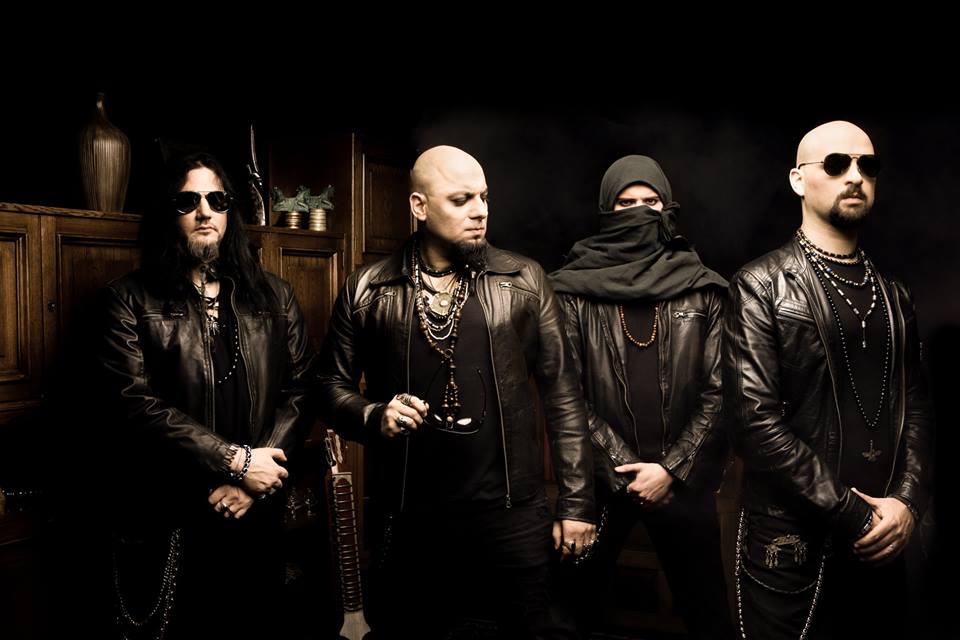
Melechesh | website | facebook | twitter |
By: Raymond Westland
When it comes to fusing metal music with Middle Eastern flourishes few can do in such a commanding way as Ashmedi does with Melechesh. The band’s latest release, entitled Enki, is another musical tour de force as only he can deliver. Enough reason to pride his mind about this remarkable release, his upbringing and cultural roots, his fascination for ancient Sumerian lore and living as a 21st century nomad…
(((o))): It took you guys almost six years to come up with a worthy successor for The Epigenesis. Did you feel any pressure writing material, which is just as good?
Ashmedi: Yes, but it was the same story when I had to come up with music that could rival the Emissaries album. It’s not just pressure, but it’s an issue of responsibility as well. As a band we represent a certain area in the world and not so much one country. We want to make people feel proud so we’d better deliver something that is really good. It’s a crippling feeling, but you have to be a musician as well. Just don’t think too much about it and let your creativity flow. Once I’m in that mindset composing becomes a lot easier. Five years in between albums may seem long, but we spent a lot of time on the road. After the touring cycle for the last album ended I was just very tired and I had to take some time off. I also handle the business side of the band, so that takes a lot of time as well.
(((o))): What were you specifically aiming for this record?
Ashmedi: The real writing for Enki started two years ago and what I wanted to achieve is to conjure some more sonic Sumerian magic (laughs). When I sat down and the contours of the album were starting to become visible I was aiming for some really all-encompassing music. That is what Enki is all about. It has a good mixture of technicality, aggression, feel, Middle Easternisms and magic of course. It’s all there.
(((o))): What I really like about Enki is the overall diversity, yet it has a very balanced feel to it as well. How did you manage to achieve that?
Ashmedi: I don’t know, I guess that is where good songwriting skills come into play. There are bands that only care about being as technical as possible and other bands focus on sounding as exotic as possible. To have everything there captured within a solid structure and not to be a one trick pony or something, that’s the difficult bit. Being able to write good songs like Metallica and Slayer did back in the day. Just good songs, you know? That is the ethos I have as a musician.
(((o))): Lyric-wise the themes and subjects explored on the album are firmly rooted in ancient Assyrian and Sumerian lore. What do you find so inspiring about those old stories?
Ashmedi: Also add the Kabbala and other holy writings. I’m off Armenian and Assyrian descent and all those stories, culture and lore are a part of me and who I am. These are my roots, so why not? There are countless bands from Scandinavia to China who sings about Vikings wearing horns on their helmets. The Vikings actually didn’t, but some people insist they did. Sumer and Mesopotamia are the cradle of civilisation, so when it comes down to history, mythology and culture it doesn’t get any better, you know? You get the real deal here (laughs).
(((o))): Sticking with the history theme from the previous question, what are your thoughts on those religious I.S. lunatics desecrating and destroying countless Assyrian artifacts and ruins?
Ashmedi: It really sucks. It just shows how easy destruction is and how difficult it is to create something. I don’t know what gives them the authority to destroy stuff and think that they’re doing a good deed. I’m sure that in their mind they’re doing the right thing. It’s beyond logic and I just can’t put my head around it. The same with killing people. How can you kill someone in the name of a god who’s supposed to be the all merciful? He should be called the all vengeful instead. They are lost, you know? How can you destroy and erase the history and culture of all the proud and ancient people that once dwelled and prospered in that region? It’s just beyond me. When I wrote the lyrics for a song called ‘Lost Tribes’ I heard they shot my cousin. He was hurt bad, but he’s still alive luckily. There are some hints and plays about that unfortunate event in some other songs as well on Enki. My family who live in the region are Christians and they have to pay the non Muslim-tax. I’ve heard about the tax in history lessons back in highschool, so how ridiculous is it that people still have to deal with that in this day and age? It’s just plain insanity.
(((o))): How do you deal with your dual role as the creative mastermind and being the manager of Melechesh?
Ashmedi: I need to be in a special headspace in order to really catch the vibe of what Melechesh truly represents. That is certainly true when it come down to writing the lyrics and not so much for the music. It totally contradicts my role as band manager. That’s one of the difficulties I have to deal with. I’d rather deal with just the music and I could dispense with all the business stuff that comes along with it being the band manager. I don’t have much of a choice I’m afraid. It’s 24-hour thing. It’s not a job, it’s a calling. Basically a whole lot of sleepless nights and unhealthy lifestyle. Frankly, if Melechesh wasn’t there I’d probably have a high end job, have a nice drink at a beach bar and put my MBA degree to good use. I don’t want to complain, but it’s takes up all of my time. I didn’t choose it, it chose me (laughs).
(((o))): How did you guys end up recording Enki in Greece?
Ashmedi: We recorded the drums at the studio of former Septicflesh skinsman Fotis and the other parts were recorded in a different studio in Athens as well. The whole album was mixed in Sweden. I just like the whole Mediterranean vibe with all the food and the good weather. We spent three months there. Besides, I like to try out things outside my comfort zone and gather as much different viewpoints and perspectives on my music as possible. It stimulates my creativity as a musician. It feels good to be in a place like Istanbul and Athens with all the history and cultural things going on. I prefer being there than to record an album in some grey industrial town where it’s raining all the time. Athens is a cosmopolitan place, a city where East meets West. It really has a vibe of its own, just like Istanbul. I certainly don’t rule recording an album in Iceland or something, but this time around it just worked out the way it did.
(((o))): Would a Melechesh album sound totally different if it would be written and recorded in some desolated place somewhere in Norway or Iceland for instance?
Ashmedi: No, not at all. Melechesh will always sound like Melechesh. We’ve recorded an album in Sweden before and Emissaries was put to tape in a German city called Hagen. No weather or place can influence how our music comes out. But I would be totally bummed out. I like to sit at a bar, order dinner and a bottle of wine every night. That’s something you can’t do in Norway, because of the ridiculously high prices over there. I don’t like to be a little child with a small allowance. I like to live the way I do, namely comfortably (laughs).
(((o))): You managed to get Sakis (Rotting Christ), Max Cavalera (Soulfly) and Rob Caggiano (Volbeat) to guest on Enki. How did you manage to ensnare them and what did their presence add to the overall listening experience?
Ashmedi: I’ve known these guys for years and they’re my friends. I wanted to collaborate which each one of them at some point and the recording of Enki was a great opportunity to do just that. Sakis lives in Athens, so when he got wind that we’re going to record in Athens he came down and did his parts. Same case with Rob. As for Max Cavalera I wanted to work with him for a long time and this time around I had written this piece that really fitted a more thrash metal type of vocals and Max was perfectly suited for the job. He recorded his parts in his own studio. It just fits like a glove. We share almost the same kind of background, in the sense that we both grew up in difficult circumstances and in a place that is outside the proverbial metal periphery. I also subscribe to the whole tribal thing that Max has going on. Sakis really has this mystical quality to his vocals, which perfectly added to the song he’s on. Rob Caggiano is a very agile guitar player. He isn’t a show off, but he’s an incredibly gifted musician. The track he plays on asked for a very metal type of lead and he really managed to deliver just that.
(((o))): Finally, you like to relocate every few years. How does the nomadic lifestyle fit you?
Ashmedi: My mother calls me a nomad (laughs). I used to live in Africa as a kid and I spent time in the States and Turkey for a while as well. Nowadays I’m residing in Germany. The thing is that many people take the whole border concept too seriously. I don’t. They’re just man-made. People from the Stone Age could walk everywhere and birds can fly everywhere. We live on a planet called Earth and at the risk of sounding like a hippy I’m a living creature that likes to go everywhere. I like travelling and discovering the world. I want to go to many places, with or without the band. I’m a nomad and I’m a citizen of a planet called Earth. The place isn’t so big. Look at Europe. You can travel a couple of hours in each direction and before you know it, you’re in a different country.