Interview: Epimetheus
The reaction that I always treasure is those times where we are the heaviest band on a bill. I love seeing people who don’t listen to doom or stoner metal look confused, where they’re wondering what is happening here, and then seeing them remaining in the room. Even if they still look confused by the end.
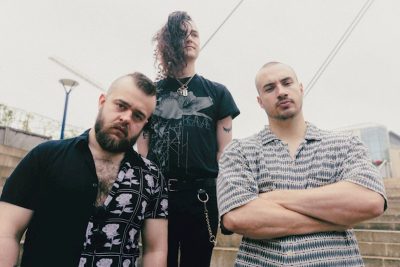
Comprising bassist/vocalist Ben price, guitarist Cillian Breathnach and drummer James Jackson, Epimetheus are a power trio in its purest form. Tight, weird, and impossibly loud, they are everything you’d want from people who cite Sunn O))), Sleep and Philip K Dick as influences. To celebrate the release of their debut full-length Perseus 9, David Bowes caught up with them to discuss what goes into making a band sound this this massive.
E&D: How did you come together and what were your initial aims?
Cillian: How we came together as a band is now a 10-year long story. Me, Ben and James all went to university together. Me and Ben starting playing together in the second term of our first year, when we met and were into the same kind of stuff. We started what was, at the time, a classic rock band.
Ben: Mostly covers.
Cillian: Just to play in pubs in uni was the goal because it was something to do. We stuck together through a bunch of different line-up changes. James joined in third year, which would have been 2017.
Ben: You’d played with us before that, though. We had a revolving door of different drummers for a number of years, one of whom was James but he was busy from 2014-2016. We managed to convince him to join properly in 2017.
Cillian: All this time we are not called Epimetheus. We are called Mandalorian. And then Disney decides to turn The Mandalorian from an obscure piece of lore that only about four people, Ben included, know about to a major streaming service. We left uni, had a bit of a disastrous Battle of the Bands…
Ben: It was Metal To The Masses.
Cillian: Yeah, it wasn’t even just any battle of the bands, it was Bristol Metal To The Masses. We had to play with a fill-in bassist, it went disastrously wrong, and then COVID happens. Up to that point didn’t have a massive identity as a band outside of ‘we do what we want to do’. We had written one song that we still play live, called ‘Machetezilla’, which is a bit of a signpost of the direction we would take in that it’s a bit heavier, a bit more classically doom metal rather than us doing fun classic rock with a stoner edge. Then we had two years of no gigs to ruminate on why we’re doing this.
James: Also, Ben picked up the bass.
Cillian: Yes, Ben was previously a rhythm guitarist so we decided to become a power trio as it’s a cool lineup setup, basically.
Ben: I think part of the idea for how we have the band now is that we wanted to add simplicity wherever possible, for the reason that if you turn up and you’re easy to set up and soundcheck when you’re trying to make your way in a local scene, sound engineers and promoters will like you. We wanted to be easy to work with so being a three-piece was very much a part of that, and knowing our own gear inside and out was a part of that too.
E&D: Given that simplicity was such a huge focus for you, how important was it that you try to capture your live sound for the record?
Ben: Imperative. We’d never consider doing it any other way.
Cillian: Since forming Epimetheus in ‘21, ’22 and being like, “Okay, name change, vibe change, it’s simple,” we did an EP that was almost like a demo. It was so DIY. It was a different operation, still us finding our feet compared to the album. That was us in the practice room, doing everything live. I did a solo on one of the takes and it was built into the room. It was a terrible idea, recording-wise, and you should never do that but we wanted it almost to make a point of it’s improvised, it’s super chaotic. That’s what’s exciting about seeing us. When we’ve gotten feedback from the people who have seen us and enjoyed us, it’s like, “You guys didn’t come off the rails.” It’s like a train tilting off the rails and you’re wondering if it’ll stay on. It does, because it’s huge, but there’s just enough uncontrolled stuff. There’s a way of translating your band’s sound which is like, “We’ve got time to make an album. We can add as many guitar tracks as we like and we can add as many vocal layers and whatever we want” but the bands we got into who influenced our sound were always the ones that the drums are dry as fuck. Basically, everything recorded at Electrical Audio, in terms of the drums sound totally crisp; Steve Albini’s way of pointing two mics at the drums in a figure-eight pattern and it sounds like you’re in the room with them. Whenever we had recorded with other people and had an approach where we’d maybe be less involved in it, the drums would come back and they’d be wet as absolute fuck.
James: Everything being over-compressed, sounding too crisp. Nowadays I think it’s too easy to get a crisp sound with the tools that are available. You can get a “professional” sound, very crisp-sounding, boring, so having something a bit crunchier, gnarlier, was what we wanted.
Ben: A lot of metal these days is too sterile and too focused on perfection. It has to be completely on the grid, it has to be note perfect and pitch perfect throughout and that’s not what I like in music. I prefer a band to be together. Even if it’s not ‘perfect’, whatever that means, if the band operate as a unit and all know what they’re doing, it doesn’t matter if it isn’t perfect to someone else’s standard. If that bands operates as one unit, that’s what I like in a live band, and in a band in general. That being together is very much a part of our sound and if we tried to record this record in more of a traditional, ‘now we’ll track the drums, and now the guitar, and now the bass…’ you’d lose part of the magic or at least what I like about our sound.
E&D: One thing I read was that the bass drum was recorded using a guitar amp?
Cillian: I saw this trick on YouTube years ago but if you take a shitty guitar combo, with like a 10” speaker, and wire it backwards into an XLR plug it’s recording the signal of whatever that speaker cone is doing. If you put that in front of the bass drum, you get all of the flap of the bass drum skin. It’s as close to using the bass drum itself as a microphone as possible. It’s a big subby sound but there is still a bit of air to it because it is technically still a microphone, even though it does have a diaphragm the size of a personal pan pizza. That, like so much of our gear, was what we had lying about. Doing less, adding minimalism to the equation, includes that gear aspect. It wasn’t as though, “We’re going to record an album so we have to go into the studio as they have the best ribbon mics for vocals” or whatever, we can just do it and it sounds good.
James: The bass drum, you could maybe argue that it lacks a bit of clarity at times but even then I prefer it to the fashionable sound, which is like a pork chop hitting a table.
Cillian: One of the reasons that we love our scene in Bristol so much is that it’s very accepting of people that stand out, and we stand out in that way of people see us as a heavy band, and we’re not making not-heavy music, but they think it’s going to be really aggressive and sharp-sounding – the kick’s going to be like a hammer and the guitars will be like razors. We’re more influence by the stoner doom stuff, with guitar tones like you hear on Sunn O))) records, that I’m always trying to do as much as I can while being in a band, which is an interesting combination as those guitar tones are built around having no drums and having no ‘song’ going on at the same time. It’s us cosplaying as that first Black Sabbath album where they just went in and did it in a day. We would never use the term ‘messy’ to describe our sound as we are together as a unit but if you tried to transcribe it into GuitarPro, it’d be all over the place.
E&D: What was your approach to song construction?
Ben: It was all written before we got there but we can’t ever write songs in their entirety without all being in the room together. We try and it just doesn’t work. So often someone will come with an idea, or a few ideas that they think go together, and we’ll play around with them for a few hours, maybe put it down for a bit if we can’t think of where it should go, pick it back up later but everything has to be done together.
James: An example that Ben goes back to would be ‘Drift Beyond’ and how different it was when it started. Playing it live, it didn’t work so we completely rewrote it. It’s arguably still the same song in the same way as the Biffy Clyro cover of ‘Buddy Holly’ is the same song but also is not.
Ben: That track was part of a phase I went through when writing this record that I thought we had to have a single. Not like a pop single, but we have to have one song that’s relatively simply constructed. We did write a song like that, which was the original version of ‘Drift Beyond’. It was a good song but it wasn’t what people wanted to watch us play.
Cillian: It’s a lot of repetition for a period of time longer than what you’d think would be boring. We’ve played so many of these songs for so long. There’s so many ways you can repeat things and change up the texture. Take ‘Perseus 9’ for example. A lot of that is the same two bits – the verse and the chorus – but then the texture changes, even though there’s only three of us. How you do that and how it sounds is a way of keeping things interesting for eight minutes, which is relatively long for some songs but again, we’re weaned off the slow doom stuff where you can get into a different headspace when it comes to putting a song together and not going, “What if people get bored?”. We’d know when people were getting bored because that’s when they were going to the bar. You can see that happening and know it isn’t working, even though objectively it’s the most “Hey, here’s a verse and a chorus! It’s a fun time”. We were putting together songs that have non-repeating structures, like you repeat a riff for ages and then take it to a completely different place like ‘Terraform’ ends in a completely different place to how it begun. It’s basically two songs glued together by a little middle bit but it always get to somewhere.
James: It’s the same idea but louder and heavier. ‘Perseus 9’, for an 8-minute song, doesn’t have a lot of ideas in it but with tempo and tone changes, you can do a lot with a little.
Ben: We’re all big fans of Sleep and I think they’re a really good band at doing that . We are playing the same riff over and over for six-plus minutes but we’re not playing it in the same way. It feels fresh but it feels familiar. Even though there are different things happening, it’s still the same riff and it gets you into that almost meditative place where you just zone in on that and there’s nothing else going on. When we play I sometimes feel like I get tunnel vision because I’m just playing the riff and that’s all that matters at a given moment. I find it’s about getting into that kind of state of repetition. That’s when I get most out of it.
E&D: You’ve mentioned that most of your gear is stuff that you have worked on yourselves. How did you come to adopt that approach and what edge does it give you to buying off-the-rack?
Cillian: I think a lot of doom is about amplifier worship. The audience are there to hear the gear as much as they are to hear you. The fourth member of Epimetheus is amplifiers. I’m a guitar nerd, that’s my day job, and so that feeling of finding of what works for us is an opportunity to undo gear idiosyncrasies that make bands sound less like how I would like them to sound. Like, we have a bassist who loves to do those little fills and accentuations so if I’m assembling Ben’s pedal board – not to take all credit for Ben’s bass playing – I know that there has to be a little mark here to keep the upper-mids at this point because that’s what’s going to go above my guitar sound. It means when we play live the sound isn’t going to become undone. There’s also the performance aspect of it, in that we’ve built switches so that we can go from a clean sound to a very heavy sound instantly. That’s what people who play with traditional gear can do anyway using presets but we like the sound of loads of different stacked analogue fuzzes together so if we can hit a button and still achieve that, it means we’re not there with Kevin Shields levels of tapdancing. You know when you see a band play and they’ve spent too much time on their pedalboards but haven’t actually thought about how it’s going to turn out when you have to go in front of an audience who might not want to watch you turn on 50 different fuzz pedals at the same time. It lets us do both. We can have our cake and eat it.
James: From the outside looking in – I’m not a guitar nerd, all I care about is drums, really – Cillian’s created a very difficult problem to solve with the style of guitar that they’re playing, which is ridiculous aluminium necked baritone that you then have tuned to ridiculous tuning, and then you have to build a heavy and thick sound that doesn’t just completely die, and you’ve honed that. The reason that we have a unique tone is that we have a unique problem in the sense of what it is you’re trying to do. It could be very easy for that to seem like a gimmick but it isn’t. “Oh, you play in drop F? That’s the lowest I’ve ever heard!” But it’s not a gimmick. It’s absolutely earnest and sincere. It’s not because it’s cool, it’s because it’s what we wanted to do.
Cillian: The way we sound when playing in that tuning is that we both gravitate towards stuff like Sunn O))). I will want to let things ring out low and slow whereas Ben likes to actually play an instrument. He can do that over me doing some insane stuff, staying low and thick. Getting the right level of feedback, that chord can go on forever and then Ben can do something interesting over it. Or having loads of delays going, where you have this thing that almost sounds like a synthesizer rather than a guitar because there’s enough delay and reverb going on, as opposed to just having tremolo picking happen and it sounding awkward and out of time. It lets us express what we want to, and also it’s loud as hell. You can feel it in your belly. A big part of amplifiers is all live. It’s not the cock rock, “I’ve got 4x12s because it’s fun, it’s a rock show and you want to see that”. No, it actually creates a feeling like you want to shit yourself because it’s so fucking loud. It lets you get closer to that songwriting state of zoning in, meditating. You forget the outside world because all the outside world is, is sound pressure levels coming at you.
Ben: We also look to add simplicity wherever we can. Part of that is having chosen all analogue gear, nothing digital. Cillian has constructed all the pedal boards and knows how they all operate, a lot of the pedals you built yourself as well. Even the basses I like, which are Ibanez Sound Gear basses because they’re cheap, they have a nice neck and the pickups on them are good for what you pay, they come active. I don’t want anything to do with batteries so the one I currently play, I bought it, took it straight back and, with you (Cillian), we took it back to your house and ripped the electronics out of it so that it’s passive. I don’t want anything to do with batteries because that’s just something that can go wrong. Now, you just plug it into the amp and you’re good.
Cillian: It’s guitar nerd squared, really.
Cillian: …and the poor drummer is left saying, “Can you guys stop fucking around?”
E&D: How does sci-fi tie in with your sound and lyrics?
Ben: Lyrics, mostly. I suppose I’m the primary lyricist, but we all contribute. The starting point for songs on this record is that they are all directly inspired by Philip K Dick’s works I’d been reading. ‘Perseus 9’ was, I thought, named after the spaceship in A Maze Of Death, but it turns it’s actually Persus 9 and I had just misread it. The book is about a group of people stuck on a spaceship orbiting a black hole, and then the ship’s computer creates endless scenarios and dreamlike states where they all pass the time while they are stuck in this orbit with no power. To keep themselves sane when they wake up, the dreams always end with them killing each other because that exorcises the animosity between them, so that when they wake up there’s less danger of them actually killing each other. That idea inspired me for what I wanted to write, about that relentless cyclicality that is freeing in its own way.
Cillian: There’s a lot of metal that’s very brutal and aggressive, and we’re not like that. Then when you get into the psychedelic stuff, ‘spacey’ is a word you hear used a lot for whatever reason. The idea of that journeying out, or even the inward journeys that PKD likes to write about, of into some sort of strange self-obsession. The sci-fi universe sets a mood of anything can happen because of the technology and the nature of it being in the future but Philip K Dick isn’t Star Wars, and neither is a lot of the old Soviet stuff – it’s very personal, squaring away this burnt-out hippy thing of “Anything’s possible!” It’s more like, “Oh God, anything’s possible…” That change is an interesting tone for metal lyrics because the extremity of the music matches that in some ways. Similarly, that meditative thing where you start to look inward in that way. It feels cosmic but not just in the sense that we’re like, “Oh, wouldn’t it be cool to go to lightspeed.”
James: Cillian alluded to proggy bands and the sci-fi-ness of their writing. It’s almost influenced by their need to be intellectually stimulating and have lots of things going on at once, and all of that lends itself very well to sci-fi. I feel similarly with the kind of music that we’re trying to envoke. If you look at drone music there is a spiritual aspect to it and that is something that maybe isn’t immediately obvious when you think sbout sci-fi. There is a spirituality to it because it is still about human experience. It’s an extremity of human experience but there is a relatability to a sci-fi story. That’s one of the reasons it’s so popular, that while it does scratch an intellectual itch it scratch a human itch as well. But really simply, I think we all just love sci-fi so why not write about it?
Ben: For me, a lot of Philip K Dick’s works aren’t really about the science or even the fiction, they’re about the ideas and that’s what I find really inspiring as a vehicle when writing lyrics. There are ideas and concepts that are, as James said, relatable outside of the context of being in the book. It allows me to touch on themes that are more related to, even emo bands. There are some songs that are quite personal but they are told through a lens that is abstract. That makes them relatable in a different way. It’s not a bunch of blokes with floppy hair and pierced lips saying, “This is exactly what I’m sad about and you should be sad about it too.” It’s, “Here’s an idea. What does it do for you?” I know what I wrote each of the songs about but I’m not expecting anyone to interpret them in the same way, mostly because you can’t hear the lyrics as that’s the sound we went for. For me, sci-fi and Philip K Dick’s work in particular is a really good vehicle for very universal, very human concepts that you can interpret in an open-ended way. I like using them as an inspiration for my lyrics as it’s less overt in its messaging.
E&D: Bristol’s scene is legendary, and you have mentioned that being part of it has put you on some bills that aren’t your typical ‘metal’ line-ups. What has the reaction to you been like and has being on bills like that influenced how your sound has evolved?
Cillian: It’s definitely been a big influence but also in some ways it’s coincidental that what we want to do isn’t so reliant on the aspects of metal that non-metal fans will find more objectionable. There’s a warmth to it, we’ve not got as many screamed vocals that would put off people who are just there to see other bands who are more rock or indie. When we think about writing, like ‘Drift Beyond’, we know that we’re not on fully metal bills, and that’s what initially made us pull back a bit but people are really into this very loud, heavy-but-not-aggressive thing. The reaction has always been extremely positive because it’s different to what you would hear on both of those kinds of bills. Music fans in general now are much more open to genres of all kinds.
James: I think the biggest thing, and it’s a shame that it has to be this reductive, but you know when you ask someone what kind of music they’re into and they go, “Oh, a little bit of everything” so you say, “What about metal?” and they go, “Oh, but not metal!” The reason for that is that the public in general really struggle with harsh and growled vocals, it’s just not palatable for them. That’s not the reason that we don’t do it, it’s just that’s a sound that we’re not that interested in doing. We’d rather have melodies. That’s just how we end up writing. The beneficial effect of that is that someone who would normally react more negatively towards a traditionally metal band doesn’t have that off-putting element. Again, I love metal, I love screamed vocals, all of us do but the fact that we don’t do that does mean that a non-metal audience might give us a go.
Ben: The reaction that I always treasure is those times where we are the heaviest band on a bill. I love seeing people who don’t listen to doom or stoner metal look confused, where they’re wondering what is happening here, and then seeing them remaining in the room. Even if they still look confused by the end. “I don’t understand what is happening. I also can’t stop watching it.” They’ll be feeling it as well, especially if we get the opportunity to play as loud as we want. That’s what I really like. I think we achieve that not just because of melody but also because a lot of it is very groove-centric. A lot of bands are quite head-down. There is groove to a lot of doom but it’s in a more stompy way as opposed to ours, which I think are a bit more free-flowing.
Cillian: James is not not a jazz drummer a lot of the time and I think a lot of people lock into that. It’s not blastbeats all the time. A lot of James’ fills, I don’t know what the fuck you’re doing. It’s jazzier than what you would get over a lot of dronier doom stuff, most of the time. There are some who combine those sort of things but they’re probably not playing in a pub in Bristol on a Saturday night.