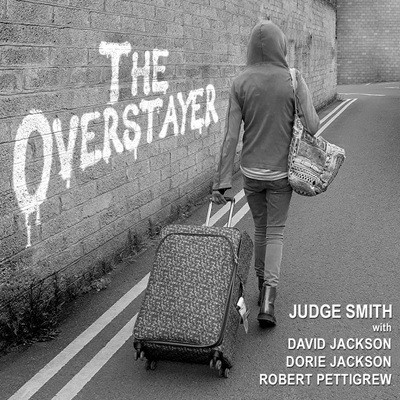
How did this slip past me last year? How did this slip past me? The answer, I may never know. But its time to give to it a long-overview of Judge Smith’s The Overstayer. Judge may be known as the co-founder of Van der Graaf Generator with Peter Hammill nearly 60 years ago. But beyond the Van der Graaf sound, Smith has been involved with projects for classical, rock libretto, television, composing, and a book on Life After Death.
He has come a long way to prove he’s more than just a founder. With 14 CDs and two DVDs in the can, Judge Smith is always tackling subject matters by going on airships, mountaineers climbing the Italian alps, and a retelling of the ancient myth of Orpheus. There’s not a single stop sign for Smith to delve into the next chapter in his songstory, dealing with illegal immigration on The Overstayer.
With the help of Robert Pettigrew’s Pipe Organ, fellow VDGG alumni David Jackson and his daughter Dorie lending Judge a helping hand on the vocals, it tells the story of an illegal migrant woman that Dorie steps into the role of in her vocals as the Overstayer. With the usage of sax and pipe organ, the story can be challenge, but you feel the situation being uncomfortable, but the music is emotional and memorable for the tragic story that’s about to unfold.
Smith’s narrative textures show cases the teacher’s escape from the chaos that’s occurring in her home country and travel on a tourist visa. Going west in the UK, where she tends to stay illegally. But her journey is seen though the point of view in Dorie’s double-tracking vocals in the first part of the story. Once we get into the second part which channels Kurt Weill and Bertolt Brecht’s The Threepenny Opera, Dorie visions the story set in the late ‘20s, early ‘30s in a carousel in its darker tone, detailing her time teaching and as a headmaster, knowing the consequences will happen to the main heroine.
You can tell Judge was listening to the works of Ivor Cutler, Philip Glass and Steve Reich for inspiration for the Overstayer’s music with its surrealism, harsh outcomes, and brutal atmospheres behind his narration, detailing what’s happening in Dorie’s portrayal in the story. With the third movement, it’s a sense of a cabaret vibration, walking in the streets of the UK going from east to the west with vocals whispering rumours, about the Overstayer.
And they are not pretty. There’s a nod to ‘Malaguena’ section between the pipe organ and the blaring sax that Pettigrew and David trade jabs with each other in the boxing ring as if they were Muhammad Ali and George Foreman, boxing it out in 1974 at the Rumble in the Jungle in Kinshasa, Zaire. But it’s the fourth and final movement where the Overstayer has to return home.
If she doesn’t, she’ll break the law, but she is a civil servant, and a bureaucrat. It gets even more intense for David and Robert to set up the clock-ticking momentum for Dorie to do the unthinkable at the very end. With four movements that is on this bad boy, it may not be for the faint of heart. However, Judge Smith is willing to push the envelope even further to make listeners stay with him until the very end. Whether you get it or you don’t, you can’t help rooting for Smith’s story-structures to endure and be a part of the adventure he embarks on.