The school of thought that there are no new ideas – merely old ones meshed, mangled or melted together – has been repeated from Ecclesiastes to Mark Twain. It is a theory particularly prevalent in music. Beethoven’s Fourth Symphony has a beat drop that would floor the most jaded raver. Chuck Berry’s acceleration of blues riffs is audible in songs as varied as those from the MC5, to Crass, to Taylor Swift. It is all-too easy to listen to a piece of music and say, “hey, that sounds like that other piece of music”.
Except Ulcerate. Yes, they play a kind of death metal, even though to describe their music as such falls so far short of its true definition that it is like calling an elephant a grey thing with four legs and a long nose. Ulcerate’s music churns, swirls, swells and pummels. And it has so many nooks and crannies that it deserves its own place in the hall of heaviness.
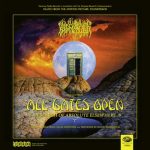
If your eyes glazed over at “death metal”, please persevere, with this review and the album itself, Cutting the Throat of God. The growls and rasps of Paul Kelland – who also plays bass with a massive, warm, brain-addling tone – are, on the surface, regulation death metal, but they become a fourth instrument for the band in a way that regular gore-loving metal bands are unable to achieve. This is art, not because it is necessarily beautiful (although it could be argued that it is) but in the same way that HR Giger’s intricately detailed yet sometimes grotesque “biomechanical” paintings and sculptures garnered a reaction from the audience.
This is the New Zealand band’s seventh album and it is their best – a weighty opinion, granted, when their previous record, the ideally timed Covid-era classic Stare Into Death and Be Still was high on many people’s album-of-the-year lists. It is also their most accessible, which is a bit like saying Everest is easier to climb than the north face of the Eiger.
That said, it is a very difficult album to review, mainly because there is so much going on. On early listens, it is a maelstrom of roars, moody guitars, thick bass tones and the dizzying drum tracks of Jamie Saint Merat. So far, so familiar (at least since 2016’s Shrines of Paralysis, when they introduced more dissonant, atmospheric elements to their music to accompany the battering).
But then you notice that there are more varied dynamics than even their own previous two records – loud-quiet parts that could be described as post-something-hyphen-something-else if it wasn’t so darn heavy. Take the wall of sound that begins ‘Further Opening the Wounds’ – for a song with such a violent title, it starts with a strangely calming blanket of distorted guitar.
And there are little bits that provide shafts of melody and nods to, well, rock ‘n’ roll (as was mentioned in the opening paragraph, it is difficult to produce something 100 per cent original with instruments that teenagers have been mucking about with since the 1950s). The opening track, ‘To Flow Through Ashen Hearts’ is a case in point. It begins sullenly, with a brooding guitar vamp, but then Michael Hoggard conjures some other-worldly sounds from his instrument, over Saint Merat’s octopodan drumming. But at its heart, it is a verse-chorus-middle-eight rock song – played at about a zillion beats per minute.
Hoggard’s playing has been lavished with praise by guitar aficionados since Shrines because of its use of unorthodox tunings and scales, but not nearly enough attention has been paid to the occasional “chugga-chugga” palm-muting riff he places among the squalls of noise. These nuggets of gristle (first heard on this record on track two, ‘The Dawn is Hollow’) are at first barely noticeable, yet once you do, you look forward to every single one.
It would be remiss not to mention the album and song titles – clearly this is not music for an afternoon at the beach. And the weighty titles (‘Undying as an Apparition’, ‘Transfiguration In and Out of Worlds’ and ‘To See Death Just Once’ are but a few) imply a certain amount of angst. It must be said that to these ears the lyrics are unintelligible, but a quick google search reveals that the album is replete with anguish. Take ‘Transfiguration…’, which opens with “Downcast within primordial depths, Shallow breath after shallow breath, The anguish of emptiness manifest, Within a caustic web of old truths”. Or the title track, which boasts lines such as “Cutting the throat of God, The passage to atonement has vanished, True repentance was never in reach”. Profound and affecting to many, metal 101 to others. But kind of expected, either way.
But I have not listened to this album constantly since its release for the lyrical content. I listened to it because even in the realms of extreme metal, Ulcerate are producing something genuinely original and moving – a work of art that reveals a little more each time you play it. It will probably turn out to be favourite album of 2024.Turns out that Ecclesiastes and Twain may have been wrong, there are new ideas in the world.