Interview: All Men Unto Me
Roadburn have requested the full album performance of Requiem, so we'll do the whole thing, it's really exciting to go on that narrative journey.
Two years after returning to Roadburn Festival as the live voice of Ashenspire, Rylan Gleave is stepping onto the festival’s stage again—this time fronting his own project, All Men Unto Me. Sander van den Driesche caught up with Rylan ahead of a full-album performance of Requiem, unpacking what it means to bring a newer, heavier artistic identity to Roadburn, how the record’s themes of transmasculinity, perception, and inherited power structures took shape, and how the band is translating its choral weight and synth-drenched doom into a living, flexible set on one of heavy music’s most adventurous platforms.
E&D: Thank you for meeting with me to chat a little bit about All Men Unto Me and the upcoming Roadburn performance. A couple years ago where you played Roadburn with Ashenspire and now you’re back with like All Men Unto Me. So how does it feel to be asked back to perform your own music I suppose?
Rylan: Yeah, it’s different! Ashenspire is Alasdair (Dunn – drums)’s vision, he’s the one performing, they’re his words. But the multitasking of him being able to play drums and sing those songs at the same time would be impossible. So it’s a privilege every time to step in as live vocalist for Ashenspire. And because I know him so well, we have that shared understanding of what he wants to talk about with the music. I like to joke that I’m still kind of, like, the guest vocalist for Ashenspire. It’s been over 8 years haha. So, yeah, it’s very different coming to Roadburn in the All Men Unto Me capacity. It’s a much younger project. I really liked the first album that we made with All Men Unto Me, but I don’t think that was wholly the Roadburn vibe. And then Requiem, it feels like the artistic identity is that bit more solid.
E&D: I recently listened to your new album again and it did strike me how doomey it actually is. Whereas then the first release, In Chemical Transit, it’s almost like neo classical. Like it’s very contemporary.
Rylan: Yeah. Like alternative chamber music, which is fine. But yeah, I don’t think that says musically what I want to say anymore.
E&D: So you will not do anything with that first album when you do the Roadburn show at all? Is that really just history? Is Requiem your new musical direction?
Rylan: Yeah. I think so. Roadburn have requested the full album performance of Requiem, so we’ll do the whole thing, it’s really exciting to go on that narrative journey.
E&D: The album is around 50 minutes in length, are you just going to play it in full or will there be additional intermissions or things like that?
Rylan: Oh, haha! You have a discerning eye. So we will potentially have some quite interesting, transitional material provided by Oliver Vibrans, who’s playing the synths. We have yet to discuss exactly how long that will go for, how much we’re gonna just vibe out on the day. But, yeah, I think just giving ourselves the extra bit of flexibility, that bit of allowances for any tempo movement in the actual show. On the live stage things can speed up a little bit sometimes, so who knows?
E&D: So you’re playing the full album, which is of course in itself tells some sort of a journey? Is it a concept type album?
Rylan: I think it is. I don’t think I thought of it that way when writing it, but Scott (McLean – guitar, bass, album producer) likes to joke that me and Alasdair can only write concept albums. I would say there is a narrative that underpins the beginning of that journey through the end. A lot of it is about looking at the same experience or structure from slightly different angles, or letting something sit for a long time and then feeling differently about it. The way that you’re seeing it has changed, and sometimes that is more confrontational and upfront, sometimes more reflective and stepped back. It’ll be the first time we’ve actually played the whole thing through live. We played some gigs for New Music Biennial, but the format of that was very different.
E&D: I was wondering also, I think I remember you played it maybe two, three times?
Rylan: Yeah. Last year.
E&D: And you used some musicians that were actually on the album recording for that?
Rylan: Most of them. On the album, Scott played both guitar and bass, so he can’t do both of those live. For the London and Bradford shows we did, we had Neil Charles. He’s a great player, he played with Sun Ra Arkestra and the Mingus Big Band and was telling us stories about playing alongside Tina Turner. I met him through Paraorchestra a couple of years ago. He’s amazing. It was tricky though trying to get rehearsals done with half the people in in Glasgow and half in London. So, we’ve got Hamish Black. He’s been playing in Ashenspire for the last year and a bit. He plays in Civil Elegies as well. So he’s playing bass in All Men Unto Me and he’s also doing backup vocals. His stage presence is just amazing.
E&D: I know, I’ve seen him on stage before with Civil Elegies and other bands and he’s a very interesting person to watch on stage.
Rylan: Yeah, he doesn’t stop! He’s wonderfully all over the place. In a few Ashenspire shows he’s just dived into the audience immediately. So, yes, Scott and Alasdair and Hamish and then Oli who’s doing synths and samples. We were hoping to have my friend Simone (Seales) playing cello, but they couldn’t make the Roadburn weekend.
E&D: So will that then be covered more by the synths basically?
Rylan: Well, I have actually learned those parts on guitar. So I’m fucking about playing those, to varying degrees of success. But I think some of it sounds very cool.
E&D: From seeing you with Ashenspire it’s clear you’re not very static on stage yourself, does this mean you will basically stand more still on stage with the guitar the whole time?
Rylan: I’m not a stationary performer. I’m finding very strategic moments to take the guitar off, like leave it for a bit, and then go perform, and then come back and pick it up. It’s usefully actually because I have a bad shoulder injury, so putting it down is nice.
E&D: It probably creates a whole new challenge for you as well to, like, because you’ve never done this before as far as I know.
Rylan: So I played guitar at those two shows last year, but much simpler versions and only on two songs. My instrument has been my voice for so long. Guitar is challenging, man. It’s hard. I’m finding the multitasking of the guitar and singing very difficult. I’m not yet good enough that I can do them both equally, so I have to focus on one or the other. If I’m focusing on the guitar, I go a little bit flat, and if I’m focusing on the voice, then I’m hitting the wrong strings.
E&D: You mentioned a bit about the content of Requiem and, where your first release In Chemical Transit was really more like, I suppose what’s in the album title as well, more like the chemical transition you’ve been through in your personal journey. I remember reading about your voice changes and certain songs you used to play and then also, they completely changed because your voice changed because of the chemical procedures basically. Do you cover a similar sort of journey on Requiem or does it have a different focus?
Rylan: I guess it I would say it overlaps with transition in the sense that transition doesn’t essentially end. But enough for me has changed that it’s rare I’m read as a woman. So, ostensibly my social transition has ended. Reflecting on that in the context “what does it mean to be a man in today’s world”… I guess Requiem is more in that realm. I am treated differently, I think, than a lot of other men, and I think a lot of that is because people read me as gay. I’m not fussy about that, but I think it means people assume that I’ve had a very different background in terms of things like access to particular education or opportunities, or what my life was like growing up, and socialisation more generally. There’s still a kind of exclusion even if it’s not intention. So I was looking at that alongside the umbrella of the Anglican church; for me, that still feels like one of the strongest patriarchal spaces still that I’ve been in. Roles were so clearly defined when I was singing in church choirs. And this isn’t a critique of the church at all, I wouldn’t say, but I think it’s interesting what has been taken from that as a power structure and mapped onto society, even if people now wouldn’t consider themselves religious. There’s still a lot that we borrow from that. I guess it’s more of an exploration of that, and what does transmasculinity look like in those worlds.
E&D: That’s interesting, because I’d never really considered how people can form an impression of someone based on very limited information. That initial impression can then shape how they treat you, judge you, or interact with you—even though they don’t actually know anything about what you’ve been through.
Rylan: It’s been really interesting. I don’t think it’s ever something that will change 100% because I can’t go back to being a child change the experiences that I’ve had, none of us can. I will say, I don’t think most of the people I know are weird about it, some people maybe don’t even notice or, they wouldn’t say anything. Sometimes, particularly in like the underground heavy music world, people will reference bands and all this like cultural stuff that I feel would have been relevant to teenage boys at the time and I’m like, cool. I wasn’t a teenage boy at that time, I have no idea what the fuck you’re talking about, haha. It’s never done with malice, we’re just pitching from a really different world.
E&D: So, but do you ever feel like you get treated differently by the other kind of bands or artists that you might see backstage at shows and festivals?
Rylan: Again, I don’t think in an intentional way, but I think it just it raises really interesting questions of, for example, shared changing rooms or sleeping arrangements. I don’t mind getting changed in front of other people, but I’m conscious that my body looks really different. I don’t want to make people feel uncomfortable. Ashenspire’s been great for that, I loved our mad European tours playing venues then sleeping upstairs with like four other bands. I think I just have a lot going on in my head about how I am being perceived, and how am I making other people feel. And about when to let things slide and when to say something. But thankfully I’ve never had a major issue with anyone backstage.
E&D: One of the great things about Roadburn in that sense is that it’s great because it is such an inclusive festival.
Rylan: Yeah. We’ve been chatting with Roadburn about access as well, ramps to the stages and stuff like that, and so far it’s been really great.
E&D: Going back to Requiem, I was wondering how much of it is really your writing, or did you write it together with the other musicians that are involved? I mean, you know, you’re not a bass player, you’re not a guitarist. So how do you get to write the music for All Men Unto Me? Do you come with the ideas and the lyrics for the music and develop these with the other musicians?
Rylan: Well, you know my background’s in quite classical composition. So I came prepared with scores! Some of those have stayed exactly the same. ‘Lux Æterna’ is pretty much beat for beat the exact same song, apart from the distorted section in the middle, where we added drums, ‘Introit’ is the same just even slower. Some of them have changed quite substantially. For ‘Sanctus’, I brought in this full score, and Scott looked at it, and said ‘it’s just this riff’. And the song is kind of just that one riff. Because Scott was playing both guitar and bass for the recording, and producing, we spent a lot of time one on one working through ideas. I would say he’s been the most significant in the way of collaborating. Which is not to make light of Alasdair bringing some amazing drum parts, and being very flexible and contributing ideas. Live, he will be playing a lot more stuff than he was playing on the album. On the slower tracks like ‘Kyrie Eleison’ and ‘In Paradisum’, he’s doing more of a textural, improvised thing. So it’s been Hamish who’s the newest addition in a way, he’s reimagining quite a lot of it. For songs like, ‘Kyrie Eleison’ because we don’t have a full church organ, Oli is playing the keyboard parts and Hamish is playing a lot of the organ pedal materials on bass. He was sending me voice notes even before the first rehearsal with textural ideas, it translate really well into the room. And Oli’s just ridiculously good, he’s worked across theatre and a lot of large scale orchestral projects, his ear for sound design is huge. Really great group of people.
E&D: What’s the future looking like? Are you working on new things?
Rylan: We have some other shows coming up, to be announced. I’ve been loosely sketching out ideas for a new album. I’m coming back to the thing of concept album writing; could I write an album that isn’t a concept album? Just a set of bangers. I think I need a bit more uninterrupted brain space to go and sit with it. It took me so long to write both Requiem and In Chemical Transit, I did them essentially back to back. And so this is the first gap I’ve had. And I’m still I’m taking commission work to with orchestras and choirs and stuff, we’ve got more Ashenspire music to be writing. So yeah, looking forward to writing some new songs soon.
All Men Unto Me will be performing ‘Requiem’ in full at Roadburn Festival on Friday April 17th at the Next Stage from 15:00-16:00
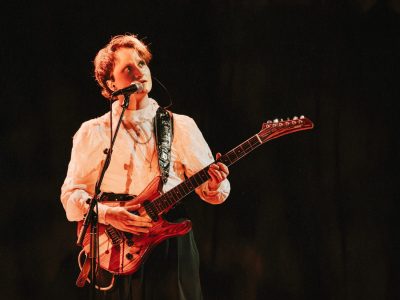
(Photo by Joe Steven Hart)