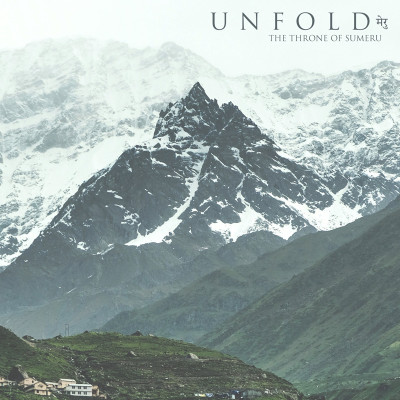
“Close your eyes. Allow yourself to hear all the sounds going on around you. Just listen to the general hustle and movement of the world, wherever you are.” So begins The Throne Of Sumeru, maybe the most mindful of heavy records in recent memory, an exploration of yin and yang intended to enhance meditation practices through the application of “extreme pulses of nature”. The latest work of Adam R. Bryant (Cave Dweller, Pando) follows that blueprint somewhat rigidly at first, Bryant guiding the listener through breathwork and visualisation exercises with the calm, steady tone of a seasoned practitioner as birds sing and water gently trickled in the background… and then it shifts gear and the bottom drops out of the universe.
The final moments of ‘The Swaying of the Spine’ are ritual drone executed at the highest level, each chord laden with distortion and delivered at maximum volume. There are echoes of early Boris here in that there is a feeling of movement and progression at work, every strum existing as part of a whole rather than as a floating, isolated sonic entity. The chant of mudras and the occasional melodic chime of a singing bowl help to elevate the overwhelming earthiness that groans and screams in the foreground, establishing from an early juncture Unfold’s intent with perfect clarity.
For the most part, The Throne Of Sumeru is exactly what it intends to be, a marriage of Buddhist practice and amplifier worship that never feels the need to differentiate between the two, applying the opposing/complementing forces of yin and yang to create works that are genuinely transformative. ‘ॐ मणि पद्मे हूँ’ (Om mani padme hum, the Sanskrit mantra associated with the bodhisattva of compassion) is suitably light, stressing chants and softer, more melodic progressions while still sounding positively monolithic, whereas ‘मेरु (Blowing Of The Kangling)’ (named for Sumeru, a mountain considered sacred within Buddhist, Hindu and Jainist teachings, and the kangling, a flute made from a human tibia or femur that is sometimes used in funeral processions) is a deeper, darker journey. Pace is slowed to a crawl, the brightness of tone is dimmed almost to pitch darkness and it feels like a journey into the underworld, a barren landscape of buzzing subsonics and the steady, ominous chime of a bell.
If there is one track that truly goes against the flow that Bryant has established it is, ironically enough, ‘Flow’. This is pure groove, a heady journey through drums, bass, sitar and sick-ass drones that feels like Om’s Advaitic Songs stripped down to its core. If the bassline doesn’t draw you in, all fuzz and louche raga charm that will rattle around the skull for days, the air of positivity and reverence that ripples through this brief but deceptively complex jam will leave you in a haze of general good vibes that will stick with you as long as that bass riff, if not longer
Closer ‘Between Two Worlds’ serves as an extended wind-down for the listening session / meditation practice / whatever you’ve been engaging in, a final 15-or-so minutes of low, comforting drone and chant that fades out to let the hustle and dim of the world back in, marking the end of a listening experience that deserves to be embraced and absorbed. For meditation novices it serves as a unique primer that bridges the world of drone and spirituality in a way that is rarely tackled in quite so explicit a manner (for more on this, Mysticism, Ritual and Religion in Drone Metal by Owen Coggins is a great text on the subject) and for experienced practitioners, it might prove to be a useful tool in your own practice. Either way, this is worth seeking out.