Bill Nelson had already made a name for himself during the time he founded critical acclaim with his band Be-Bop Deluxe in 1972 in his hometown of Wakefield, West Yorkshire, England. With five studio albums and one live album from 1974 to 1978, they combined the sounds of glam rock, progressive music, hard rock, new wave, pop, and elements of science-fiction in their lyrics, they were often under the radar when it came to their music.
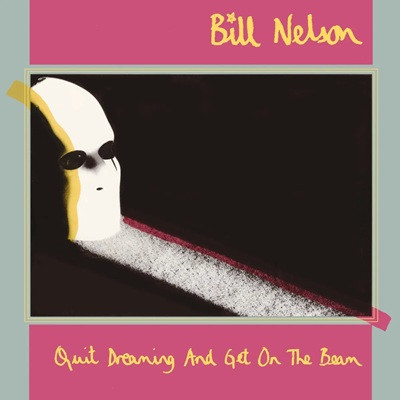
After the band split up, Nelson formed Red Noise which showed a direction of him, being a part of the new wave, post-punk atmosphere in the late ‘70s with the release of their only album, Sound-on-Sound which had been championed by Steven Wilson in the foreword notes of the reissue that Esoteric put out in 2022. Now, in 2024, Esoteric are coming back in full swing with Nelson’s catalog with the release of his solo debut released in 1981 entitle, Quit Dreaming and Get on the Beam.
Even though the album wasn’t a product of the 1980s, it was recorded between February and June of 1979 and originally planning to be the follow-up to the Red Noise album, Sound-On-Sound which embraced the new wave sound at the end of the ‘80s on EMI’s Harvest label. Taking influences from John Cage, Terry Riley, Stockhausen, and French filmmaker Jean Cocteau (Beauty and the Beast), Nelson wanted to move forward and prove to his fans that he was more than just the band he founded in 1972.
The album was completed at AIR Studios in June of 1979, but there was a change in the air. EMI had merged with Thorn Electrical Industries in October of that same year. As the merge was happening, EMI started to cull artist and various album projects who felt their projects were not commercial, were shelved. One of them, was Quit Dreaming and Get on the Beam.
You can tell Nelson was disappointed by the label’s failure to secure a release. He then collaborated with the band Skids, a Scottish punk / new wave band who unleashed their second album, Days In Europa on the Virgin label in which Nelson himself produced. At the beginning of 1980, Nelson formed his own label, Cocteau Records.
According to the liner notes by Mark Powell, Nelson describes that his “original idea for Cocteau was to be a showcase label for other musicians who were having problems getting their material released via mainstream record companies. In the late seventies there was a huge sense of change in the air, not so much in the music business, but in popular music itself”.
And with Stephen W. Tayler, who not only remixed the Be-Bop Deluxe catalog, and the Sound-On-Sound album, returns to the helm once more to give Nelson’s first solo album, a shaft of light. Listening to the Quit Dreaming album in its 3-CD/ 1 Blu-Ray set, Nelson was already on the curve of pushing forward and never looking back. Take for example ‘Living In My Limousine’ both the original and Tayler’s mix bring the futuristic quality of the possibility of living the high life.
Tayler’s version adds in that punch from the keyboards, visioning the qualities of Kraftwerk, Anthony Philips’ 1984, and the John Foxx-era of Ultravox rolled into one. There’s something sinister behind this track. Its one thing to have all this fame, success, awards, and all, but there’s a price to be paid for inside the limousine as it gets heavier and heavier in the years go by.
The thumping intro behind the train-chug speed behind ‘Banal’ deals with the reflection of repeatable sounds, same old books, same bull-shit from Late Night talk shows who tell the same joke again and again, people acting strange, its all there as Bill delves into his XTC-nod with a chorus that goes from post-punk into a ska-like routine then back into descending choirs of madness.
‘Disposable’ sounds like something straight out of a pre-New Traditionalists-era from Devo as Bill wrote this song as a semi-sequel to ‘Beautiful World’ honoring both Mark Mothersbaugh and Gerald V. Casale, but with a Cars-like sound. I can tell Nelson was listening to Ric Ocasek’s guitar structure and how he handled power chords and riffs and Devo’s dystopian structures behind the song.
‘Life Runs Out Like Sand’ takes listeners into the land of the rising sun as we are in this New Wave-meditated guidance which sends us into the 23rd century, revealing that while its understandable to move forward and never looking back, you reflect the moments that were wonderful and time begins to slip by before going into the afterlife.
Then, he goes back into the punk-rock mode with Tayler’s clear and instinctive vibration for Bill to get on his motorcycle and drive off into the night by creating a different perspective on the new mix behind ‘Decline and Fall’ and heading into the Brat Pack-like films from John Hughes with the ‘White Sound’ filling in the library during Saturday morning detention in The Breakfast Club.
He then goes back once more, honoring the sounds of Oingo Boingo’s Only a Lad-era as if Danny Elfman was listening to this album for inspiration to get an understanding of what Bill was doing during that time frame with ‘A Kind of Loving’ which speaks of ‘Little Girls’ at times but with a fast-speeding arrangement. Let’s take a look at some of the highlights from the second disc where it tackles the singles and an unearthed radio session Bill had done in March of 1981, followed by a John Peel session in June of that year.
‘Hers is a Lush Situation’ sounds like a leftover from the Hardcore Devo-era from 1974-77 in which Bill had done one of those bedroom recordings back in 1971 with Northern Dream. You feel the clock-ticking drum machine, sinister synths, growling guitar textures that Bill would create to fill the tension with a void while hitting the dance floor with ‘Mr. Magnetism Himself’ that would knock Madonna out of the ball park with his own usage of dance music before hitting the Piccadilly and Peel sessions out of the ball park from the fast-sped punk orientated of ‘Stay Young’ to a rare nod to Conny Plank in its Kraftwerk motif, a-la Autobahn style on ‘Konny Buys a Kodak’.
He then returns to the ambient oceans for a brief meditation taking place in ‘After Life’ which channels Brian Eno’s Another Green World-era then heading back into the futuristic world of late ‘70s Berlin where he honors Fripp, Bowie, Eno tackling the Heroes-era on a Peel Session for ‘Jazz’.
Nelson has done his homework very well when it comes to honouring the three maestros of art, weird, surreal, experiments, and ambient sounds by following in their footsteps. This album deserves a lot of recognition for the way Bill wanted to prove his fans that he was more than just a founder of Be-Bop Deluxe and Red Noise. He wanted to push that envelope by being a part of the new wave / post-punk. And he did.
The remixes Tayler has done is in great effect, making the sound clear. There will be a divided line the sand whether they prefer the original or the new stereo mixes Tayler had worked on, but that’s for another time. Tayler has proven to honor and stay true to Nelson’s vision, similar to what he has done with Hawkwind’s In Search of Space and Doremi Fasol Laitdo. And for us, the journey has just begun to get on the beam.