Interview: Million Moons
Everyone in this band is very fond of, and feels quite deeply connected to, nature and we wanted to write a collection of music that encourages people to reflect on the consciousnesses and lived experiences of creatures that are non-human. Each of the pieces on this record are written to evoke feelings of, or match with, a concentration of different creatures. They’re different from people but they’re every bit as worthy of compassion. The goal is to get people feeling more connected in general to nature.
While the world of sweeping, cinematic post-rock isn’t quite as oversaturated as it once was, it still takes something special to stir the mind and the senses like the greats once dead – whatever that elusive factor is, Million Moons have it in spades. With the recent announcement of their third full-length You Be Good, I Love You as well as a slew of tour dates across the UK, David Bowes spoke to Edward Thompson and Solomon Radley about the record’s creation, nature and making it big in China.
E&D: Thanks for giving me your time. I just saw the announcement about your signing with dunk! Congratulations.
Ed: Thanks very much, we appreciate it. And A Thousand Arms in the US as well.
E&D: How long had those been in the works?
Sol: Quite a long time. Charlene from Ripcord has emailed dunk! many times over the last few years and I have been as well. It was about November, December last year that I first heard back from Wout (Lievens, label manager) because we had the demos but hadn’t yet recorded the album. They made the decision to sign us just based on the demos alone which was unexpected but also great. We’ve had the experience of sending the demos out to a number of labels and I think sometimes people have trouble with making the leap from what the demos sound like to how the finished product will. We’re thankful for dunk! putting that trust in us to allow us to finish the product to the level that we want.
E&D: How long did that process take?
Ed: We started writing probably about two years ago, shortly after the release of I May Be Some Time and went about the process of creating a number of demo tracks. Our previous way of working was that we wrote a lot of tracks and whittled it down. This one we were much more decided with how we take individual tracks forwards, so tracks that weren’t showing to have promise were immediately discarded. So actually, we only ended up with 8 tracks – we haven’t discarded anything off the record and have just worked on those 8 for 18 months. We finished producing demos in summer of last year and Sol meanwhile was adding drums to all the demos and improving things. We spent a lot of time with tonal experiments and layering, trying to get new sounds out of the equipment that we had and experimenting with different sets and effects pedals, adding in plug-ins and DSTs and stuff going on in the background to make the production sound a bit more polished and professional. That’s before even taking it all to Lewis (Johns, producer), same producer as last time, then recording both the drums and a few other bits and pieces in the studio, which we did in January this year. Then Lewis did production for us at The Ranch Production House, and here we are. We’ve got the masters back and are almost ready to release. It’s a different process compared to the last record, characterised by a lot of experimentation, and dare I say a bit more attention to detail. Every single lead line you hear on the record is comprised of at least three different guitar tracks moving simultaneously in unison to build that texture, those layers, rather than having one track running. Some of the guitars on the record you’ll hear are comprised of up to ten to twelve sets of guitars, which is a challenge to replicate live but we’ve got a few widgets and gadgets we use in order to create more layers out of the two guitars we use. We try to do as much live as possible. That’s where we’re at, it’s really exciting and we can’t wait to take it to the live audience as well. We demoed one of the new tracks at Ripcord Fest and I think it went down really well. We’re really happy with the tonal quality of the new material.
Sol: On the experimentation side, all of what he said is true but we didn’t even touch on the few new instruments that have not been on our music previously, trying out sounds and wondering what could work well. We’ve got live saxophone, church organ, and on the attention to detail side, Ed on previous records has used a bit of sampled piano. We have had access to live piano before when we were at Little Farm but this time he’s taken the time to record as much of the live piano as possible. He’s gotten access to a church organ to really get a rich, natural sound for the tracks that feature that instrument.
E&D: I can really imagine church organ working well given the scope of your material. Have you always had the level of ambition to include something of that scale or is it something that’s specific to this material?
Ed: A combination of both, I think. On this record we’ve decided to push it a bit further in terms of the experimentation but the opportunity for using those kinds of instruments has always been very much on our radar. Church organ especially is one. Lewis had never recorded in a church before so that was a first for him. I’ve always found that there’s a good match up with post rock in terms of the kind of textures you’re trying to create. It’s always surprised me that people haven’t leant into it previously but they are quite awkward to find, organise, gain access to and record. We’ve got pictures from the recording of microphones on 10m booms in order to get up towards the boxes where the pipes are held. It’s not an easy process. We had a fair amount of grit and determination on this record to try and get that over the line but it sounds great. Other complications like the organ isn’t in A440, it’s in A432, which means it has to be retuned to match the rest of the music, things like that. It’s very challenging which is probably the reason people don’t do it that often but I think that music combines really neatly with the tonal quality, and the messaging behind the album as well.
E&D: I was wondering about the messaging behind this album. You’d spoken previously about the scale of it, that it spans aeons, you mentioned nature and wildlife during Ripcord Fest, so is there an overall concept?
Sol: We’ve spent a lot of time talking about concepts in general for the record. I think it’s important with instrumental music to have something to tie all of the tracks together into a body of work. This time was a little bit different from previous instances where Ed had written lots of demos and I helped curate them into something that felt cohesive but this time Ed wanted a concept that he could try and write to, so that the tracks were written for the concept. We came up with an idea quite early on that we discarded, then came back to when we decided that we did quite like it after all. Everyone in this band is very fond of, and feels quite deeply connected to, nature and we wanted to write a collection of music that encourages people to reflect on the consciousnesses and lived experiences of creatures that are non-human. Each of the pieces on this record are written to evoke feelings of, or match with, a concentration of different creatures. They’re different from people but they’re every bit as worthy of compassion. The goal is to get people feeling more connected in general to nature.
E&D: Can I ask which animals, or is that something that you’re wanting to leave to the listeners to decipher?
Sol: I’ve written a few track by track bits already and I want to leave the details of that, but we’re calling the record ‘You Be Good, I love You’ which were the last words of a parrot called Alex who was the subject of the world’s longest running and most in-depth study into parrot intelligence. He was an African grey who learned hundreds of words and showed an ability to read. Lots of birds demonstrate intelligence that people say are comparable to a toddler, but Alex had been taught to speak using human language. It might seem to some like a bit of a parlour trick but it does offer a window into how these creatures operate. The story goes that each night as he went into his cage he would say to his handler, “You be good, I love you” and one night when he went back to his cage, he never woke up. This was to honour him.
E&D: That really is a lovely tribute. I understand you’ll be a putting out a single soon.
Sol: Yes, ‘Black Sun Rising’ and we’re hoping to get the first cut of the music video back today. That’s the song we demoed at Ripcord Fest. We’re very excited to release that and we have two more to release before the record which is out on June 26.
E&D: Is there anything you can say about the music video regarding the shooting or the direction?
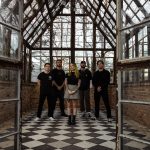
Sol: Absolutely. The song ‘Black Sun Rising’ is about birds. Ed’s original title for this track was ‘The Quiet Disappearance Of All That We Love’, which is beautiful and very post-rock but if all the track names were that long they wouldn’t fit round the side of the CD, so I wanted something shorter. But that’s very much the sentiment. It made me think of the book Silent Spring which was a clarion call by a biologist (Rachel Carson) who had noticed that pesticides and other human vectors were wiping out bird life in America. The Silent Spring is the idea of the quietness of a spring without birds and for me that’s very tonally appropriate for how the song sounds and how you feel when you listen to it. It also swoops and soars. The Danish word for murmuration is sort sol, which translated into English is ‘black sun’. ‘Black Sun Rising’ is a song that’s about murmurations and the music video leans into that. We spent the weekend with Calum McMillan, filming the video in a warehouse and then we went for a walk in the park with him in Glasgow. It was in a really nice creative warehouse space and we did that the day before Ripcord Fest, so we came up a day early to record the music video. It’s in an infinity cove because we wanted to project videos of murmurations over us performing to make it a bit more abstract, more differentiated and interesting than a plain music video. I’m really looking forward to seeing Calum’s work and how it’s all come out as we haven’t seen the cut yet, but he’s obviously a very talented man.
E&D: What was your experience like at Offside Festival? The footage looked excellent and it seemed like a great atmosphere.
Ed: It was a very good day out. Really well organised, really good experience, lovely people. We went to the whole festival, got the chance to wander around, hang out with other bands and with Chinese fans, and it was just so nice. It was an engaging and endearing time, it was just lovely and the set went really well. It was well attended and it was just a brilliant weekend. Absolute blast out there.
Sol: We’re very keen to go back. We’ve been in touch with Angoal, who put on the festival and help to book other festivals across China to come back in the next few years. They’ll also be handling distribution of You Be Good, I Love You on the China mainland as well, and we learned today that it will be released digitally in China on the same day that it’s released in the UK and US.
E&D: Did either of you see an article in the Guardian a couple of months ago about China’s love of UK indie bands?
Sol and Ed: Yeah!
E&D: Do you share that feeling, and did you experience that kind of love from Chinese fans?
Ed: Absolutely. A lot of it really rang true. We really got the love in ways we weren’t expecting at all. We don’t really know how well-known we are in China. I don’t think we’re particularly well-known but nevertheless they put us on at a good set time, people really enjoyed themselves and came to say hi, did autographs and pictures and stuff which is really fun, but it really did ring true. I suppose we can use our public platform to call for sufficient funding in art spaces within our own countries and wider Europe as well – if they can do that, and help to bring in international musicians to nurture the creative space and the post-rock sector, it would be great if there was similar funding available for us within the UK.
Sol: Before that trip they covered our flights out, they put us up in the accommodation, they paid us a stipend every day for food, had a volunteer every day on hand to help us speak as it had come together quite quickly, so we didn’t know a word of Chinese at that point. They paid us on top of that. Whereas if we wanted to go to America to do a festival we’d be paying the Americans about £4-5,000 for the visa. Obviously, Ed’s based up in Mull so wherever we play in the UK the petrol costs are on us. Wherever we meet it’s going to end up costing us hundreds of pounds in petrol and transport. It was a real privilege and we felt very cared for, to have all that taken care of for us and to be able to just focus on doing the fun bit for a change.
E&D: Does it frustrate you after experiencing that, that the same level of support isn’t available for artists in the UK in terms of arts council funding?
Sol: I try not to be too cynical about things. It’s much better to count your blessings. I never want to become the kind of person who focuses on the negative but also it’s quite difficult to diagnose the original sin that collapsed the music industry – well, not collapsed. If you’re a top-level artist in the music industry you can still make quite a lot of money in this country – but for smaller, mid- and low-level artists. It might be that streaming is as much to blame as anything else as it used to be you could make money from releasing music and now that’s no longer a thing unless you get very big. It’s frustrating that the ways that artists can cover the costs has been stripped away to the point that even the labels seem to be struggling, increasingly asking for things like cuts of merch. We’re not even really at a stage where we’re having to deal with that sort of thing. Hopefully it’s in our future but I think the whole economic model, just like with TV and cinema, has been completely upended and that likely goes back to the dawn of streaming. It’s not just artists, venues are struggling too. There’s not enough money left as it’s all being funnelled elsewhere which is a shame as we have so many talented friends. The great thing about working with Ripcord, and about post-rock in general, is that people do it because they really like the music. There aren’t many egos, people are generally lovely and we’ve met some great bands. They all do really great stuff but not many people know about it. They don’t do it because they want to get rich. That’s part of it as well – we’re not looking to make our fortune doing this. Just to be able to do it is enough.
E&D: Do you think that having people who are willing to put in the work, like Ripcord and dunk!, are what we have to rely on if we want to keep independent music alive?
Ed: Absolutely. I think Charlene’s contributions in particular are absolutely invaluable. She provides a strong pathway for nascent bands to showcase their music. Without her support, I think a lot of bands would fall by the wayside and not be able to showcase their full potential, including us. She puts in so much effort trying to coach and improve bands wherever she can and she deserves all of the thanks she can get for the work she puts into it. She’s the same, she’s hardly doing it for the riches at the end of the tunnel, it’s for the love of the sector, and so do we.
Sol: It’s not just the people who run small labels but also promoters that specialise in our genre. It’s a real service for the punters as well. In a world where you get most of your music from some streaming platform and the music on their curated playlists is very narrow – if you look at a post-rock Spotify playlist, you’re not going to get the full gamut of post-rock on there. You’re going to get the same top five songs from a dozen artists – it’s a real service to be a tastemaker, curating artists that you like and giving them a platform so that people can find them. I wouldn’t know half of the post-rock bands I know if it wasn’t for people like Charlene.
E&D: Is Jay (Miller, bass) a permanent member now?
Sol: Yeah, they are now. We’ve known Jay for a very long time and I actually went to school with them. Did we also ask Jay to join the band when we started out, Ed?
Ed: I had quite a lot of jams with Jay before they moved to Germany.
Sol: Right, that’s what happened! Jay moved to Berlin and we had to find a replacement Jay in the form of Darryl for a little while, who is still a very good friend and doing his own thing. It was synchronicity as at the time, he had his other band Chaos Reigns, who are doing quite well and are kind of Dillinger Escape Plan-y hardcore, and he’s also in a post-rock band called Lunch, and felt a bit over-saturated with bands. When he told us that, it was right around the time Jay had said they were moving back to London so it was all quite seamless and amicable going from Jay to Darryl, and now Jay’s back in the way they should have been.
E&D: Did Jay have much input with the writing of the new album or was that already in motion when he came back?
Ed: No, they wrote a lot of the bass parts. That’s one of the best things about this new record, it’s the fluidity and harmony that lies within the bass parts and with them writing that, the vast majority of that, that really has taken it to the next level. It sounds really good. Jay’s done a great job with that so yeah, big contribution to the writing. Which is great, it takes a load off my hands as well.
E&D: Thanks a lot for all this. Do you have anything to add while we’re here?
Ed: I say this almost every single show but I’m just so glad that we’re playing in the genre we’re playing in. We have so many really nice experiences with the shows that we play, just lovely fan interactions, hanging outside chatting about different bands and other genres. It really makes it all worth it. Every time we go out on the road to play shows, meet new people, it’s just lovely. So a very heartfelt word of thanks in advance to the people who attend our shows.
Sol: We’ve made so many amazing friends and a lot of their bands are doing really well as well. It’s honestly great seeing everyone going from strength to strength at the moment. It’s lovely to a be a small part of that – long may it continue!
E&D: Actual final question but who are the bands who are doing amazing stuff, in your opinion, that people should be keeping an eye out for?
Sol: Maebe have just announced a bunch of tour dates that line up with what we’re doing so I hesitate to say “keep an eye out for them” but their new stuff is really good, I have to say! I love Maebe and over in the US I really love Vaudlow, they’re very good.
Ed: Civil Service, Last Of Eden, they’re similar to our kind of stuff and making waves in this sector.
Sol: It’s always really good to hang out with Civil Service as well as they’re really solid people. Same with Wildernesses as well, they’ve been really supportive, and they’ve just got a new album out so definitely check them out.