The Anthology of UnAmerican Folk Music by Marisa Anderson
Release date: May 22, 2026Label: Thrill Jockey
A guitarist of remarkable facility Marisa Anderson has been making records for twenty years or more. Varied and exploratory, often very beautiful, they have largely fallen within the context of what’s known, with slight incongruity, as American Primitive. Her music is far from primitive, but it has certainly been most engaged and informed by American folk traditions. On The Anthology of UnAmerican Folk Music she reflects on that, looking out to much further horizons, digging in to music from around the globe.
Anderson’s excellent liner notes cover both the musical sources and the story of the project’s birth, offering straightforward explanations of her motivations and process. But briefly, amongst other things, Harry Smith was a beatnik and avid record collector, assembling his Anthology of American Folk Music like an early mix tape of a disappearing cultural landscape. What Greil Marcus called “the old weird America”. Released in 1952 to little enthusiasm it slowly became a foundational resource for multiple strands of American music, including Anderson’s own. An imperfect lens but an important one.
After his death Smith’s collection ended up at the Bob Dylan Center in Tulsa, in a locked back room. This album is a result of Anderson’s determination to engage with the music hidden in that room and explore its mysteries. She approaches the collection with her ears and her heart, claiming no academic authority although I’m sure her knowledge far outstrips mine or yours. It is a record made in the spirit of exchange more than replication. From the vastness of Smith’s collection she drew her own selection, focussing not on the expected dusty Americana but on a rich seam of international releases, specifically from parts of the world America had been at war with during the past half century: The USSR, South East Asia, the Arabic and Islamic world.
At any given moment along that timeline there has been reason enough to despair of US adventures overseas but the promo for this came through just as Trump was first bombing hell out of Iran. A war that was supposed to be over in days but still rumbles along. In opposition to division this is a project of curiosity and fellow feeling, music as a universal language. Culture is a soft protest but a reminder of our shared humanity. As Anderson says “As the US becomes increasingly isolated and xenophobic I believe more and more in our shared responsibility to actively counter these reductionist narratives and reach across social and cultural divides”.
The music wears all this lightly but there are obvious differences to Anderson’s earlier records. While she plays everything here, aside from some violin by Gisela Rodríguez-Fernández, the sources are not flattened out by her playing, it still feels like a compilation. From the stillness of ‘Pair of Duduk’ to the sparkling ‘Rop Koh’ and the cycling minimalism of ‘Whistle Song’ each tune its own little world, not ghosts or shadows of their earlier selves, more like translations. Inevitably changed but continuous, adjusting to a new language.
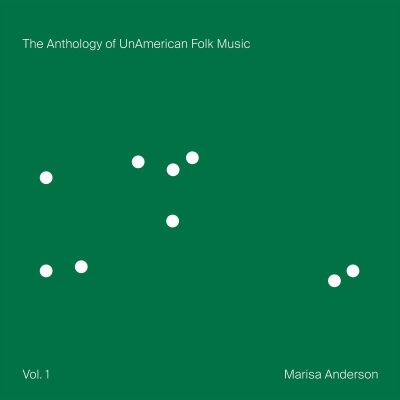
I guess it’s a kind of creole, Anderson neither attempts to master new musical systems or instruments nor does she simply transpose everything over to her more usual style. She comes to the records as something to learn from. The collection she made from Smith’s is almost a thousand tunes, in the corner of the cover here, you’ll notice it says Vol.1 so I expect there’s much more still to come. Overlapping universes of music. The sound of people.