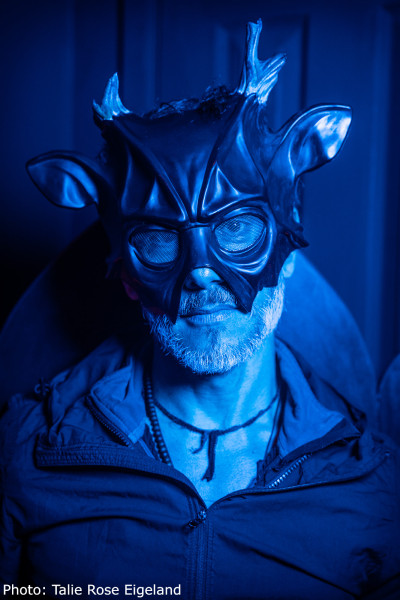
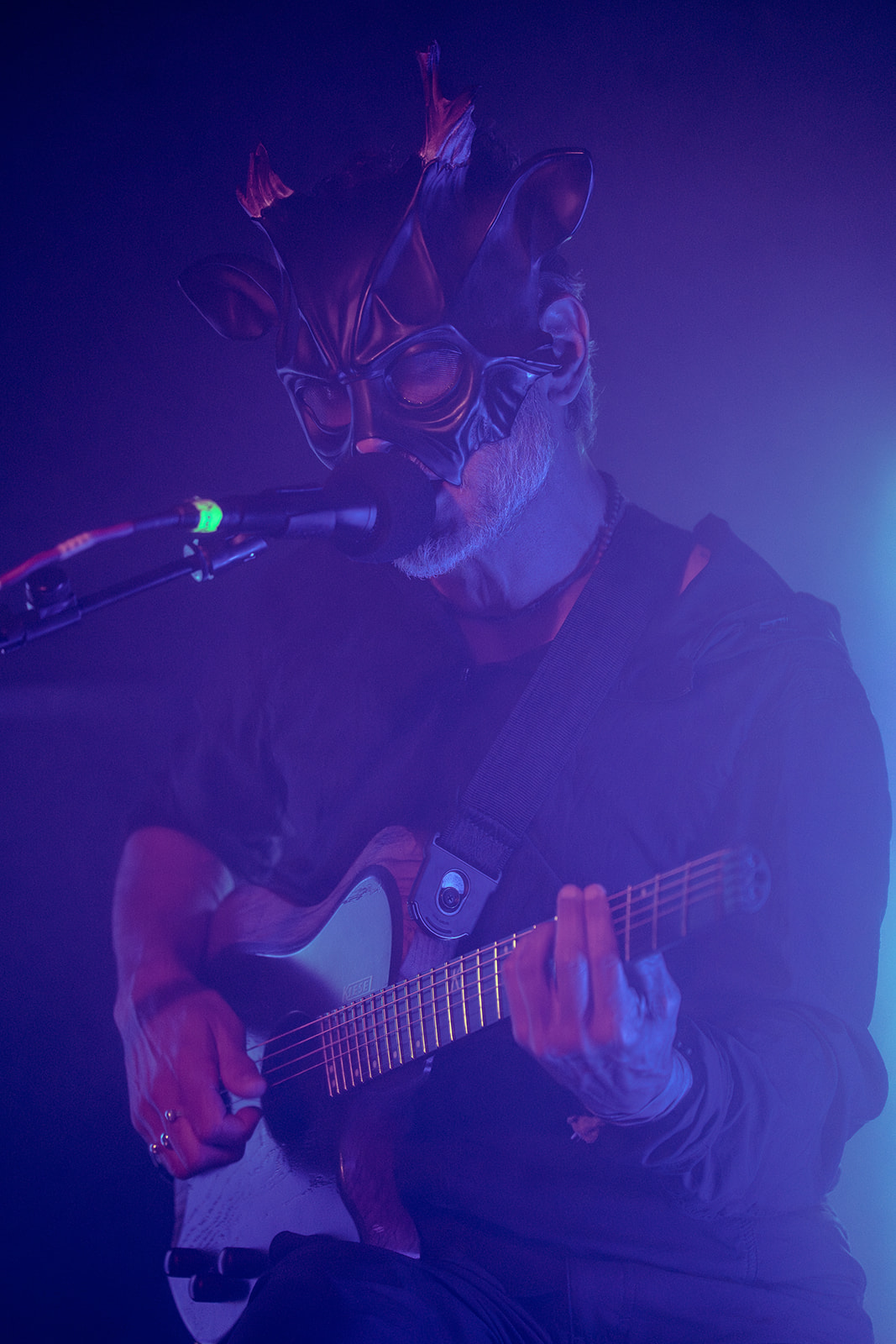
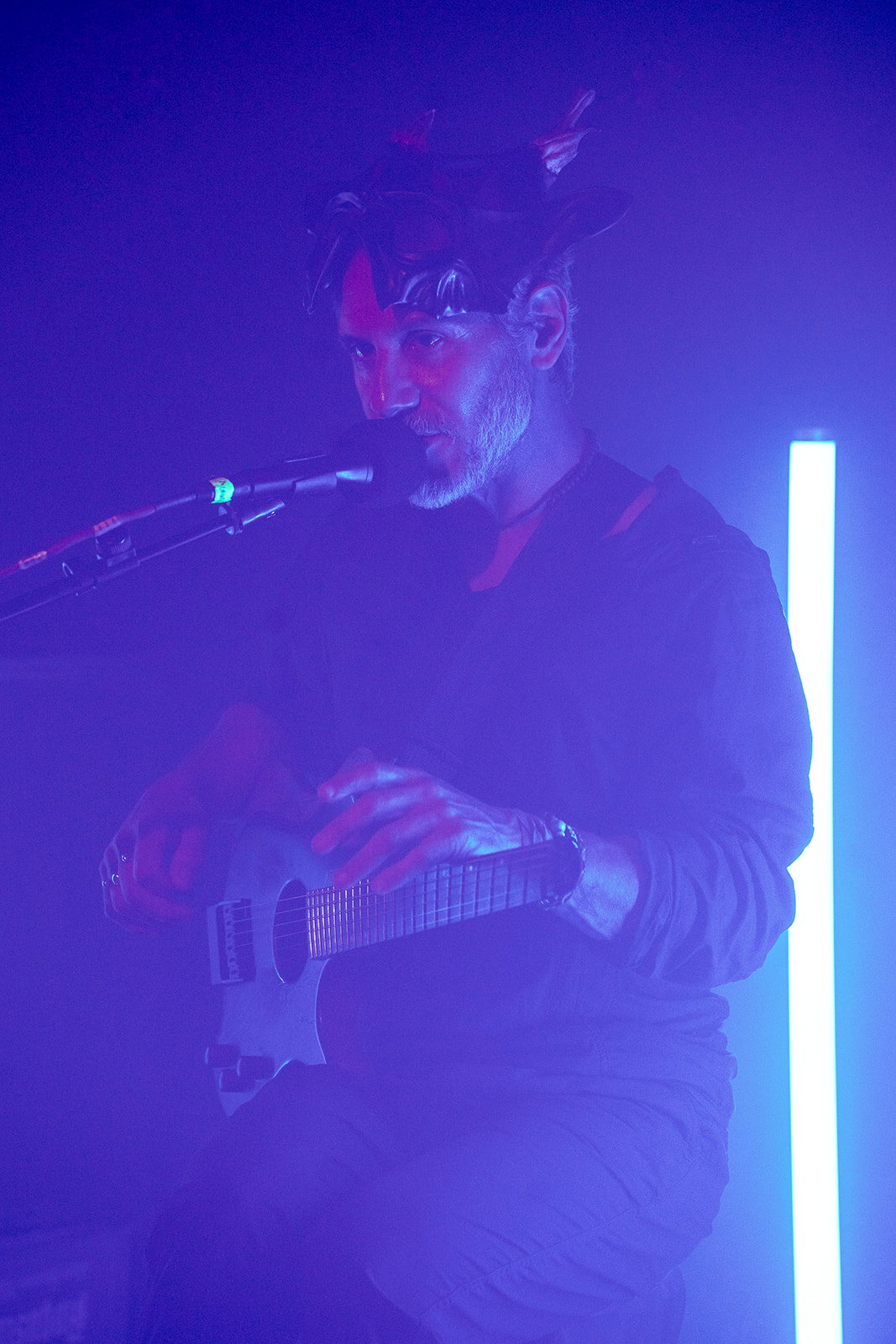
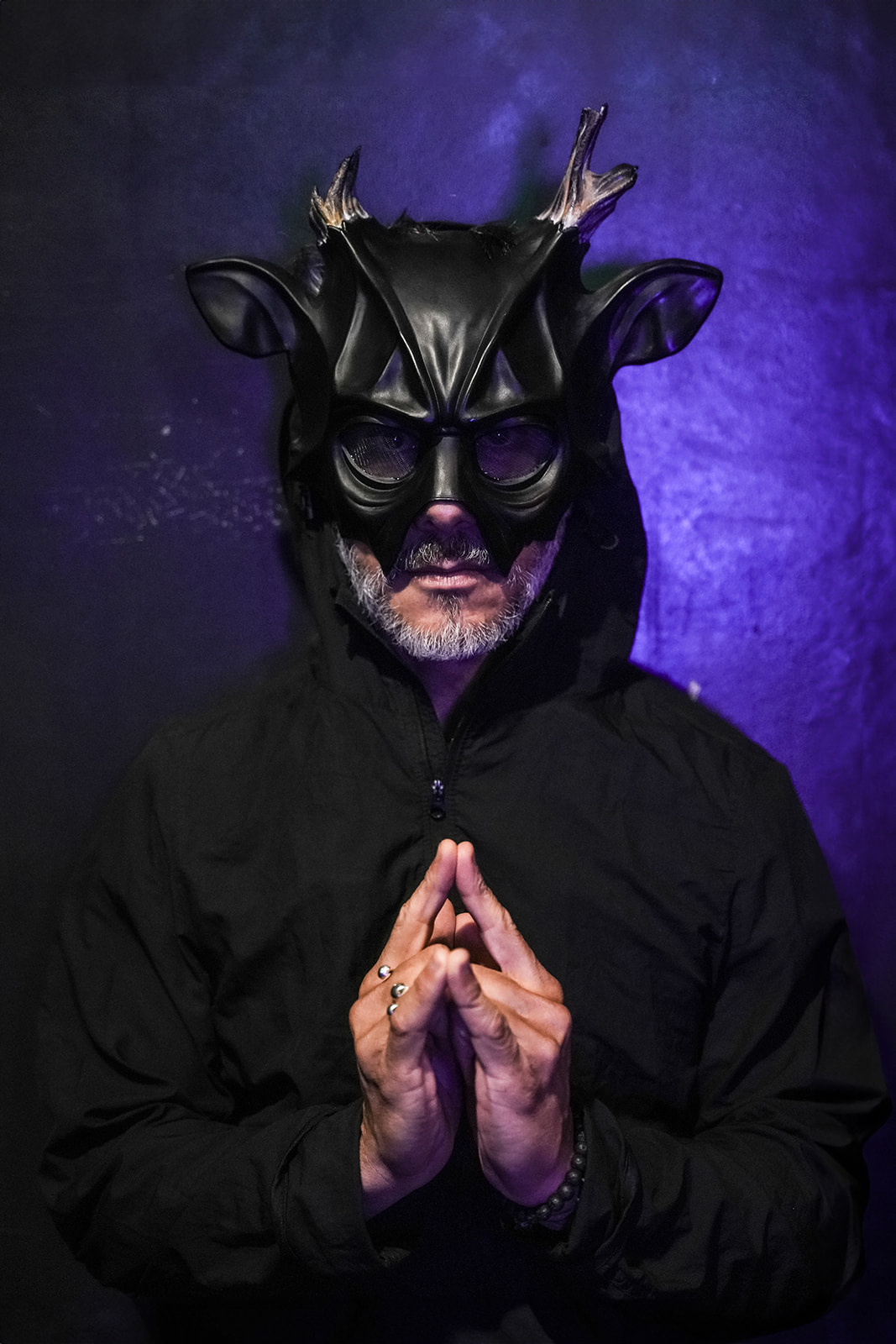
Broken antlers and the soft ears of a fawn, smoothly moulded into an inky, shadow of a mask. The bright lights of neon pillars glow, which – like our performer – are partially obscured by smoke. His sleek, hollow-body Strandberg guitar is a subtly alien axe, and his shoes are off. The shimmering ambient music which gently throbs beneath it all through powerful PA speakers is familiar from the album trilogy Mythical Human Vessel, threaded between songs, as it is here tonight. Designed as tones for sound therapy, this ambience subtly shapes the show in that direction.
BLÁNID. Photo: Talie Rose Eigeland
Your Echoes & Dust team (Joe Norman and photographer Talie Rose Eigeland) met Paul Masvidal that morning, calmly crouched at the top of the stairs at Camden’s Black Heart venue, prior to our interview in Raven Records down the street. The wonderfully warm, thoughtful and open man we had the pleasure of speaking with was also very much present on-stage that evening, although the mask he wore for much of his set – his “shadow self” as he referred to it – and the songs he performed, brought out a more serious and more emotive side.
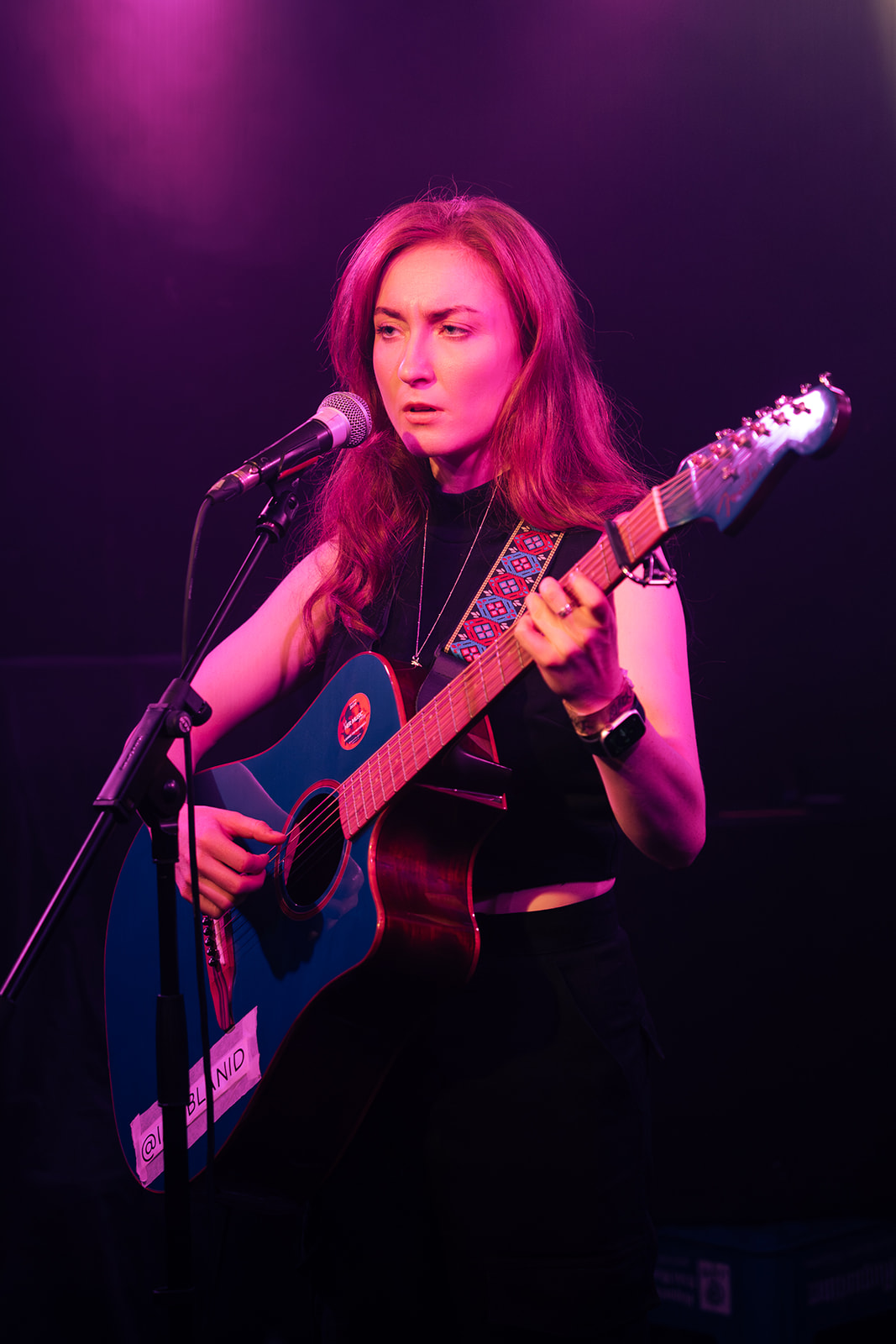
After our conversation, we had all returned to the Black Heart to catch the end of the support set by Irish singer-songwriter BLÁNID. Performing the haunting song ‘Bad Decisions’ on acoustic guitar, BLÁNID sings of regret, barriers to communication, and emotional repression in a way that is beautiful, resigned, and moving: “I have been making bad decisions / I‘ve been hiding them from my friends”.
The song peaks in a soaring climax as she taps the rhythm on the guitar body – and the silence afterwards is not just respectful.
This is a seated show, my first at the Black Heart since the COVID-19 era, and a matinee no less, so – more sober, energetic, and highly-caffeinated than at most gigs – I feel unusually alert in this intimate environment. Words from our interview with Paul – and words from the conversations we had inside Raven Records with founder Ben Dean – resound in my head. Paul’s phrases like “the raw, bloody heart of the thing”, “the crevices of the heart”. Ben’s comments about his passion for sobriety and encouraging mental well-being. Paul’s observations on the weirdness of Cynic’s music; about what he calls “Cynic tone”; and about spirituality and personal transformation. So I was well prepared – as Paul set up his laptop, his mic, his lights, his guitar – for a special afternoon performance.
Paul Masvidal. Photo: Talie Rose Eigeland
And that’s what he gave us, during a set that combined songs from a career of material (he can readily select from around 35 songs during a show, he told us earlier) with anecdotes and observations. Paul’s show was one of a small run across the UK, supporting various solo projects – especially the MHV and Aeon Spoke albums – that did not receive the promotion they deserve due to the onset of COVID-19. I saw him play a phenomenal Cynic show with Obscura at The Underworld a few weeks ago, which was amongst the busiest I have ever experienced at that venue. So I was keen to see Paul perform up-close tonight, especially to get a good view of his unique guitar style in action.
‘Letter to Love’ is one of the most optimistic songs tonight, asking “won’t you heal me, love?” Others like ‘Cactus’ place beauty alongside resignation and darkness in tender, finger-picked ballads. ‘Hand to Mouth’ stands out to me, the refrain “sometimes breathing is enough” achieving a particular poignancy, a theme that resonates with techniques from therapy and Buddhist practice. Paul is joined by a drummer friend, who adds minimalistic percussion, disembodied brushes tap a snare amidst the fog.
The audience sit in the centre, or stand around the peripheries where Talie and others shoot Paul, leaning their cameras into the murky stage lighting. There are moments of laughter and the audience calling out; there are moments of great poignancy, with rows of transfixed expressions sat still on black plastic chairs. There are respectful silences, and some passionate cheering.
Paul Masvidal. Photo: Talie Rose Eigeland
The MHV material has a different tone to Cynic yet one shaped from the same sound molecules. Cynic is dense, layered, textured while tonight, solo, its rawer, more direct, more open: stripped down to the bare bones (even with a few added laptop layers for extra weight). When you hear it in this form, it makes sense that ‘Traced in Air’ began as a stripped-down folk song – then layered up and produced in the studio. There are moments when Paul runs through the faster, stranger passages of Cynic’s music which really bring out the guitar nerd in me; this is virtuosity without ego. There are also some lovely moments of ad lib guitar as segue between songs and anecdotes.
It’s great to hear Paul play, but also to hear him speak, telling his stories. Tales of his “living room show” in Avebury the previous evening and of the notes he took on crop circles from the audience there. He tells a simple yet rather beautiful story of coming out to his family, while the family’s therapist friend – subtly arranged by Paul’s father to attend – provides support. Paul quotes Persian poetry, comments on the quality of the Black Heart’s sound tonight – the best of the tour apparently – and he wants to eat one of the Black Heart’s famous vegan roasts after the show.
As Paul stated earlier, his music is a grieving process, but it does not come across as dominated, and fundamentally distinguished, by loss. There is balance. He speaks about “letting himself be annihilated” by grief, not turning away from horror, and “meeting it with a different headspace”. He calmly dedicates ‘Traced in Air’ to “Sean and Sean” (friends and bandmates who both died in 2020) and our audience unanimously toasts them, and Paul replaces his mask.
As we reach the “raw, bloody heart of the thing”, we turn our minds to transforming…
The experience was somehow conducive to transportation and expansiveness, yet insular and introspective. It would not be entirely correct to describe this show as an act of meditation, but the music created a mental space in which I could disengage from mundane thoughts and contemplate more fundamental concerns.
Paul receives a standing ovation and compels his audience to spend time with him over a roast. We emerge from the venue – into daylit, bustling Camden – aspiring to become better observers of our own minds, and to best catch the stories we tell ourselves. And to think about how, like Paul, we exist as mythical vessels of humanity.
Paul Masvidal. Photo: Talie Rose Eigeland